Hotel email marketing playbook beyond the newsletter
Hotel email marketing that drives direct bookings, not opens. Use 5 ROI-triggered flows, post-stay timing, and recovery emails. Fix your setup fast.
The direct-booking email system, not a newsletter
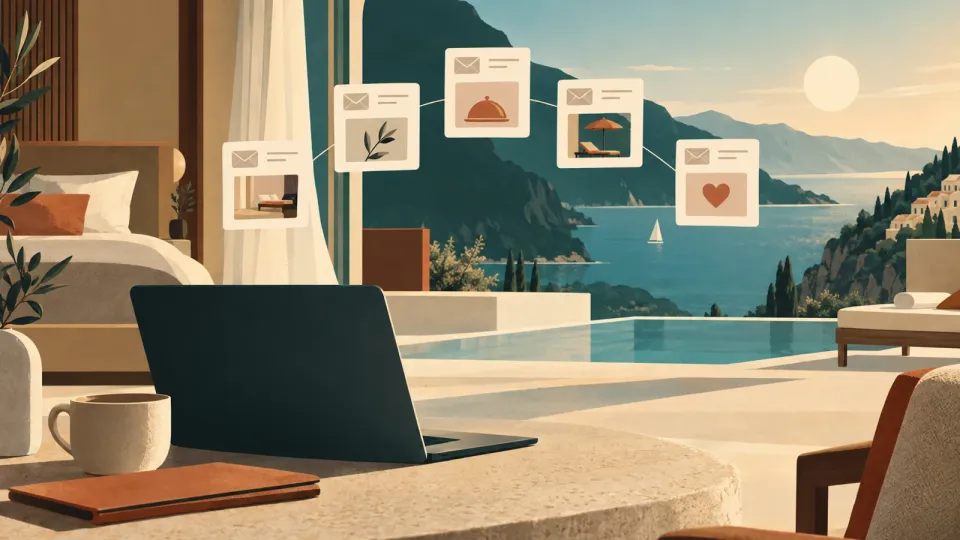
Hotel email marketing should behave like a booking engine with a calendar. The moment you accept that, your work shifts from “designing emails” to “orchestrating intent.” A good newsletter stays top-of-mind. A good email system gets rooms booked.
In hospitality, the operational mistake is obvious: most teams send one-off campaigns, then wonder why the channel feels unreliable. That is not a creative problem, it is a lifecycle design problem. Guests do not buy on your schedule, they buy on theirs.
What usually works is a set of triggered flows tied to what guests actually did, plus a small number of high-signal campaigns that feed those flows. In email marketing terms, flows are automated sequences created by behaviors, not dates. Industry data consistently shows automation outperforms one-time blasts. For example, Litmus has reported that automated emails account for roughly 2% of volume but drive 37% of email-generated sales attribution. (techradar.com)
This is why the playbook below is not “content for email.” It is the guest-to-booking path, with five flows that map to five purchase moments:
- A welcome moment where you convert uncertain interest into booking-ready intent
- A pre-arrival moment where you upsell without sounding like a pushy sales agent
- A post-stay moment that turns satisfied guests into repeat guests
- An abandoned-booking moment that recovers the “almost booked” group
- A cadence moment where you keep ROI stable even if seasonality swings
The goal is simple: emails that increase direct bookings while protecting trust. You should be measuring the channel like a revenue system, not a metrics vanity contest.
One misconception I see constantly: “If our open rate is low, email is broken.” With modern privacy protections, open rate can be misleading. Klaviyo explicitly points out that iOS Mail Privacy Protection affects tracking, which means open metrics can be inflated and less diagnostic than clicks and downstream actions. (help.klaviyo.com)
So instead of worshipping opens, build the system around triggers, clicks to booking, and revenue outcomes you can attribute to email.
Written by Andre Ginja — Founder, andginja.
Ranked: 5 email flows that produce direct bookings ROI
Here is the ranking you should care about in hospitality: the flows below are ordered by the likelihood of converting into a booking action, given how guests behave across Lisbon, Porto, Algarve, and beyond. If you only implement one thing this week, implement Flow 1 and Flow 2.
Before the sequences, one rule: every email you send must point to a single booking intent. That intent is usually one primary action, “Book your stay,” or “Check dates and rates,” with links that land on pages that match the message. If your email is about a romantic package but links to the homepage, you are paying for friction.
Flow 1 (Highest ROI): Welcome and booking intent capture
Trigger: email subscribe, inquiry, or “pre-guest” form submission (including web check-ins that capture email).
Direct-booking goal: convert “planning” into “dates selected.”
Sequence: 3 emails across 2 to 4 days.
- Email 1: Your property promise plus a low-friction offer (example: best rate guarantee or free breakfast add-on for direct bookings for the next 72 hours)
- Email 2: Social proof that matters to planners (room photos, short guest quotes you can use legally, and one “what to expect” paragraph)
- Email 3: The decision email, show the best time window and inventory-friendly language (example: “Weekend availability tends to fill first, weekday options are calmer”)
Why it ranks first: this flow captures the peak clarity moment, when people still remember why they signed up.
Flow 2: Pre-arrival experience and upsell without pressure
Trigger: booking confirmation or check-in date milestone (for example: 14 days out, 7 days out, 2 days out).
Direct-booking goal: increase upsell attachment and reduce cancellations by improving experience certainty.
Sequence: 3 emails, but you only send one if the stay window is short.
- Email A, 14 days out (or 10 to 14 days): what is included, what you can add (airport transfer, late check-out, breakfast upgrade, table reservation)
- Email B, 7 days out: personalization based on preferences captured during booking
- Email C, 48 hours out: logistics and friction removal, arrival instructions, parking info, and a “reply to this email” support line
Upsells here should feel like service, not marketing. Your best upsell is the one that solves a real trip problem.
Flow 3: Post-stay “memory to repeat stay” retention
Trigger: checkout date (or review invitation timeline).
Direct-booking goal: convert satisfaction into a second booking.
Timing: you want this early enough that the stay is still vivid, but not so early that it conflicts with checkout stress.
Sequence: 2 to 3 emails.
- Email 1, 1 to 3 days after checkout: thank you, best-of recap, request for review (with a gentle link)
- Email 2, 7 to 21 days after checkout: “next trip” email with one seasonally relevant reason to return
- Optional Email 3: only for high engagement (clicked the first recap), a “member-style” direct offer for future dates
A core principle: do not “discount blindly.” Make the repeat reason specific, like a seasonal menu item, a cultural event tie-in, or a room category upgrade path.
Flow 4: Abandoned booking recovery, 3 emails that feel human
Trigger: booking started but not completed, or dates selected then left.
Direct-booking goal: recover the “almost” group.
Sequence: 3 emails.
- Email 1: 30 minutes to 2 hours after abandonment (depending on how fast your booking engine responds), reminders plus one objection answer (parking, late check-in, cancellation flexibility)
- Email 2: next day, feature the best available room category for the selected dates, not your whole menu of options
- Email 3: 2 to 3 days later, last call with a service hook (support available, “we can help finalize your booking,” or “best available rates are currently holding”)
Do not spam. The inbox is not a billboard, it is a conversation.
Flow 5: Seasonal cadence flow, protect ROI when demand swings
Trigger: inactivity (for example, no bookings or no email engagement for 60 to 120 days) plus segmentation by traveler type.
Direct-booking goal: keep your list warm without training people to ignore you.
Sequence: 2 emails, spaced 14 to 21 days.
- Email 1: one seasonal theme and a strong “pick your dates” entry point
- Email 2: social proof and a limited reason to act now, not “today only” pressure
This flow prevents the “we only email when we have a promotion” trap.
What about open and click benchmarks?
Hospitality emails can perform surprisingly well, but you must benchmark the right metric. Revinate’s 2024 Hospitality Benchmark Report includes a figure that hospitality emails average around 2% click-through rate in the benchmark set. (revinate.com)
Meanwhile, Klaviyo’s 2026 benchmarks for campaign open rates show an average around 31%, with top performers reaching 45.1% open rate, but again you should treat open rate as noisy under privacy tracking. (klaviyo.com)
The practical takeaway is: if your click-through rate is not moving, your content and links are not matching intent. If your clicks are fine but bookings are not, your landing page or booking flow is broken.
That is the workflow. Build flows that pull guests toward booking, measure click-to-booking conversion, and keep opens as a weak signal.
At this point you have the ranked set. Next we will wire the timing that actually converts, starting with post-stay.
Post-stay email timing and content that converts to repeat bookings
The post-stay email is not a review request, it is the bridge between “we loved it” and “we booked it again.” If you treat it like a thank-you note, you miss the conversion window. If you treat it like discount spam, you destroy trust. The right approach is both simpler and harder.
Timing that wins (and avoids checkout fatigue)
Send the first post-stay email when the guest still remembers details, but after they have had a moment to breathe.
A practical default:
- Email 1: 1 to 3 days after checkout
- Email 2: 7 to 21 days later (segmented by engagement)
If you send Email 1 immediately at checkout, it competes with logistics and can feel pushy. If you wait 30 days, you get nostalgia, not action.
Email 1: recap, personalization, and a low-pressure path to your next stay
Open with a sentence that proves you remember them. Not with their name only, with what they actually did or preferred.
Structure that converts:
- A short thank you plus a “you chose X, we set up Y” line
- A quick recap of their experience in plain language (breakfast, room comfort, neighborhood tips)
- A single action: book a return stay or pick next dates
- A gentle optional review request, separate from the main action button
Keep the review link in a secondary button. Your main conversion goal is repeat booking intent, not just stars.
Email 2: give a concrete reason to come back
Email 2 should not repeat Email 1. It should answer: “Why would I return soon?”
Use one of these hooks:
- Seasonal experience: a chef menu highlight, beach season, or cultural calendar moment
- Room-specific upgrades: a room category story, what changes between categories, and who it fits
- “Next trip” planning help: a short itinerary teaser for your area
This is where location-specific expertise wins. Guests do not want generic “Portugal is beautiful.” They want Lisbon, Porto, or Algarve with dates and plans that fit their pace.
The biggest mistake: one-size follow-up and discount-first offers
If your second email is a coupon, you train future behavior. Guests learn to wait for the discount, then they stop trusting your pricing integrity.
Instead, use value offers that do not inflate margins as badly. Examples:
- Priority dinner reservation for two (you control it)
- Breakfast add-on for direct bookers (you can forecast it)
- Late checkout subject to availability, communicated as a service
Content that you can produce fast, without a redesign cycle
Each post-stay email should use assets you already have:
- Your best photo set (rooms, lobby, neighborhood sign, dining)
- The top two guest questions you answer every week (parking, check-in, quiet rooms)
- Your most booked upsells, framed as “we can add this to your next stay”
In the studio, when we helped plan AI receptionist flows and site experiences for hospitality, one lesson repeated itself: the conversion moment is when uncertainty drops to near zero. Post-stay content should reduce uncertainty about returning.
Benchmark anchors, so you know if you are close
Open rates are noisy under privacy protections, but clicks and downstream actions matter.
Klaviyo notes that privacy protections like Apple Mail Privacy Protection affect tracking, so you should use benchmarking carefully and focus on more reliable engagement signals. (help.klaviyo.com)
For hospitality email clicks, Revinate’s hospitality benchmark report puts click-through rate around the 2% area in its benchmark data. (revinate.com)
If your click-through rate is wildly below that and your links are clean, you likely have mismatch between subject line and message or weak calls-to-action.
Now that post-stay timing is nailed, the next conversion lever is pre-arrival upsells that do not feel like marketing. Let’s write those offers as service.
Pre-arrival upsells that feel like service, not pressure
Most hospitality upsells fail for one reason: the email sounds like a sales pitch at a moment guests want reassurance. Pre-arrival is when guests experience uncertainty. They want “this will be smooth,” not “we have a promotion.”
If you only change one thing this month, change your upsell framing.
The rule: upsell only what reduces friction or improves the stay outcome
Your pre-arrival upsell inventory should cluster into three types:
- Time safety: late arrival support, airport transfer, parking, early check-in requests
- Experience quality: breakfast upgrade, spa slot, table reservation, wine and dessert add-ons
- Comfort and preference: pillows, dietary preferences, quiet room note, family setup
Anything outside those categories becomes harder to justify in an inbox.
Timing windows that match guest mindset
Send upsell emails at moments where the decision is still actionable:
- 14 days out: broader planning window, good for adding experiences
- 7 days out: personalization locks, good for preference-confirmation
- 2 days out: logistics only, keep upsells minimal
If you send upsells at 2 hours before check-in, it feels chaotic. If you send logistics at 14 days out, guests forget.
Build the upsell offer as a “two-step decision”
Guests do not want to read a paragraph of options. Give them a clear first step, then a second step you can fulfill.
Example for a boutique hotel:
- Email section headline: “Make arrival effortless”
- Offer: transfer or parking assistance
- Primary CTA: “Request this now”
- Secondary: “Reply to this email with your flight or arrival time”
For restaurants tied to a hotel, upsells should be reservations, not coupons. “Reserve a table for your first night” is a planning service.
Writing that avoids pushiness
Use language that implies control, not desperation.
- Replace “Buy now” with “Add to your reservation”
- Replace “Limited offer” with “We are holding these slots for direct guests”
- Replace “Save money” with “Get the schedule you want”
This matters because the guest relationship is fragile. Pre-arrival emails are high-trust communication.
One short bulleted list, for the exact upsell modules
- Experience snapshot (one photo, one sentence)
- What it includes (3 bullet points max)
- How to add it (single CTA)
- Who to contact (reply-to inbox or phone)
The tracking misconception: open rate is not your upsell KPI
Because open tracking is affected by privacy protections, don’t judge upsell success by open rate alone. Klaviyo warns that metrics like open rates can be skewed by Apple Mail Privacy Protection due to pixel prefetching. (help.klaviyo.com)
Instead, judge upsell performance by:
- Click-through rate to the upsell page or reply action
- Conversion rate from upsell page to request
- For restaurants, show-up rate on reserved slots (if you can measure it)
Revinate’s hospitality benchmark report includes click-through rate as an output metric around 2% in its benchmark set. (revinate.com)
If your upsell emails get clicks but the requests do not come through, your friction is in the form or the handoff.
How this connects to direct bookings ROI
When pre-arrival upsells feel smooth, you also reduce cancellations and support repeat stays. The channel stops competing with the booking engine, it becomes a second front door for guest confidence.
Next up is the hardest flow to get right: abandoned-booking recovery. This is where you recover revenue without burning your brand. We will write the 3-email sequence, with timing and objections handled properly.
Abandoned booking recovery: the 3-email sequence that saves revenue
Abandoned bookings are not “lost customers,” they are interrupted decisions. Your job is to remove the exact last-mile friction that stopped the booking. If you send generic reminders, you train guests to ignore you. If you handle objections, you recover revenue.
Trigger and timing: recover while the intent is still fresh
Use a booking abandonment trigger that includes the traveler’s selected dates and room category (even if you cannot auto-fill everything, you can personalize the email content).
A practical timing model:
- Email 1: 30 minutes to 2 hours after abandonment
- Email 2: next day
- Email 3: 2 to 3 days later
If your booking cycle is complex (group bookings, tours), you can widen the windows, but the principle holds: earlier is better, but only if you can personalize quickly.
Email 1: the “we saved your dates” reassurance
This email is short. The guest should skim and instantly see their dates or selection.
Include:
- A headline that acknowledges the action: “Your dates are saved”
- One line about what happens next: “Finish in under a minute” or “Reply if you need help”
- A single primary CTA to the same booking context
Optional but powerful: address one common hesitation. Choose only one.
Examples:
- Check-in times and late arrival policy
- Cancellation policy clarity
- Parking and accessibility
Email 2: answer the objection they are thinking right now
Day-two is for the second big hesitation, often trust and clarity.
Use these tactics:
- “What is included” recap in plain language
- Photo proof of the key promised outcome (room comfort, view, dining)
- A support line: “Reply to get help finalizing your booking”
You are not negotiating price. You are negotiating certainty.
Email 3: the gentle urgency that does not feel desperate
This is where many teams blow it, they add aggressive discount codes. Do it sparingly, or not at all.
Instead, use urgency based on operational reality:
- Limited availability for selected dates
- Held rooms for direct booking windows
- The fastest path to secure the category you showed in Email 1
If you do offer an incentive, tie it to value rather than cutting margin blindly. Example: direct booking includes breakfast add-on, free late checkout request subject to availability, or a meal reservation.
Make your CTAs match the abandonment context
Your CTA must land on a page that matches the email. If the email is about a specific room category for specific dates, your landing page should preselect those dates.
Even when you cannot fully prefill the booking engine, you can keep the message coherent by using:
- A “Resume your booking” link that carries query parameters
- A fallback “Choose your dates again” link only if resume fails
Benchmarks: how to judge whether the flow is working
You will see open and click rates. But remember the privacy caveat.
Klaviyo explains open tracking can be distorted by Apple Mail Privacy Protection pixel prefetching, so treat open rate as unreliable and focus on clicks and conversion. (help.klaviyo.com)
For hospitality, Revinate’s hospitality benchmark report includes click-through rate around 2% for benchmark hospitality email performance. (revinate.com)
Use those numbers as directional checks:
- If your abandoned sequence has much lower clicks than your post-stay emails, your subject line or landing page mismatch is likely
- If clicks are fine but bookings are low, the landing page or booking friction is likely
The biggest misconception: “Abandoned booking emails are just cart emails”
They are not. Hospitality abandonment is usually about uncertainty, not comparison shopping for a commodity.
So your copy must address trust, logistics, and “what you get.” That is why objection handling belongs in Email 2.
Next section is about the platform choice itself. If your ESP makes flows hard to build and track, you will never maintain these sequences. We will compare ESP options using what matters for hospitality operators.
ESP choice for hotels: Klaviyo vs Mailchimp vs PMS-native
Your ESP choice decides whether your five flows will actually live in the system, or die after the first month. Email marketing tools are not interchangeable in hospitality because your lifecycle is tied to reservations, preferences, and time windows.
Here is the practical way to choose between Klaviyo, Mailchimp, and PMS-native solutions.
First, decide what “good” means for your operation
For hotel email marketing, the minimum “good” platform must do three things reliably:
- Segmentation by booking state and guest behavior (not just “subscribed or not”)
- Flows you can edit without engineering delays (welcome, pre-arrival, post-stay, abandoned recovery)
- Attribution or at least clean click-to-booking tracking
If your tool makes it hard to connect reservation events to email triggers, you lose the most important lifecycle moments.
Klaviyo, when you want lifecycle orchestration
Klaviyo is built around behavioral triggers and segmentation depth. It is often a fit when you want advanced flow logic and you are comfortable treating email like a product.
Klaviyo also publishes benchmarks based on data from its customers, including that average email campaign open rate is around 31% across industries and the top 10% reach 45.1%. (klaviyo.com)
And it documents why you must be careful interpreting open metrics because of privacy protections. (help.klaviyo.com)
What to watch for: Klaviyo can be overkill if you only need one newsletter and occasional campaigns. Flows and segmentation are where the ROI comes from.
Mailchimp, when you need simplicity and basic automation
Mailchimp is widely used for good reason, it is approachable. But for hospitality operators who need multi-step flows tied to booking states, you should evaluate whether the “automation” you want is available at the plan level you can afford.
A careful review of current Mailchimp plan behavior and automation access matters because pricing and feature access can change over time. For example, a TechRadar review notes recent plan changes that affect how free tiers and automation are handled (published Feb 2026). (techradar.com)
So treat Mailchimp as “start fast, then upgrade when flows become the real work.”
PMS-native, when you want fewer systems and tight reservation linkage
PMS-native or channel manager email tools can be compelling if they are already triggered by reservation events and guest profiles. The upside is less integration complexity.
The downside is usually customization depth and reporting limitations. If you cannot easily build the abandoned booking 3-email sequence with objection handling, or you cannot segment post-stay by engagement, you will hit a ceiling.
This is why many hotel teams run a hybrid approach: PMS-native for operational emails plus an ESP for lifecycle marketing and direct booking recovery.
A decision rule that prevents buyer’s remorse
If you are serious about abandoned booking recovery and post-stay retention, prioritize tools that make flows easy to implement and easy to maintain.
If you want a quick scoring model, use this checklist:
- Can you trigger Flow 2 (pre-arrival) based on booking milestone dates?
- Can you trigger Flow 4 (abandoned booking) based on booking intent events?
- Can you keep the main CTA consistent and track clicks to booking?
- Can you segment post-stay by engagement?
If the answer is no or “not without workarounds,” plan on integrating or upgrading.
What “real open and click benchmarks” should do for you
Benchmarks are not targets you chase blindly. They are sanity checks.
For hospitality, Revinate’s 2024 Hospitality Benchmark Report reports a benchmark click-through rate around 2%. (revinate.com)
Klaviyo’s benchmarks show average campaign open rates around 31% and top performers near 45.1%, but Klaviyo also warns open tracking can be skewed by Apple Mail Privacy Protection. (klaviyo.com)
So if you see high open but low click, your subject line might be fine but your content or CTA is weak.
My blunt opinion, as someone who has shipped hospitality systems
If your email system depends on manual campaign work for abandoned recovery and post-stay, you are building a fragile revenue channel. Pick the ESP or architecture that makes flows boring to operate.
Next, let’s make it concrete. We will stitch all five flows into one implementation plan you can execute without turning your hotel into a software project.
Implementation plan: wire the five flows in the right order
You do not need a redesign project. You need an implementation order that gets revenue moving fast, then tightens execution.
Here is the order I recommend for hotel email marketing when the goal is direct bookings.
Step 1: Fix the conversion chain (before you write more copy)
Your flows will fail if your email points to unclear pages.
Check these in order:
- Booking landing pages load quickly and are mobile-first
- Your email CTAs land on pages that match the room type and date context
- Your booking confirmation pages send the right signals to your ESP or tagging system
- Your unsubscribe and preference center behavior is correct
If these are wrong, you will waste time tuning subject lines.
Step 2: Launch Flow 1 (Welcome) and Flow 4 (Abandoned booking) together
Welcome gets new subscribers converting. Abandoned booking recovers intent you already had.
This combo gives you fast learning:
- If Abandoned booking has low clicks, it is likely message-to-landing mismatch
- If it has decent clicks but low bookings, it is likely landing friction
- If Welcome has low clicks, it is likely weak decision offer in Email 1
Step 3: Add Flow 2 (Pre-arrival upsells) with a clean upsell inventory
Start with only two upsells you can fulfill consistently.
Common “easy wins”:
- Breakfast upgrade
- Airport transfer or late check-out request
Once the flow is stable, expand based on what your team can actually deliver.
Step 4: Add Flow 3 (Post-stay repeat) after you have review mechanics figured out
Post-stay needs operational discipline. If you ask for reviews and your team cannot handle follow-up, you create noise.
Launch with the first recap email and the repeat-booking CTA. Add the review request as secondary.
Step 5: Run Flow 5 (Seasonal cadence) as controlled refresh
This flow should not be a “marketing newsletter.” It should be date-based, segmented, and designed to keep a stable booking pipeline.
Aim for consistency, not frequency.
What to measure so the system improves every week
Track these three metrics for each flow:
- Click-through rate to the booking action
- Booking starts or reservations completed attributable to the flow
- Unsubscribe rate and complaint signals (in hospitality, trust is currency)
Because open tracking is affected by Apple Mail Privacy Protection, prioritize clicks over opens for diagnosis. Klaviyo discusses how open rate tracking can be impacted by privacy protections. (help.klaviyo.com)
Benchmark interpretation, so you do not overreact
Use Revinate hospitality benchmarks as directional guidance for click-through rate, around the 2% area in its benchmark report. (revinate.com)
If your click rate is far below that for abandoned booking, you probably have one of these issues:
- weak subject line to match the abandonment context
- CTA sending users to a page that forces them to reselect dates
- content not addressing the top objections for that guest type
The content templates you should standardize across flows
To keep it maintainable, standardize the “modules”:
- Primary value headline (service outcome)
- One image block that proves the promise
- One objection line (logistics, trust, policy)
- One CTA button
If you cannot keep your flows consistent, you will not keep them running.
A short anecdote from production work, and why it matters
When we built the PT-PT voice receptionist pilot for Appleton Medical Care, the success was not the voice actor quality. It was the system’s ability to answer the guest question immediately, with the right follow-up and minimal friction. Hospitality email flows should be built the same way: fewer words, sharper intent, immediate resolution.
You are now ready to build. The last step is converting your new system into a measurable ROI improvement cycle.
Editorial QA: the 12 checks that stop email flows from underperforming
When hotel email flows underperform, it is rarely the ESP. It is usually execution mistakes that break intent. This section is an editorial QA checklist you can run before you launch or after you notice weak booking lift.
1) Does every email have exactly one primary booking action?
If you have “Book now” plus “Explore rooms” plus “Read our blog,” you are splitting attention. Keep one primary action aligned to the flow goal.
2) Do your CTAs land on the right page?
Abandoned booking should not land on a homepage. It should resume the booking context.
3) Are subject lines consistent with the offer?
Guests scan. If Email 1 says “Your dates are held,” but it sells a different experience, clicks will fall.
4) Are you respectful on timing?
Pre-arrival at the wrong moment feels like noise. Post-stay too soon feels like pressure.
5) Is your upsell framed as a service?
An airport transfer email should feel like assistance, not a promotion.
6) Do you avoid open rate obsession?
Open tracking is impacted by privacy protections. Klaviyo explains Apple Mail Privacy Protection changes open tracking behavior by prefetching tracking pixels. (help.klaviyo.com)
So use open rate as a weak signal only.
7) Are you measuring clicks to the booking action?
Open rates do not book rooms. Clicks, booking starts, and bookings do.
8) Are you matching device experience?
Hotel bookings are mobile-heavy. If your landing page is clunky, flow performance collapses.
9) Are images optimized and honest?
Do not use stock images that misrepresent the room or dining experience. Guests will churn, and complaints follow.
10) Are you using segmentation where it matters?
Minimum viable segmentation for hospitality:
- new subscribers vs guests who already stayed
- engaged vs non-engaged
- booked length-of-stay or date proximity
11) Does abandoned recovery handle objections?
You need exactly one objection line per email, not a policy wall.
12) Are you staying within hospitality benchmark ranges?
For hospitality, Revinate’s benchmark report puts click-through rate around 2%. (revinate.com)
Klaviyo’s campaign open benchmarks show average opens around 31% with top performers near 45.1%, but again opens are affected by privacy. (klaviyo.com)
So compare clicks and downstream bookings, not just opens.
One practical experiment you can run this week
Pick one flow, usually Abandoned booking Email 1. Change only one variable:
- subject line headline
- or CTA copy
- or the objection line
Run the test for a week or until you have enough volume for stable learning. Then keep what improves click-to-booking.
This is how you build confidence in the system without constantly rewriting everything.
External reference, so your measurement logic is grounded
Email tracking and attribution are where teams get confused. Klaviyo’s documentation is a clean starting point for how deliverability and engagement metrics are interpreted, and how benchmarking should be used. (help.klaviyo.com)
When you combine that with hospitality-specific benchmark context from Revinate, you get a measurement loop you can actually trust. (revinate.com)
Now the only remaining question is execution ownership. Who builds, who approves, who measures, and who iterates? Next section turns the playbook into a specific next step you can do today.
Conclusion: your next step to get direct bookings from email
Email marketing does not need to be complicated to be profitable. It needs to be lifecycle-based, triggered, and aligned to booking intent. If you implement the five flows in the right order and QA the conversion chain, you will stop treating the channel like a gamble.
Here are the decisions to lock in before you write another email:
- Build flows that map to guest moments: welcome, pre-arrival, post-stay, abandoned booking, and seasonal cadence.
- Measure clicks to booking actions, not opens. Open rate can be affected by privacy tracking behavior, and tools like Klaviyo document that reality. (help.klaviyo.com)
- Use hospitality benchmark context, for example Revinate’s hospitality benchmark report puts click-through rate around the 2% area, as a directional check for whether your content-to-intent alignment is close. (revinate.com)
If your flows are underperforming right now, do not guess. Your next step is to run a one-hour teardown of just two flows:
- Abandoned booking recovery Email 1
- Post-stay Email 1 recap
Write down, for each email:
- what the primary CTA is
- what page it lands on
- which objection or value promise it actually answers
- what guest action you want next
Then fix the conversion chain, not the aesthetics.
One specific thing you can do today: open your abandoned booking recovery flow and confirm that the first email (sent 30 minutes to 2 hours after abandonment) links to a resume booking page that includes the selected dates or category. If it does not, that is the revenue leak to patch first.
If you want someone else to verify the logic quickly and tell you exactly what to change next, book a 30-min teardown of your current flows at /contact.
Related guides
Hotel digital marketing: the simple 6-channel stack
Hotel digital marketing does not need 20 channels. Use this 6-channel stack (SEO, Google Hotel Ads, metasearch, email, Instagram, OTA) plus the 4 to skip.

Best hotel branding: the boutique playbook
Best hotel branding for boutique properties, minus brochure fluff. Learn the 5 operational components, timelines, rebrand costs, and next step.
Hotel newsletter strategy: turn past guests into bookings
Hotel newsletter strategy that turns past guests into direct bookings. Segment stays, run a 90-day sequence, send fewer emails, win.
Restaurant marketing: the 4 levers that move covers
restaurant marketing that drives reservations: build Google Business first, then Instagram, then email, then reviews. Stop wasting spend, start booking.