
Restaurant marketing: the 4 levers that move covers
restaurant marketing that drives reservations: build Google Business first, then Instagram, then email, then reviews. Stop wasting spend, start booking.
Why restaurant marketing fails when it starts with social
Most restaurant marketing fails for a simple reason: it confuses attention with reservations.
A cold post can get likes and still do nothing for next Friday. You need marketing that converts while people are actively hungry, deciding, and comparing. In practice, that means you build the channels that catch demand intent first, then you layer brand and loyalty on top.
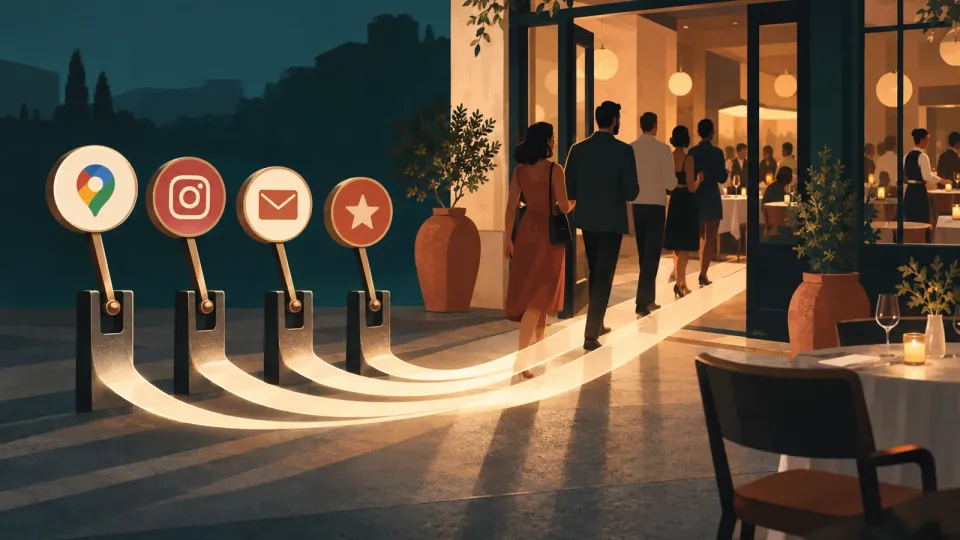
Here is the working model we use in operator work, it is not a theory deck. Your marketing has four levers, and you should build them in this order for best ROI:
- Google Business (captures “near me” and map intent)
- Instagram (creates credibility and urgency through visual proof)
- Email (turns visitors into repeat demand on schedule)
- Reviews and word of mouth (the trust flywheel that makes the first three convert)
The mistake is spending heavily on the last two before the first two are tight. You get engagement without bookings, then you blame the algorithm, your food, or “the market”. Those are expensive excuses.
If you need a proof point from inside the work, Duval showed what happens when content and discovery are treated as a sales system instead of a branding hobby. That engagement delivered a clear bookings lift (reported as 2x outcome) after the stack was aligned around what diners actually search for and trust when they choose a table.
Let’s also kill one more misconception early: “restaurant marketing” is not one thing. It is demand capture plus persuasion plus follow-up. If you only do the persuasion part (social), you are marketing to people who are not currently in buying mode.
So the real question is not “What should we post?”. The question is “Which lever moves the next reservation, and what would we stop doing until that lever is working?”
Lever 1: Google Business Profile that earns calls, not just views
Google Business Profile is the fastest path from hunger to booking, because it sits inside the moment people search “restaurant near me” or browse maps.
Your goal is not to look nice. Your goal is to remove friction for the decision. That means the profile has to answer, in under five seconds, three questions: “Is it the right place for me?”, “Is it reliable?”, “How do I book right now?”.
Start with the basics, then get ruthless about what hurts conversion:
- Categories and services, match what people actually search.
- If you are a Portuguese-focused restaurant, don’t bury that behind a generic label.
- Photos and video, prioritize the dish outcomes.
- Owners overspend on wide shots and forget the plate close-up, the dining room feel, and the moment a guest gets seated.
- Business info accuracy.
- Hours, address, phone, website link. If any of that is wrong, you do not have a marketing problem, you have a lost-reservation problem.
- Posts and updates.
- Use them like operational signage, not like a newspaper.
Reviews are the other half of Google, and this is where operators often get in trouble. Google’s policies are explicit: businesses should not offer incentives for reviews, should not discourage negative reviews, and should not selectively solicit only positive reviews. (support.google.com) That includes discounts or freebies in exchange for posting or changing a review. (support.google.com)
So you can ask, but you cannot game.
The conversion workflow I recommend looks like this:
- After a meal, you ask for a review once, with a neutral request.
- You respond to negative reviews quickly and professionally, you do not fight.
- You keep review requests operational and consistent, you do not spike them unnaturally.
What to stop doing here:
- Stop paying “review automation” vendors.
- Stop telling staff to “push 5 stars”.
- Stop blaming conversion on your menu before your profile is correct.
When Google Business is tight, it becomes your always-on front door. Everything else supports that door, or you should pause the spend until this lever earns its keep.
Lever 2: Instagram that turns visuals into table confidence
Instagram works best when it does what Google cannot: it builds confidence before the call, reservation, or walk-in.
Google answers “can I find you and book now?”. Instagram answers “will I like it when I get there?”. That credibility is visual, so you need an operator-grade content mix, not a random feed.
Here is the simplest rule that keeps this lever ROI-positive: every post should reduce one decision risk.
Common decision risks for restaurant guests:
- “Will the food match my mood?”
- “Is the place real, or is it hyped?”
- “Will I feel comfortable, casual or special?”
- “What is the vibe, not just the menu?”
Your content mix, built around those risks:
- Food outcomes: close-ups of the dish plate, plating detail, and one repeatable hero item.
- Hospitality moments: seating, service gestures, the “first bite” vibe.
- Social proof, without cringe: photos of real guests only when you have rights, otherwise use awards, press, or community events.
- Operations transparency: set-up before service, seasonal sourcing, and limited-time specials.
What most owners do wrong:
- They post only promo creatives. That trains followers to ignore you.
- They post only staff selfies. That is not a buying signal.
- They treat stories like a diary, but guests are looking for proof.
A practical workflow that fits restaurant reality:
- Shoot once per week, edit in one batch.
- Capture 20 to 40 assets. You will never have enough when you try to do it after service.
- Publish on a schedule you can sustain.
- Consistency beats intensity. You want a feed that feels “alive” but not erratic.
- Every week, one special occasion post.
- More on this in the next section, but Instagram is where you frame the occasion before guests search.
- Use captions like micro menus.
- Name the dish, say what it tastes like, and link it to a use case: “for date night”, “for groups”, “for late dinner”.
One operator-grade trick: tie your Instagram content to the proof your Google profile already needs.
- If a dish sells on Google, it needs plate photos on Instagram.
- If your Google photos are outdated, your Instagram can temporarily compensate, but fix Google too.
The goal is not follower growth. The goal is reservations you can actually trace back to confidence, which then shows up as calls, web bookings, and walk-ins.
Lever 3: Email that books repeat visits on a real cadence
Email is the most counterintuitive lever in restaurant marketing because it feels old, but it is the one channel you can schedule.
Instagram is an unpredictable billboard. Google is a search moment. Email is direct demand on your terms.
The job of restaurant email is not to be clever. It is to trigger repeat behavior.
A simple framework that works for independent operators:
- Win: turn visitors into subscribers.
- Activate: send the first “come back” email within days, not weeks.
- Repeat: send predictable signals that match your capacity and season.
How to build your list without turning your restaurant into a signup kiosk:
- Add a Wi-Fi sign-up that includes “get our weekly specials” as the value.
- Add a QR to the receipt, with a one-line promise.
- Capture on reservation flow, if you have a booking system.
Now the cadence, honest and operational:
- Weekly newsletter, one email.
- Two “special push” emails per month.
- Transactional emails if you have online booking, these count as follow-up.
What to stop doing with email:
- Stop sending only discounts. Discounts attract deal hunters, not regulars.
- Stop blasting the whole list with every change. Segmenting is how you avoid annoying your best guests.
- Stop writing one generic template, then changing only the dates.
Instead, use lifecycle logic that matches how restaurants sell:
- New subscriber (first 0 to 7 days)
- A welcome email with your best two dishes and a simple “what to order” suggestion.
- First visit known (first 7 to 30 days)
- A “you liked X, try Y” email. If you do not know what they liked, send a “seasonal menu highlight” that makes choosing easy.
- Inactive (60 to 90 days)
- A comeback email framed around a reason to return, like a new menu cycle, a chef’s special, or a specific experience.
- VIP segment (optional)
- Invite to pre-launch items, tastings, or limited seating events.
Email topics that consistently convert:
- Weekly specials with an ordering hint.
- Menu changes with a “why now”.
- The special occasion framing, anniversaries, birthdays, groups.
- Review request follow-up after a great experience, if it can be done neutrally.
For review policy safety, remember Google discourages incentivized or biased solicitations on its platforms. (support.google.com) Email can be fine for neutral reminders, but do not turn it into a “leave a positive review and get X” machine.
When email is working, you stop guessing. You see demand show up after sends, then you iterate on subject lines and offers based on what your guests actually respond to.
Lever 4: Reviews and word of mouth, the trust flywheel
Reviews are not decoration. They are a conversion layer for Google, for calls, for walk-ins, and for even your email signups.
The mistake is to chase review count instead of review velocity and relevance. A smaller number of detailed, authentic reviews can beat a pile of empty stars.
You want two outcomes at once:
- Velocity: new reviews keep your listing feeling current.
- Specificity: reviews contain decision-relevant details.
Start with what you are allowed to do.
Google Business Profile policy explicitly prohibits incentives such as payment, discounts, free goods, or services in exchange for reviews, and it discourages or prohibits selectively soliciting only positive reviews or discouraging negative reviews. (support.google.com) Your review process has to respect that.
So how do you get more reviews without policy risk?
A compliant, high-quality review workflow:
- Ask at the right moment
- Not when someone is angry, not at checkout pressure.
- Ask when the meal has landed, and the experience is fresh.
- Make the prompt easy and specific, not loaded
- Example prompts you can train staff to say:
- “If you enjoyed today, could you share a quick note about what you ordered?”
- “Was there a dish you’d recommend to someone else?”
- Respond to reviews like an operator, not a brand account
- For positives: thank them, then add a useful detail.
- For negatives: acknowledge, offer a fix, and invite resolution. Do not argue.
- Build review velocity without spikes
- Review blasts, sudden clusters, or “review every guest” on one day can look manipulative.
Now the word-of-mouth engine, the part people forget because it is slower but more durable.
What creates word of mouth:
- A repeatable “signature moment” in the meal
- Friendly service that guests feel comfortable recommending
- A special occasion framing that turns the visit into a story
That is where you connect reviews to a category of guests who search and decide faster.
The “special occasion” segment that punches above its weight:
- anniversaries
- birthdays
- date nights
- team dinners
These guests do not shop by price first. They shop by confidence and vibe. If you make it easy for them to imagine the moment, they book.
Operationally, this means:
- Put a small, consistent “occasion ready” message into your Google photos, your Instagram captions, and your email subject lines.
- Offer a clear, simple enhancement, for example a dessert candle request or a set menu upsell. Keep it operational and consistent, so staff can deliver it.
Duval is a good reminder of how a focused content and discovery alignment can change outcomes. When the system targets what diners trust and search, the effect shows up in bookings rather than vanity metrics.
The trust flywheel is the reason you should treat reviews as part of your sales engine, not as an afterthought.
ROI ranking: which lever to fund first (and what to cut)
If you fund the wrong lever, you pay for visibility without conversion. So the only ROI conversation that matters is, which lever should take your budget first for covers.
In a typical independent restaurant, here is the ranking we see work in practice when the fundamentals are uneven:
- Google Business (highest ROI when your info and photos are incomplete)
- This is demand capture. Fixing it usually improves calls and web bookings quickly.
- Reviews and word of mouth (best ROI once Google is close to correct)
- It lifts conversion on every other channel because it answers trust questions.
- Instagram (ROI improves when it supports your top dishes and occasions)
- Instagram becomes a credibility amplifier for people who are already considering you.
- Email (best ROI when you can segment and you can follow a steady cadence)
- It drives repeat demand, but only if list quality and lifecycle are real.
Now, what to stop doing because it eats money and time:
-
Cold flyers with generic “best restaurant” messaging.
-
You are paying to interrupt, without matching intent.
-
Generic Google Ads that target broad “restaurant” keywords.
-
You are buying clicks without proof or conversion readiness.
-
Buying followers or engagement bots.
-
You are buying signals that do not translate into reservations.
-
Monthly “brand campaigns” with no operational follow-through.
-
If the kitchen cannot sustain the special you advertised, you burn trust.
-
Review incentive schemes on Google.
-
Google prohibits incentives like discounts or freebies in exchange for reviews, or selectively soliciting only positive reviews. (support.google.com)
A more honest budgeting approach:
- Budget first for accuracy (hours, categories, booking link).
- Budget next for proof (photos, dish outcomes, occasion framing).
- Budget last for amplification (paid spend or more frequent content) once your conversion layer is stable.
A working “coverage” test you can run in one week:
- Check Google Business Profile for accuracy, hours, photos, and booking path.
- Post enough Instagram assets so that your top dishes have consistent visual proof.
- Start a weekly email with one clear offer, weekly specials or a seasonal highlight.
- Run a review request workflow that is compliant and consistent.
If you do that in the right order, you will feel it in the booking pattern.
And when results do not show, the problem is usually one of these:
- Your menu positioning is unclear.
- Your booking path is hard to use.
- Your photos do not match what you sell.
- Your guest experience does not support the story your marketing tells.
That last one hurts, but it is the only honest failure mode.
The special occasion playbook, how to book birthdays and dates
Special occasions are a cheat code in restaurant marketing because they reduce comparison shopping. When guests are celebrating, they are less price-led and more confidence-led.
You can build this segment with three things: a clear framing, an easy add-on, and proof that you deliver.
First, the framing. You should speak to the occasion, not only the menu.
Instead of only writing “New menu this week”, your content and email should say things like:
- “Date night at [your restaurant], warm lighting, signature dish, and a dessert moment.”
- “Birthday ready tables, group-friendly pacing, and a candle dessert add-on.”
Do not overcomplicate it. Operators who overspecify fail because staff cannot deliver the promise consistently.
Second, the add-on. The best add-ons are small, operationally safe, and repeatable.
Examples that typically work:
- dessert with a candle
- a simple “share plate” for groups
- a pre-set menu for team dinners
Even if you never discount, you still need to make the experience feel curated.
Third, proof. This is where reviews and Instagram overlap.
- Google photos and review text should show what “occasion ready” looks like.
- Instagram stories should show setup and the dessert moment, so guests can imagine themselves there.
How to operationalize this without breaking your day:
- Create a one-page internal checklist
- What to ask, what to confirm, what to deliver.
- Train one script
- Staff should be able to say it in ten seconds.
- Use your confirmation message
- If you have reservations, confirm “We noted this is a birthday” or “We will set aside your table for date night”.
- After service, prompt with a neutral review ask
- If your guest had a great occasion, you can invite them to share a note about the experience. Keep it compliant with Google policies on incentivized or selectively soliciting reviews. (support.google.com)
A misconception to avoid: “Special occasion marketing is pushy.”
It only becomes pushy when you fake it, or when you turn it into discounts. Real operators make it about comfort and pacing. Guests feel cared for, and that produces word of mouth.
If you do this well, your reviews start to include the words that special occasion guests search for: “romantic”, “birthday”, “group-friendly”, “great pacing”. That is how you turn one segment into a compounding advantage.
Duval’s kind of booking lift is a reminder that when discovery and trust are aligned, you get measurable reservations, not just brand chatter.
Your next step is to choose one special occasion theme for the next two weeks and make it consistent across Google photos, Instagram visuals, and your email subject line.
What to do in the next 7 days to increase bookings
You do not need a new identity. You need a tighter stack.
Here is a 7-day plan that focuses on the four levers in the right order, so you get measurable booking lift signals quickly.
Day 1: Audit your Google Business Profile like a guest
- Verify business name, address, phone, and hours.
- Confirm primary category matches your positioning.
- Add or replace photos for your top dishes and your dining room vibe.
- Ensure your booking link works.
Day 2: Set up a review workflow that is compliant
- Train staff to ask for reviews neutrally.
- Remove any language that promises discounts, gifts, or “better reviews for better ratings”. Google prohibits incentives for reviews and discourages selective solicitation of only positive reviews. (support.google.com)
- Plan how you will respond to negative reviews in under 24 to 48 hours.
Day 3: Publish Instagram proof for the dishes people decide on
- Post at least three assets: one signature dish close-up, one dining room vibe, one hospitality moment.
- Write captions that name the dish and link it to the occasion, date night, or group dinner.
Day 4: Build your email list capture
- Put a QR at the till that leads to a clear signup value, weekly specials or seasonal highlights.
- If you already collect emails through reservations, clean duplicates and segments.
Day 5: Send Email #1 with a single clear offer
- Subject line: the benefit, “This week’s [signature dish] plus a quick ordering hint.”
- Body: two dishes, one occasion suggestion, one clear booking path.
Day 6: Send Email #2 to a small segment (only if you can)
- Segment by first-time vs returning, or by guest interest if you have it.
- If you cannot segment, send the same weekly email again to the whole list but change the framing to an occasion.
Day 7: Tighten the “special occasion” layer
- Update your Google photos captions if you use them (or swap one image that shows the occasion vibe).
- Put one occasion line into your Instagram story highlight.
- Prepare one internal checklist for staff, birthdays or date night, and use it.
If you execute this correctly, you will learn fast what matters. You should see changes in:
- calls and direction requests
- reservation conversions after Google browsing
- repeat behavior after email sends
- review frequency and review text specificity
One operational caution: do not create demand on channels you cannot fulfill.
If you advertise a “limited chef tasting” but your kitchen cannot deliver consistent pacing, you will get disappointed guests and worse reviews. Your marketing promise has to match operational reality.
This is why we prefer building the stack, not chasing tactics. Restaurant marketing is a system.
When your stack starts booking more covers, keep only what delivers results and cut the rest. That is how you stay profitable while others chase vanity engagement.
Restaurant marketing FAQ: fast answers to the stuff that blocks bookings
If you are a restaurant operator, you probably have the same questions we hear every week. Here are direct answers that help you decide, without guessing.
Do I need a big social media budget to get reservations?
No. Social earns trust, but reservations usually come from intent channels first. Start with Google Business accuracy and proof, then build Instagram to reinforce top dishes and occasions.
What is the safest way to ask for reviews?
Use a neutral request after the meal. Do not offer discounts, free goods, or services in exchange for reviews, and do not selectively solicit only positive reviews. Google’s policies are explicit about these restrictions. (support.google.com)
Should restaurants send emails every day?
No. A typical cadence is weekly plus occasional special pushes. The real requirement is consistency, and the ability to deliver what the email promises.
What should I email if my menu changes weekly?
Email weekly specials with a “what to order” hint. Then send occasional emails when you have a clear experience reason to return, seasonal ingredient focus, or a special occasion framing.
What is the best first lever for a restaurant with no online traction?
Google Business. Fix your categories, hours, phone, booking link, and photos first. Then use reviews to improve conversion on that front door.
How do special occasion campaigns increase bookings?
They reduce comparison shopping. Guests celebrating search for confidence and vibe. If your Google photos, Instagram content, and email language consistently describe the occasion experience, bookings follow.
Can I run Google Ads for restaurant marketing?
You can, but only after your profile and booking path convert. Broad, generic campaigns waste spend when your Google Business Profile is weak or outdated.
What is the single biggest mistake restaurant owners make?
Treating marketing as content posting, instead of a conversion stack.
If you want to tighten your restaurant marketing fast, follow the 7-day plan: Google first, review workflow next, Instagram proof, then email cadence, then the special occasion layer. That order protects your ROI and keeps execution realistic.
Written by Andre Ginja — Founder, andginja
Next step: run a restaurant marketing teardown this week
Your next step today is not to post more. It is to identify the weakest lever in your stack and fix it with operator-grade clarity.
Here is what to do right now, in ten minutes:
- Open your Google Business Profile and book a table as a guest would.
- If the booking path is confusing, your marketing ROI collapses no matter how good your food is.
- Look at your top three photos on Google.
- If none are recognizable dish outcomes, update them. Proof beats polish.
- Write a one-line “special occasion” promise for your restaurant.
- Date night, birthday, or team dinner. One sentence that staff can deliver.
- Draft your next email subject line.
- Make it a benefit and a reason to return, not a generic promo.
If you want a second pair of eyes, that is where a teardown helps. In my experience shipping content systems and running hospitality AI and software pilots, the fastest wins come from mapping each lever to a specific customer decision and then fixing the friction.
One more reminder on the reviews lever: you cannot buy or incentivize reviews for Google. Google prohibits incentives like payment, discounts, free goods, or services in exchange for reviews and discourages selectively soliciting positive reviews. (support.google.com) Build a workflow that earns authentic reviews instead.
If you want to go from “we post sometimes” to a reservations engine, book a teardown.
Want a teardown of your restaurant's marketing stack? Book a free 30-min audit and we will point to the exact lever to fix first, what to stop doing this week, and what to ship next.
Related guides

Hotel digital marketing: the simple 6-channel stack
Hotel digital marketing does not need 20 channels. Use this 6-channel stack (SEO, Google Hotel Ads, metasearch, email, Instagram, OTA) plus the 4 to skip.

Hotel email marketing playbook beyond the newsletter
Hotel email marketing that drives direct bookings, not opens. Use 5 ROI-triggered flows, post-stay timing, and recovery emails. Fix your setup fast.

Social media marketing for vacation rentals: Instagram to bookings
Social media marketing for vacation rentals, Instagram to bookings. A STR playbook that cuts vanity metrics and turns DMs into direct reservations.
When to hire a hospitality marketing agency (and when not)
Decide if a hospitality marketing agency fits your hotel. Get a decision tree, cost reality, KPI demands, and red flags. Book a review.