
Albufeira Beaches: Old Town, Resorts, and Quieter Picks
Albufeira beaches compared for day trips and stays: Old Town coves, resort strips like Oura, plus calmer options such as São Rafael and Falésia.
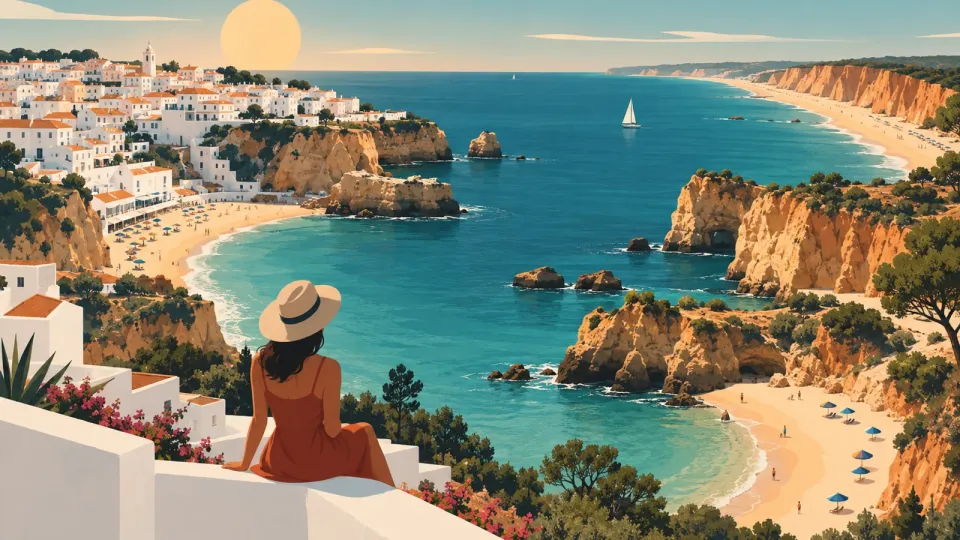
Why Albufeira feels split into “beach towns”
One of Albufeira’s biggest surprises is that you are not choosing “one beach town,” you are choosing a coastline mood.
From Praia da Oura to Praia do Peneco, the municipality’s shoreline changes fast. You move between sandy urban beaches with umbrellas, a lively strip near nightlife, and stretches where the cliffs and distance naturally thin crowds.
That pattern matters if you are a day visitor or if you are picking accommodation. If you stay in the Old Town or around the central beaches, you can walk to water in minutes, but you also land closer to the densest services and foot traffic. If you stay farther east near Oura, you get a “resort strip” feel, still close to the action. If you base yourself near Falésia or São Rafael, you trade convenience for more room to breathe.
Albufeira’s own beach overview makes this geography explicit: it notes that from Praia da Oura to Praia do Peneco you get the most frequented beaches near urban zones, while other areas (including sections from around Ponta da Baleeira toward Galé) can offer more protected, wind-sheltered settings. Source: Câmara Municipal de Albufeira. https://www.cm-albufeira.pt/en/node/247
A common mistake is to assume “closest beach to your hotel” also means “best beach for your day plan.” In reality, beach choice is really about:
- How fast you want to reach sand (walk versus drive)
- How you want your beach to feel (urban convenience versus relaxed layout)
- How you handle access (tunnels, stairs, long cliff edges)
A second mistake is to treat beaches as interchangeable. They are not. Some are known for iconic access, like the Old Town beach that reaches the sand through a pedestrian tunnel. Others are known for long cliff-backed sands, like Falésia, where the beach is part of the landscape.
If you want an objective anchor, use official quality signals. Albufeira has many beaches awarded with Blue Flag recognition, which is designed to reflect criteria like water quality, safety-related services, and environmental management. Source: Câmara Municipal de Albufeira reporting on Blue Flag results. https://www.cm-albufeira.pt/artigo/albufeira-atinge-recorde-de-bandeiras-azuis
Old Town beaches that win on walking time (and iconic access)
If your top goal is “be on the sand fast,” the Old Town coastline gives you the quickest payoff. You also get some of Albufeira’s most recognizable access points.
The Old Town’s signature beach connection: tunnel to the sand
The best-known Old Town beach experience is Praia do Peneco, also widely referred to as Praia do Túnel. The official Visit Albufeira page describes the Peneco Stairway as a landmark pedestrian connection between the historic centre and Praia do Peneco, built into the cliffside and framed by sea views. Source: Visit Albufeira. https://visitalbufeira.pt/visita/escadaria-do-peneco/en/
You can also find a clear historical “tunnel” description in the general reference material: Praia do Peneco is described as one of the two beaches that front the town, with Praia do Túnel at the western end and Praia dos Pescadores at the eastern end, connected via a pedestrian tunnel cut through the cliffs linking the town square to the beach. Source: Wikipedia (summary of local naming and layout). https://en.wikipedia.org/wiki/Praia_do_T%C3%BAnel_(Peneco)
What that means for your day plan
Old Town access turns beach time into an add-on, not a separate outing. You can do a morning swim, then step back into the narrow lanes above.
Here is a practical way to plan it:
- Start from the historic streets (Old Town lanes and viewpoints)
- Commit to the descent route (stairs or lift access depending on your comfort level)
- Use the beach as your base for 2 to 3 hours
- Return before the heat peaks if you do not want to queue for shade and services
Day visitor versus accommodation logic
- Day visitor sweet spot: Old Town beaches minimize transfers. Your “lost time” is mainly the descent and ascent.
- Accommodation sweet spot: If you stay near the Old Town, you can keep the beach flexible. You can go back for lunch or a towel break without planning a full transport segment.
Blue Flag signal for confidence
If you like beach quality indicators, Albufeira’s municipal Blue Flag reporting lists beaches in the central town area, including Peneco and Pescadores among the awarded beaches for the season referenced in the municipal update. Source: Câmara Municipal de Albufeira. https://www.cm-albufeira.pt/artigo/albufeira-atinge-recorde-de-bandeiras-azuis
A misconception to avoid
You might read “central” and expect “always chaotic.” Even within the Old Town, beaches vary in feel. Visit Albufeira notes that Praia do Peneco has a calmer and more spacious environment compared with the adjacent commerce-heavy side, due to a lower concentration of commercial activity. Source: Visit Albufeira (Praia do Peneco). https://visitalbufeira.pt/praia/praia-do-peneco
That means you can still choose “Old Town” without choosing the busiest corner every time.
Praia da Oura and the “resort strip” feeling, minus the guesswork
Praia da Oura is where many visitors first notice Albufeira’s resort-strip character: high-energy surroundings, dense services, and a beach that feels integrated into the town’s accommodation and leisure zones.
What makes Oura different from the Old Town
Visit Albufeira describes Praia da Oura as one of the most moved and emblematic beaches of Albufeira, highlighting its proximity to the area of nightlife and its large hotel and restaurant presence. Source: Visit Albufeira. https://visitalbufeira.pt/praia/praia-da-oura
Municipal beach overview pages also describe Oura as having very different qualities from west to east, with a more equipped character in the west and a more naturalizing feel in the east, including more cut rock features defining the eastern boundary. Source: Câmara Municipal de Albufeira (Praias, Oura). https://www.cm-albufeira.pt/praias/oura
That is a key detail for planning, because “Oura” is not one identical beach mood.
A simple, workable split for your day
Use this practical rule when you arrive:
- If you want convenience and action: aim toward the busier, more equipped western side of Oura
- If you want calmer water breaks: walk east along the sand toward the naturalizing and more rugged coastal edge described by the municipality
You do not need a perfect forecast to use the rule. You just need the orientation.
Transport and logistics for stays
If you stay in this zone, you usually benefit from reduced logistics. You can handle beach days like a schedule item: breakfast, beach block, lunch nearby, then evening back in town.
If you are using car parking and you want to reduce stress, plan for the area around central beaches to have more competition for spaces than quieter coves. Albufeira’s municipal documents and local PDFs frequently discuss parking arrangements near beach access points, such as the Olhos de Água parking facility and access corridors. Source example: municipal parking information PDF discussing an Olhos de Água car park capacity. https://www.cm-albufeira.pt/sites/default/files/RepositorioPublicacoes/2023/boletiminformativojan-fev2023.pdf
I am not claiming parking is easy or hard, but central zones tend to be the most in-demand.
The “crowds” misconception
A common mistake is to decide between “Oura” and “not Oura” as if one is always full and the other is always empty. That is not how geography works.
Visit Albufeira openly frames Oura as busy, but the municipal Oura page also describes east to west differences and the existence of more natural, quieter-feeling pockets toward the eastern boundary. Source: Visit Albufeira (Oura busier context). https://visitalbufeira.pt/praia/praia-da-oura and Câmara Municipal de Albufeira (Oura east naturalizing). https://www.cm-albufeira.pt/praias/oura
So you can choose Oura for convenience, then adjust the specific spot you claim.
A quality anchor you can verify
Albufeira municipal updates on Blue Flag beaches include Oura among the awarded beaches for the season referenced in their announcement, which is one reason Oura remains a popular base for families and mixed groups. Source: Câmara Municipal de Albufeira. https://www.cm-albufeira.pt/artigo/albufeira-atinge-recorde-de-bandeiras-azuis
Practical takeaway: if you want the resort-strip feel but still want to reduce the “maximum energy” experience, choose Oura for location, then walk your session toward Oura’s eastern edge.
Quieter beach options that still stay close to Albufeira
“Quieter” does not mean “far away,” and it does not mean “no one will ever be there.” The best quieter options around Albufeira are quieter because of geography, access style, and how commercial density changes along the coast.
1) Falésia, for big-landscape sand and natural boundaries
Praia da Falésia is one of the most distinctive picks if you want a long beach experience tied to the cliffs.
Wikipedia describes Falésia as a beach associated with a large cliff, with particular zones showing a reddish color, starting near Barranco das Belharucas and extending toward Vilamoura, and it notes that the sand is recommended for swimming where the areal lacks rocky zones. Source: Wikipedia (Praia da Falésia overview). https://pt.wikipedia.org/wiki/Praia_da_Fal%C3%A9sia
Even if you do not care about the geology, you should care about the scale. Falésia is long, so the beach supports internal “micro choices.”
Also, the municipal beach overview frames Albufeira’s coast as having multiple contexts: some areas are more sheltered and varied by cliffs and geography, not just by hotel density. Source: Câmara Municipal de Albufeira beach overview. https://www.cm-albufeira.pt/en/node/247
2) São Rafael, for limestone-cliff character and a calmer vibe
If you want a quieter feel without abandoning the Albufeira coast, Praia de São Rafael is a strong candidate.
Visit Albufeira describes São Rafael as an iconic destination within the municipality, known for its imposing limestone cliffs carved by natural erosion over thousands of years. Source: Visit Albufeira. https://visitalbufeira.pt/praia/praia-de-sao-rafael/pt/
The municipality adds a concrete visual idea: it points to notable rock formations shaped by wave action and rainwater, naming examples such as Ponte Pequena and Ninho das Andorinhas. Source: Câmara Municipal de Albufeira (São Rafael). https://www.cm-albufeira.pt/praias/sao-rafael
That is helpful because it gives you a “what to look for” during your walk, which can replace the need for constant crowd-checking.
3) Praia do Peneco as a calmer Old Town anchor
If you want quiet while still being near Old Town services, Praia do Peneco can work.
Visit Albufeira explicitly describes Praia do Peneco as a continuation natural to Praia dos Pescadores but with a more calm and spacious environment, due to a smaller concentration of commerce. Source: Visit Albufeira (Praia do Peneco). https://visitalbufeira.pt/praia/praia-do-peneco
Avoid the mistake of chasing “distance from town” only
Some travelers assume the quietest beaches are always the ones farthest from town. In Albufeira, distance is only one variable.
Cliffs create natural separation. Beach access style changes where people concentrate. And different sections of the same named beach can feel different.
Here is a quick decision framework you can use on arrival:
- If you want less foot traffic: choose the eastern or more rugged end of a long beach (Falésia sections, Oura eastern edge)
- If you want Old Town proximity: choose Peneco over the busiest commercial-facing side
- If you want scenic rock formations: choose São Rafael, then build your day around shoreline walks
Quality checks you can verify Municipal Blue Flag results include many beaches across Albufeira. For example, one municipal update lists Falésia Alfamar, Oura, and Peneco among the awarded beaches. Source: Câmara Municipal de Albufeira. https://www.cm-albufeira.pt/artigo/albufeira-atinge-recorde-de-bandeiras-azuis
Blue Flag is not a guarantee of empty beaches, but it is a useful baseline for water quality and service standards.
Old Town versus resort strips: which base fits your travel style?
Choose your accommodation like you choose a lens. Old Town, resort strips, and calmer cliff zones create different kinds of “focus.”
Base option A: Stay near the Old Town for walk-first beach days
If you want to treat beach time as flexible, Old Town access is hard to beat.
Why it works:
- You can reach a central beach using the town’s pedestrian connections, including the iconic Peneco Stairway route.
- You can pivot after lunch or when the light changes, because you are already close.
Evidence of that access logic comes from the Visit Albufeira description of the Peneco Stairway as an emblematic pedestrian connection between the historic centre and Praia do Peneco. Source: Visit Albufeira. https://visitalbufeira.pt/visita/escadaria-do-peneco/en/
Best for:
- Day trips with short schedules
- Couples or small groups who want restaurants and streets close to sand
Tradeoffs:
- You are closer to the core foot traffic
- You should expect more competition for shade and services at peak hours
Base option B: Stay near Oura for a resort-strip rhythm
If your idea of a beach holiday includes evening plans, then the Oura zone fits.
Visit Albufeira frames Praia da Oura as highly emblematic and moved, linked to nightlife proximity and a high density of hotels and dining. Source: Visit Albufeira. https://visitalbufeira.pt/praia/praia-da-oura
Best for:
- Multi-day stays where you want a simple routine (beach, shower, dinner)
- Groups who do not mind a “busy by default” environment
Tradeoffs:
- You may need to walk east within Oura for a calmer stretch, because Oura itself changes along its length. Source for east-west naturalizing versus equipped context: Câmara Municipal de Albufeira (Oura). https://www.cm-albufeira.pt/praias/oura
Base option C: Stay closer to Falésia or São Rafael for a scenery-led day
If your priority is how the coastline looks and feels, not just how fast you arrive, you should consider Falésia or São Rafael.
Visit Albufeira describes São Rafael as iconic with limestone cliffs carved by erosion over thousands of years. Source: Visit Albufeira. https://visitalbufeira.pt/praia/praia-de-sao-rafael/pt/
Wikipedia describes Falésia’s long cliff-backed context, including its reddish cliff color in certain sections and extension toward Vilamoura. Source: Wikipedia (Praia da Falésia). https://pt.wikipedia.org/wiki/Praia_da_Fal%C3%A9sia
Best for:
- Photographers and filmmakers who want dramatic edges and long walking compositions
- Travelers who prefer fewer “core town” distractions
Tradeoffs:
- Your beach day likely needs more planning for transport or longer walks
A common planning mistake: booking a beach name without checking the section
For Falésia and Oura especially, your chosen “beach” is actually a set of sections. Albufeira’s own municipal framing emphasizes that beach patterns change across the municipality. Source: Câmara Municipal de Albufeira beach overview. https://www.cm-albufeira.pt/en/node/247
Action you can take when choosing a base:
- Pick one beach you want to visit daily.
- Identify whether it is “walk-first” from your accommodation.
- If it is Oura or Falésia, decide which side or section you want, then anchor your searches around that.
A quality anchor you can use for any base Municipal updates list many beaches in the Blue Flag recognition set, which can help you avoid “bad surprise” water days. One municipal update lists Oura, Peneco, and Falésia areas among the beaches in the awarded list. Source: Câmara Municipal de Albufeira. https://www.cm-albufeira.pt/artigo/albufeira-atinge-recorde-de-bandeiras-azuis
That still does not prevent crowds, but it helps you pick with more confidence about basic beach standards.
How to get to the beaches: walking routes, lifts, and transit choices
How you reach a beach can matter as much as which beach you pick. In Albufeira, the coastline has cliff edges and built-up stretches, so access varies from tunnel descents to stair-and-lift viewpoints.
Old Town to Peneco, use the landmark pedestrian connection
If your beach target includes Praia do Peneco, plan your route around the dedicated pedestrian connection.
Visit Albufeira describes the Peneco Stairway as an emblematic pedestrian connection between the historic centre and Praia do Peneco, integrated into the cliffside. Source: Visit Albufeira. https://visitalbufeira.pt/visita/escadaria-do-peneco/en/
Also, general reference material describes the town layout with Praia do Túnel at the western end and Praia dos Pescadores at the eastern end. Source: Wikipedia. https://en.wikipedia.org/wiki/Praia_do_T%C3%BAnel_(Peneco)
Practical tip:
- If you want the most iconic descent, go for the tunnel arrival experience for Peneco.
- If stairs are not for you, look for alternatives like lift access options listed by local signage and route descriptions, then decide based on what your group can handle.
Use municipal beach zoning to predict walk versus drive
Albufeira’s municipal beach overview suggests that the stretch from Praia da Oura to Praia do Peneco includes the most frequented beaches closest to urban zones. Source: Câmara Municipal de Albufeira. https://www.cm-albufeira.pt/en/node/247
That helps you decide transport before you even leave your accommodation. Closer urban zones often mean more direct routes, but they also mean more foot traffic.
A practical transport checklist for day visitors
When you are choosing where to go first, ask these questions:
- Do I have a hill or cliff descent in my plan? If yes, choose your return timing carefully.
- Will I need shade near my arrival point? If you arrive early, you can set a base that works for your route.
- Am I planning multiple beaches? If yes, pick adjacent ones in one direction along the coast.
Municipal documentation shows that Albufeira invests in accessibility information at beach entry points, including updated physical accessibility conditions. Source: Example municipal document referencing accessibility information commitments. https://www.cm-albufeira.pt/sites/default/files/RepositorioAvisosEditais/2026/ata-2026-03-17-camara-municipal-006.pdf
I cannot tell you specific elevator hours for your travel dates because access rules can change. But I can tell you what to do: look up the municipality’s accessibility and services information near your chosen beach entrance once you arrive.
Consider the “tempo” tool, use local shuttle concepts carefully
Some visitors plan using a tourist train concept that operates seasonally. A municipal tourism-related PDF flyer describes an old town route between the old centre of Albufeira and Oura with multiple stops, including central beaches like Praia dos Pescadores. Source: Albufeira.com hosted PDF flyer (tourist train). https://albufeira.com/_docs/Albufeira_Tourist_Train-July_2021_Leaflet.pdf
Because it is a dated example, do not treat it as confirmation for your exact dates. Use it as a cue to search locally for the same service name and route when you arrive.
Big-picture transit from outside the city
If you are traveling to Albufeira from other Portuguese cities, rail connections matter. Comboios de Portugal (CP) publishes route diagrams and pricing pages. Source: CP Alfa Pendular information and pricing example pages. https://www.cp.pt/info/documents/d/cp/comboio-porto-lisboa-faro-lagos-v-r-s-antonio and https://www.cp.pt/info/documents/d/cp/precos-alfa-pendular-porto-oriente-faro-1
Even if you do not use the train, check station details so you can plan the last leg to your accommodation.
Action you can take today Pick one beach from this article and write your access route as a sentence. Example: “I am going to arrive via the Old Town to Peneco stair connection, then return for lunch before late afternoon.” That one sentence prevents half-day confusion.
Day-trip itineraries that match beach personality (2 to 5 hours)
If you only have one day, your best strategy is to match each beach stop to a specific mood. Albufeira makes this easy because different areas feel different.
Itinerary 1 (2 to 3 hours): Old Town photo walk plus Peneco swim
Best for: day visitors who want the iconic access moment and quick beach time.
- Start in the historic centre and plan your descent through the Peneco Stairway connection.
- Evidence: Visit Albufeira calls it an emblematic pedestrian connection between the historic centre and Praia do Peneco. https://visitalbufeira.pt/visita/escadaria-do-peneco/en/
- Arrive at Praia do Peneco and build your view around the cliffside framing.
- Evidence: Visit Albufeira describes Peneco as having a calmer, more spacious environment due to lower commerce concentration. https://visitalbufeira.pt/praia/praia-do-peneco
- Swim and reset for 60 to 90 minutes.
- Return before the peak heat and use nearby streets for lunch.
Quality check idea: if you want to anchor your day, Albufeira’s municipal Blue Flag reporting includes Peneco among the listed beaches in that recognition set. https://www.cm-albufeira.pt/artigo/albufeira-atinge-recorde-de-bandeiras-azuis
Itinerary 2 (3 to 4 hours): Oura resort-strip morning, calmer east afternoon
Best for: accommodation near town who wants action but not maximum busyness for the whole day.
- Go to Praia da Oura early for the lively, central resort feel.
- Evidence: Visit Albufeira describes Oura as moved and emblematic, near the nightlife area with lots of hotels and dining. https://visitalbufeira.pt/praia/praia-da-oura
- Walk east along Oura if you want a calmer stretch.
- Evidence: the municipality describes east-to-west differences, where the east becomes more naturalized and more tranquil, with rock formations defining the eastern edge. https://www.cm-albufeira.pt/praias/oura
- Stop for water and a break once you feel the tone shift.
Common mistake to avoid: do not pick one spot at Oura and assume it represents the whole beach. Oura is a strip of moods.
Blue Flag anchor: the municipal Blue Flag announcement lists Oura among the beaches in the awarded set. https://www.cm-albufeira.pt/artigo/albufeira-atinge-recorde-de-bandeiras-azuis
Itinerary 3 (4 to 5 hours): São Rafael limestone cliff walk plus sand time
Best for: people who prefer scenery-led days.
- Start with the cliff views at Praia de São Rafael.
- Evidence: Visit Albufeira highlights São Rafael’s limestone cliffs shaped by erosion over thousands of years. https://visitalbufeira.pt/praia/praia-de-sao-rafael/pt/
- Use the rock-formation names as your “walk script.”
- Evidence: the municipality points to Ponte Pequena and Ninho das Andorinhas and explains how waves and rainwater shaped the limestone. https://www.cm-albufeira.pt/praias/sao-rafael
- Swim or rest for 90 to 120 minutes.
- Add a second coastal viewpoint nearby only if you are already energized.
Mistake to avoid: do not plan this itinerary as a “quick snack beach.” São Rafael feels best when you give it time to reward you with shoreline composition.
Itinerary 4 (Half day): Falésia long-sand experience
Best for: travelers who want a long coastline session and optional wandering.
- Choose a Falésia section and commit to a single direction for your walk.
- Evidence: Wikipedia describes Falésia as a beach associated with a cliff that begins near Barranco das Belharucas and extends toward Vilamoura. https://pt.wikipedia.org/wiki/Praia_da_Fal%C3%A9sia
- Plan your swim zone based on the sand and rocky layout.
- Evidence: Wikipedia notes that it can be recommended for swimming, especially where the sand lacks rocky zones. https://pt.wikipedia.org/wiki/Praia_da_Fal%C3%A9sia
- Take 20 minutes to explore before you settle.
Action you can take today Pick one itinerary and decide your start time. Then decide whether your route needs stairs, a long walk, or a car leg. That single choice locks in everything else.
Beach quality signals you can actually verify before you go
Many travelers plan beaches by vibes alone. You can do better with a few verifiable signals.
Use Blue Flag as a shortlist filter
Albufeira’s municipality publicly reports Blue Flag recognition results and lists multiple beaches included in the awarded set.
In one municipal update, the city reports a record number of Blue Flags for Albufeira and lists beaches that include Alemães, Arrifes, Aveiros, Belharucas, Falésia areas, Inatel, Manuel Lourenço, Maria Luísa, Olhos de Água, Oura, Peneco, Pescadores, Rocha Baixinha sections, São Rafael, Salgados, Santa Eulália, and more. Source: Câmara Municipal de Albufeira. https://www.cm-albufeira.pt/artigo/albufeira-atinge-recorde-de-bandeiras-azuis
This does not guarantee your day will be quiet or that the sea will be flat. It does give you a baseline that the beach management and standards were met for that season.
Confirm accessibility and support information on the spot
Albufeira’s municipal documents also reference updated accessibility information at beach entry points and on the municipality’s website during the bathing season.
Example evidence: a municipal record notes commitments to provide updated information on physical accessibility conditions and support services in the bathing area. Source: Câmara Municipal de Albufeira document referencing accessibility information at beach entry points. https://www.cm-albufeira.pt/sites/default/files/RepositorioAvisosEditais/2026/ata-2026-03-17-camara-municipal-006.pdf
Action step for your trip:
- When you choose your beach, check for accessibility notes before you commit to a descent.
- If you have a mobility limitation in your group, choose a beach where the route is known to be easier, then verify details at the entrance.
Use bathing water profile and dates when available
If you want more technical support, the Portuguese environment agency publishes information on bathing waters, including the bathing season dates and bathing water quality summaries.
For example, ARH do Algarve entries show bathing season dates and include beaches like Arrifes and Aveiros with documented time windows for the bathing season. Source: Agência Portuguesa do Ambiente (ARH do Algarve page with bathing water listings). https://apambiente.pt/en/node/1010
I am not listing quality ratings here because the page can be detailed and your exact beach might differ. But the key takeaway is simple: you can check sea water information for specific beaches rather than guessing.
Remember the scope: beaches are managed differently
Not every coastline is under the same conservation or protected-area rules. If your trip also includes protected coastal wetlands, that is a separate planning layer.
For context, Portugal’s natural protected area pages describe how visitor education and trail access works for protected coastal systems like the Ria Formosa nature park. Source: Visit Portugal page on Parque Natural da Ria Formosa. https://www.visitportugal.com/en/content/parque-natural-da-ria-formosa
That is relevant because some visitors confuse “Albufeira beaches” with “all Algarve beaches” and assume the same rules apply everywhere. In practice, management and ecosystems vary by location.
Common planning mistakes
- Mistake 1: Picking beaches by only Instagram photos. Photos rarely tell you about access routes or management.
- Mistake 2: Assuming all Blue Flag beaches are equal. Different beaches have different layouts, rock edges, and levels of commercial density.
- Mistake 3: Planning without considering bathing season dates. The environment agency lists season windows for specific beaches, so check the time window for when you arrive.
Action you can take today Choose two candidate beaches from your travel plan and check the ARH bathing-water listing for the bathing season dates for those exact names, then decide based on your arrival window.
A filmer and photographer’s guide to beach variety without burnout
When you plan a beach day as a filmmaker or photographer, you are not just looking for sand. You are looking for repeatable compositions, light-friendly movement, and coastline textures that work across lenses.
Albufeira is unusually good for this because it offers three distinct visual languages within one municipality: urban cliffs and tunnels near the Old Town, resort-strip energy around Oura, and limestone cliff drama at São Rafael and Falésia.
Old Town: use the tunnel and cliff edge for strong establishing shots
Praia do Peneco, known as Praia do Túnel, gives you built-in staging for an establishing shot because you reach the beach through a landmark pedestrian connection.
Evidence: Visit Albufeira calls the Peneco Stairway an emblematic connection between the historic centre and Praia do Peneco, integrated into the cliffside. https://visitalbufeira.pt/visita/escadaria-do-peneco/en/
Use it like this:
- Shot 1: A high viewpoint wide to show the cliff and town edge
- Shot 2: A mid movement shot through the descent route
- Shot 3: A landing frame where the tunnel moment resolves into sand and sea
This workflow keeps your day from turning into “walk, shoot, repeat” without structure.
Oura: capture a gradient from high-energy to calmer coast
Visit Albufeira describes Praia da Oura as moved and emblematic, tied to nightlife proximity and dense hotels and dining. https://visitalbufeira.pt/praia/praia-da-oura
Then the municipality adds a powerful creative detail: the beach is very diverse west to east, with the west dominated by tourist equipment and the east becoming more natural, with a cut rock define at the eastern boundary. https://www.cm-albufeira.pt/praias/oura
So you can plan a two-phase shoot:
- Phase one (west side): use wider crowd-aware frames if you want a “resort energy” story
- Phase two (east side): switch to quieter compositions with a more natural shoreline edge
You get variation without changing locations.
São Rafael: limestone formations give you story beats
Visit Albufeira describes São Rafael’s limestone cliffs as shaped by thousands of years of erosion. https://visitalbufeira.pt/praia/praia-de-sao-rafael/pt/
The municipality makes it concrete with named formations like Ponte Pequena and Ninho das Andorinhas, tied to how waves and rainwater shape the limestone. https://www.cm-albufeira.pt/praias/sao-rafael
For a filmmaker, named features help you avoid blank-screen days. You can write a simple beat list in advance:
- “Arrive, establish the cliff forms”
- “Move to a formation for a close-up”
- “Return to a wider sand and sea frame”
Falésia: long cliff-backed sand supports movement and pacing
Wikipedia describes Falésia as a cliff-associated beach whose stretch runs from near Barranco das Belharucas toward Vilamoura. https://pt.wikipedia.org/wiki/Praia_da_Fal%C3%A9sia
For photography, long beaches support a consistent “walk and frame” rhythm. You can shoot sequences where your horizon line stays stable while foreground texture changes.
Avoid burnout: pick one creative constraint per day
Here is a practical framework you can apply immediately:
- Old Town day: “One iconic access moment” (tunnel or stair connection)
- Oura day: “One gradient” (west-to-east change)
- São Rafael day: “One named formation sequence” (Ponte Pequena, Ninho das Andorinhas)
- Falésia day: “One long line” (walk direction stays consistent)
Quality baseline: Blue Flag coverage supports confidence in beach standards across many Albufeira beaches, including Oura, Peneco, Pescadores, Falésia areas, and São Rafael as listed by the municipality. Source: Câmara Municipal de Albufeira. https://www.cm-albufeira.pt/artigo/albufeira-atinge-recorde-de-bandeiras-azuis
Action you can take today Pick one beach category, then write a 4-shot plan on your phone before you leave your accommodation. That reduces wasted movement and protects your time for editing later.
Your next steps for picking the right Albufeira beach area today
You can pick the right Albufeira beach area faster than you think, if you decide using two questions first.
Step 1: Decide your “reach strategy” (walk-first or plan-a-leg)
- Walk-first: choose Old Town beaches like Praia do Peneco (Praia do Túnel) because the Peneco Stairway provides an emblematic pedestrian connection from the historic centre. Source: Visit Albufeira. https://visitalbufeira.pt/visita/escadaria-do-peneco/en/
- Plan-a-leg: choose Falésia or São Rafael when you want scenery-led beach time and are okay with more travel time.
Step 2: Decide your “beach personality” (iconic, resort, or scenic quiet)
Use these quick matches:
- Iconic and central: Praia do Peneco, calmer-feeling compared with the adjacent commercial-facing side. Source: Visit Albufeira. https://visitalbufeira.pt/praia/praia-do-peneco
- Resort-strip rhythm: Praia da Oura, lively and emblematic, with west-to-east variation for calmer pockets. Sources: Visit Albufeira, and Câmara Municipal de Albufeira (Oura east-west). https://visitalbufeira.pt/praia/praia-da-oura and https://www.cm-albufeira.pt/praias/oura
- Scenic quiet: Praia de São Rafael, defined by limestone cliffs shaped by erosion, with named formations. Source: Visit Albufeira and municipality. https://visitalbufeira.pt/praia/praia-de-sao-rafael/pt/ and https://www.cm-albufeira.pt/praias/sao-rafael
- Long sand with cliffs: Praia da Falésia, cliff-associated and extending toward Vilamoura. Source: Wikipedia. https://pt.wikipedia.org/wiki/Praia_da_Fal%C3%A9sia
Step 3: Verify quality and access information for your exact beach
Use two practical checks:
- Blue Flag shortlist: Albufeira’s municipal Blue Flag update lists many beaches, including Oura, Peneco, Pescadores, Falésia areas, and São Rafael in their awarded set. Source: Câmara Municipal de Albufeira. https://www.cm-albufeira.pt/artigo/albufeira-atinge-recorde-de-bandeiras-azuis
- Bathing season and bathing water listings: the Portuguese environment agency publishes bathing water windows by beach. Source: Agência Portuguesa do Ambiente (ARH Algarve bathing water listing). https://apambiente.pt/en/node/1010
One common mistake to stop today
Do not book a beach name without checking what section you will actually use. Oura changes from west to east, and Falésia is a long cliff-backed stretch. Choose your side as part of your plan.
Do this today (one action)
Open your notes and pick one beach for your next day in Albufeira, then write:
- the access strategy (walk-first via Old Town or plan-a-leg)
- the beach personality (iconic, resort strip, or scenic quiet)
- one verification link you trust (Blue Flag municipal update or ARH bathing water listing)
Then you are ready to schedule your camera bag, your lunch timing, and your return route with confidence.
Related guides
Praia da Oura, Albufeira for people who want action
Praia da Oura is Albufeira’s Strip for groups, with an early-morning sweet spot and quieter zones for sleep. Go today, no surprises.
Things to do in Albufeira beyond the beach
Things to do in Albufeira beyond the beach: explore the Old Town, panoramic viewpoints, local routes, and rainy day plans.
Lagos or Albufeira: choose your Algarve base
Lagos or Albufeira: choose your Algarve base. Compare Old Town vs Oura, nightlife, family comfort, and practical travel logistics for car-free trips.

Restaurantes em Albufeira — flee the traps (in English)
Restaurants in Albufeira without gimmicks, choose between the Strip, the Old Town, and Olhos de Água. Real picks, honest seafood, when to avoid.