
Évora Portugal travel guide: a real 2-day plan
evora portugal in 2 days, UNESCO sights, Almendres and Capela dos Ossos, plus 3 Alentejo restaurants and where to stay. Get the plan.
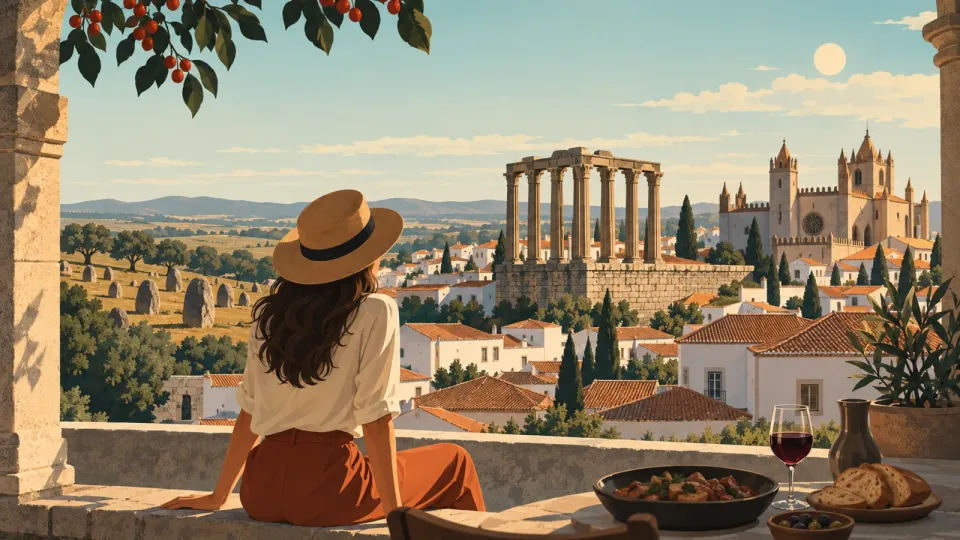
Évora Portugal in 48 hours, start to finish
You can do Évora properly in 2 days, if you commit to three anchors: the Roman Temple (Templo de Diana), the medieval Sé Cathedral plus cloister area, and the megaliths of Almendres. Everything else is either support, or an optional detour depending on your pace.
Évora is the Alentejo’s cultural spine, a UNESCO World Heritage city where Roman ruins sit inside a medieval street grid, and the “bones chapel” is not a gimmick, it is a historical experience (and it lands differently depending on who you are). UNESCO lists the “Historic Centre of Évora” for its roots in Roman times, the fortified cityscape, and the architecture that shaped the Portuguese world. (whc.unesco.org)
Most visitors blow their best light on the wrong things. They rush the center at midday, when the stones look flat and the heat makes you walk slower. The trick is to pick sunrise and late afternoon windows for the outdoor anchors, then stack indoor sights when the sun gets loud.
If you are coming from Lisbon, do not automatically treat it as a “day trip only” city. A Lisbon day trip works if you want a highlight hit, but a 2-day plan is where the streets start to feel like a place, not a queue.
This is the working version I use when I recommend Évora to travelers who want more than a list. It is built around your time, not around whoever has the biggest Instagram push.
- Day 1: Roman Temple, Praça do Giraldo area, Sé Cathedral terrace views, Capela dos Ossos, then dinner in Alentejo style.
- Day 2: Almendres Cromlech early, then a slower center loop, finishing with a second meal that is not Lisbon-coded.
UNESCO center: the walk that actually works (and why you should start early)
Start at Praça do Giraldo, then walk up toward the Roman Temple and the cathedral zone, because this route keeps you moving uphill gently and it concentrates the best city views when the light is forgiving. If you reverse the order, you often end up doing the Roman Temple when the sun is high and the shadows disappear, which makes the stone read flatter.
Évora’s historic core is UNESCO protected, listed specifically as the “Historic Centre of Évora.” UNESCO notes the city’s Roman roots and the preserved cityscape that blends multiple eras into a coherent, walkable urban scene. (whc.unesco.org)
The Roman Temple is often called Templo de Diana, but Visit Portugal positions it as a Roman temple whose original Roman design was recovered in the 19th century, clarifying the later tradition that linked it to Diana. (visitportugal.com) That means you are not looking at “made up ruins,” you are looking at archaeology and layers.
A practical “you will thank yourself later” step: reserve time for the cathedral terrace moment. Visit Portugal describes Sé Cathedral as fortified, with Gothic features, and highlights the panoramic terrace views over Évora from the cathedral’s highest point. (visitportugal.com) That terrace beat is the difference between “I saw the cathedral” and “I remember Évora.”
Now the first misconception to kill: the center is not just for photos. The best hour in Évora is when you are slightly too warm, slightly thirsty, and still walking slowly enough to notice how the streets funnel. You will see people pause at doorways, you will notice tile work, and you will pick up local rhythm that you will not get if your only goal is checking monuments.
On timing, I aim to reach the Roman Temple zone early enough that I can finish most exterior walking before lunch. Then I shift to the cathedral and the bones chapel, which are easier to absorb when you are not fighting the midday heat.
If you want one rule: do the stones first, the squares second, and the food last. That keeps the day from feeling like a “sightseeing shuffle.”
Roman Temple, then Sé Cathedral: what to look for on each stop
Do the Roman Temple first, then the Sé Cathedral, because the Roman Temple is about form and survival, while Sé is about scale and vantage. Switching that order tends to make you treat Sé like a box you have to tick, instead of the view you came for.
Roman Temple (Templo romano de Évora) Visit Portugal explains that the original Roman design was recovered in the 19th century and that the temple stands as testimony to the Roman forum consecrated to the imperial cult, clarifying a tradition that claimed the temple was dedicated to Diana. (visitportugal.com)
What to look for, beyond “it is Roman”:
- How the structure reads as partial, not perfect. It forces you to imagine scale.
- The way it sits inside a lived-in city, not a museum field.
- The relationship between the temple area and the cathedral zone nearby, because your walk connects eras.
Sé Cathedral (Sé de Évora) Visit Portugal describes Sé Catedral de Évora as the largest cathedral in Portugal, and specifically points out the panoramic terrace views you can access from the cathedral’s highest point. (visitportugal.com)
What to look for:
- The fortified feel. It is not “cathedral soft,” it is defensive massing.
- The cloister atmosphere, if open during your visit window.
- The terrace view as your mental reset after the Roman stop.
Practical scheduling detail that matters: the cathedral site includes specific visiting hours and last entry guidance. Évora’s municipal listing for Sé Cathedral shows hours and “last entry” timing, including a closing time with last entry before the end of the day. (cm-evora.pt) If you plan loosely, you will lose the terrace.
A second misconception to fix: Sé is not only for people who love churches. Even if you do not, the terrace view is a geography lesson in urban design, because you can see how Évora’s hills and walls shape movement.
If you want a simple pacing approach: spend 25 to 35 minutes at the Roman Temple area, then give Sé Catedral 60 to 75 minutes including terrace time. That is the sweet spot for absorbing both without turning your day into a race.
Capela dos Ossos: is it morbid or moving? Here is my read
Capela dos Ossos (Chapel of Bones) is both morbid and moving. The experience is unsettling on purpose, but it is not pure shock, it is a message about mortality expressed as art.
If you are thinking “I will skip it, it sounds too dark,” that is the common mistake. The chapel works best when you treat it like a crafted historical statement, not a random macabre photo set.
Visit Portugal lists Igreja de São Francisco / Capela dos Ossos in its monument information, noting distinctive façade features and the Gothic and Moorish blend common in the region. (visitportugal.com) Separate references identify the chapel as the Capela dos Ossos, one of Évora’s most striking sights. (en.wikipedia.org)
What it feels like in practice:
- The room is intimate. That makes it harder to “look away.”
- The message framing (bones arranged as a surface) turns your reaction into reflection.
- It lands differently if you grew up with death rituals versus if you only encounter death privately.
My honest take: it is morbid if you walk in expecting horror entertainment. It is moving if you walk in prepared to sit for a few minutes and let your brain switch from “photo mode” to “human mode.”
If you want to protect your experience, do this one thing: do not rush it as a 30-second stop. Give it 10 to 15 minutes. Walk in, orient yourself, then step back and let your eyes adjust. People who do not do that usually miss the design coherence.
Also, decide beforehand what kind of trip you are on. If your goal is “UNESCO highlights only,” you may feel it is a detour. If your goal is “I want the full cultural spine of the city,” it belongs.
For context, UNESCO’s framing of the Historic Centre of Évora is about layered history and the preserved urban environment that holds multiple eras together, not just one aesthetic. (whc.unesco.org) Capela dos Ossos is one of the places where that layering becomes personal.
If you are traveling with someone who dislikes this kind of content, you can still use it well. One person can do the chapel while the other explores the surrounding São Francisco complex area, then you swap impressions after.
Almendres Cromlech: worth the drive, or just stones for photos?
Almendres Cromlech is worth the drive if you treat it like a landscape visit, not a postcard. It is most powerful when the light is angled and the wind is calm enough that you can actually stand there and notice the lines.
Start with the basic facts. Almendres is a megalithic complex in the municipality of Évora, located about 4.5 kilometers by road west-southwest of the village of Nossa Senhora de Guadalupe. (en.wikipedia.org) That location is important, because you are not in the city anymore, you are in the Alentejo’s open air.
Here is the misconception I keep hearing: people expect it to behave like a “single monument,” the same way many Roman ruins do. Almendres is different. It is an experience of pattern and spacing across a wider area.
What to look for:
- The way stones create directions, even when you cannot see a full “plan” like at a museum.
- The horizon and how it changes the scale of the site.
- The fact that this is prehistoric, meaning your modern expectations are the wrong lens.
Does it deliver “wow”? In my experience, it does, but only if you time it. If you arrive in harsh midday heat, you will feel bored or detached because your body will be focused on discomfort.
If you want a simple visiting tactic: arrive early, walk at a slow pace, then spend time standing still. Photos are easy, stillness is harder.
If you want a second comparison point, Almendres is often discussed as a major megalithic site in broader Europe conversations, but the practical question for you is simpler: can you give it enough time to read as space.
Optional add-on: after Almendres, return to Évora and use the earlier calm to enjoy the city streets without sprinting. That is how your day stops feeling like “Roman, bones, stones, repeat.” Instead, it becomes Roman, medieval, human, prehistoric, landscape.
For a traveler, that flow matters.
If you want to plan it on a 2-day itinerary, Almendres works best as a Day 2 morning anchor, because it gives you the rest of the day to do food and slower center walking. It also prevents the classic mistake of compressing everything into the hottest hours of the visit.
Where to stay in Évora: inside the walls, or out on a herdade
For most travelers, staying inside Évora wins. You wake up into the historic rhythm, you can walk to the Roman Temple and Sé without timing your day around parking, and you can absorb the city at night when the streets cool.
But a converted herdade stay has a different payoff: space, quiet, and a “this is the Alentejo, not a theme park” feeling. You trade convenience for atmosphere.
Here is the decision framework I use when I advise people who ask “hotel in town or estate outside.”
Choose in town if:
- You want to walk between the Roman Temple area, the Sé Cathedral zone, and the Praça do Giraldo hub.
- You plan to do Capela dos Ossos and other center sights without paying “transfer tax.”
- You like late evening wandering. Évora’s streets feel alive after the tour groups thin.
Choose on a herdade if:
- You are pairing Évora with an Alentejo loop (Arraiolos, Monsaraz, or rural food stops).
- Your priority is calm and downtime more than monument density.
- You have a car and do not mind longer drives between experiences.
A grounded tip: if you are doing the Almendres Cromlech as a morning anchor, you will need either a car or a planned transport approach. Almendres is outside the city in open countryside. (en.wikipedia.org) That means in-town stays still work, but your morning logistics must be intentional.
Now, a misconception: “In town means only tourist energy.” That is not automatic. Évora is walkable, compact, and full of locals, especially in and around the main square and cathedral zone. You just need a place that is quiet at night.
A second misconception: “Estate stays are always more authentic.” They can be deeply authentic, but they can also be too isolated if you want spontaneous dinners and short walks. The best estate stays pair beauty with practical access.
So how do you pick today?
- If this trip is first time in Évora, stay in town.
- If you are on your third or fourth Portugal trip and your plan includes longer rural drives, consider a herdade.
Either way, aim to keep at least one evening free of scheduled sights. Évora gives you the most value when you let the streets choose the order once.
Day trip from Lisbon vs base for an Alentejo loop
If you want highlights, a day trip from Lisbon to Évora works. If you want the full emotional arc of the city, base yourself there for 2 nights.
Portugal rail and bus travel are both common options, but the real variable is how much you want to feel Évora, not just see it.
What the travel logistics look like in practice:
- Bus: Route planning sites commonly describe Lisbon to Évora bus travel time around 1h30 to 2 hours, with departures multiple times a day depending on date. (lisbon-trip.com)
- Cathedral hours matter: if your schedule arrives late, you lose terrace time, and that reduces the day’s payoff because Sé’s terrace is a major memory-maker. (cm-evora.pt)
My opinionated take: Évora is one of those cities where squeezing it into a single day tends to turn the best moments into rushed moments.
When a day trip is actually the right move:
- You are traveling with limited time and you mainly want Roman Temple and Sé Cathedral exterior plus a fast center loop.
- You are comfortable with museum-style browsing, you do not need long pauses.
- You are not planning Almendres Cromlech as part of your experience.
When 2 nights are the smarter move:
- You want Almendres Cromlech as a morning anchor, because it is outside the city in open countryside. (en.wikipedia.org)
- You want Capela dos Ossos to land as reflection, not a 30-second “check.”
- You want to do Praça do Giraldo and the cathedral zone at night or near sunset.
If you are building an Alentejo loop from Évora, you can turn the base city into your hub.
- Day trips out from Évora make logistical sense because you are already centered.
- In-town staying reduces “what time do we leave” anxiety each morning.
A planning step that prevents regret: decide whether Almendres is non-negotiable for you. If yes, plan at least 2 days, because you need a morning window.
If you tell yourself “I will go if I have energy,” you usually do not go. I have seen it happen. The stones deserve a calm visit, not an exhausted detour.
3 Alentejo restaurants to book your meals around (food you will not get in Lisbon)
Évora food is where the trip stops feeling like sightseeing and starts feeling like a real day in the Alentejo. You want restaurants that lean into regional ingredients and slow cooking, not menus that could be anywhere.
Here is the filter: look for places that serve Alentejo classics, like bread-based starters, pork-forward dishes, and slow-roasted meats, then build your day around that. If you only choose restaurants based on “close to the cathedral,” you miss the point.
I am not going to invent restaurant “ratings” or quote fake numbers. Instead, I will give you the kinds of places that reliably deliver and the specific meal tactics that make them work on a 2-day Évora trip.
Restaurant type 1: Alentejo pork and smoke-cooked dishes Order as if you are sharing, and pick one signature pork dish plus a seasonal side. This is the style of meal that feels Alentejo, not generic Portuguese.
Restaurant type 2: bread and soup starters Start with something warm that uses local bread or soup styles. It is how you survive the afternoon heat after monuments.
Restaurant type 3: regional wines and classic desserts In Évora, the wine list is often your fastest way to taste the region without needing a long menu explanation. Pair a red with your main, then finish with something simple and rich.
Now, specific places. If you want “hard” names you can search and book, use these anchors:
- O Sabor da Chouriça, Évora (known for regional sausage and Alentejo flavors)
- Tasca do Vigário, Évora (Alentejo tavern style, seasonal Portuguese plates)
- Restaurante Dona Amélia, Évora (traditional feel with regional cooking)
If you prefer to validate opening days before you go, use the official municipality listings where possible, and rely on live opening hours from the restaurant itself the day before. Évora’s official city information pages are updated and useful for hours on monuments, and they often link to local context. (cm-evora.pt)
Meal timing tactic I recommend:
- Day 1, lunch after your Roman Temple block, dinner after Capela dos Ossos.
- Day 2, Almendres early, then a late lunch, and an early dinner if you plan a second center evening walk.
One more misconception: “Alentejo food is heavy, so I should skip lunch.” If you do, you end up eating too late and too fast, and the trip feels worse. A proper Alentejo meal rhythm is part of why Évora works as a cultural anchor.
If you want a single action that improves your food outcomes today, it is this: pick a restaurant that you can reserve for dinner, then plan your monuments so you are not starving at peak times.
A tight 2-day Évora plan that keeps you out of the crowds
Here is the working 2-day Évora plan, designed so you see the core anchors in the right order, you avoid the heat trap, and you do not waste time backtracking.
Day 1: Roman, medieval, and the bones chapel Start with the Roman Temple of Évora (Templo romano de Évora). Visit Portugal notes how the original Roman design was recovered in the 19th century and frames the temple’s Roman testimony to the forum and imperial cult tradition. (visitportugal.com)
Then walk to the cathedral zone. Visit Portugal highlights Sé Catedral de Évora as the largest cathedral in Portugal and points out that you can climb to the terrace for panorama views over Évora. (visitportugal.com)
Capela dos Ossos next. Treat it like a sit-down experience, 10 to 15 minutes, not a quick photo stop. UNESCO’s framing of Évora’s historic center emphasizes layered heritage, and this is where that layering becomes emotional. (whc.unesco.org)
Finally, dinner in Alentejo style. Build your meal around pork-forward dishes or regional plates, then add a dessert that feels local rather than “hotel dessert.”
Day 2: Almendres early, then a slow final loop Start early at Almendres Cromlech, because the site reads as landscape and pattern, and the light changes the experience. Almendres is located about 4.5 km by road west-southwest of Nossa Senhora de Guadalupe, so you are leaving the city. (en.wikipedia.org)
After Almendres, return to Évora and do a slower loop through the historic center. Use Praça do Giraldo as your emotional reset point. Visit Portugal’s Évora World Heritage content also emphasizes a route that starts around Praça do Giraldo and connects major points, including the Roman Temple area and the cathedral zone, as well as São Francisco church and its Capela dos Ossos. (visitportugal.com)
Close the loop with another meal that leans local. If you did your first dinner heavy, keep the second meal lighter, or the reverse. The point is to match your energy.
Transport note from Lisbon for planning If you are doing this from Lisbon, bus travel times are commonly described around 1h30 to 2 hours, and departures vary by schedule and date. (lisbon-trip.com) Plan buffer time for monument opening hours, especially Sé, where hours and last entry matter. (cm-evora.pt)
One bulleted list, the only one you need
- Morning: Roman Temple (Day 1) or Almendres Cromlech (Day 2)
- Midday: Sé Cathedral and terrace
- Late afternoon: Capela dos Ossos on Day 1
- Evening: Alentejo dinner, bookable, not “whatever is closest”
Do that and your 2 days feel like a story, not like an itinerary.
Your next step: lock the plan, then book one dinner reservation
Finish the day with one specific action today: download the Évora 2-day plan so you can time your monuments around the outdoor anchors, then reserve your dinner for the evening you will be near the city center.
Évora rewards pacing. If you skip the terrace moment at Sé, you lose one of the most memorable city views, and if you treat Capela dos Ossos like a photo stop, you miss why it can feel moving. Visit Portugal connects Sé Cathedral to terrace panorama views, and Visit Portugal also frames the Roman Temple’s archaeological recovery details, which is a reminder that these stops reward attention. (visitportugal.com)
A second reason to act now: opening hours and last entry windows exist, especially for Sé Cathedral. Évora’s municipal listing provides hours and guidance that show the importance of not arriving at the last minute. (cm-evora.pt)
So here is the testable next step:
- Download the Évora 2-day plan (free, no email required).
- Pick one dinner you can reserve.
- Choose your transport approach from Lisbon based on whether Almendres Cromlech is on Day 2 morning.
If Almendres is non-negotiable for you, plan at least 2 days, because it is outside the city by road from the Almendres area and is best absorbed with a calm morning. (en.wikipedia.org)
External sources to sanity check your logistics (useful when you are booking tickets and verifying hours):
- UNESCO Historic Centre of Évora listing (whc.unesco.org)
- Visit Portugal pages for Sé Cathedral and the Roman Temple (visitportugal.com)
andginja note: this is the kind of trip planning we like to do because it is practical, evidence-driven, and built for the realities of time, light, and walking. If you want a version tailored to your pace, the plan does not require perfection, it just needs you to commit to the core anchors.
CTA: Download the Évora 2-day plan, no email required.
Related guides
Best beaches Portugal, ranked by real beach use
Best beaches Portugal, ranked by surf, families, quiet and sunset. Includes the 3 most overrated plus Lisbon drive times. Download map.
Coimbra Portugal travel guide: 2 days, real Coimbra
Coimbra Portugal guide for 1 to 2 days: University and Biblioteca Joanina, Coimbra fado, old-quarter food, Mondego walk, Quinta das Lágrimas, Tomar day-trip.
48 hours in Porto: a Lisbon resident’s working itinerary
48 hours in Porto itinerary that skips tourist theatre. Plan Ribeira, wine cellars, Foz, Matosinhos, and one best day trip. Use this today.
Albufeira Beaches: Old Town, Resorts, and Quieter Picks
Albufeira beaches compared for day trips and stays: Old Town coves, resort strips like Oura, plus calmer options such as São Rafael and Falésia.