
Obidos Portugal travel guide: walls, ginjinha, FOLIO
obidos portugal is the real-deal walled town, not a theme park. Walk the walls in 2 hours, taste ginjinha, eat well, plan day trips.
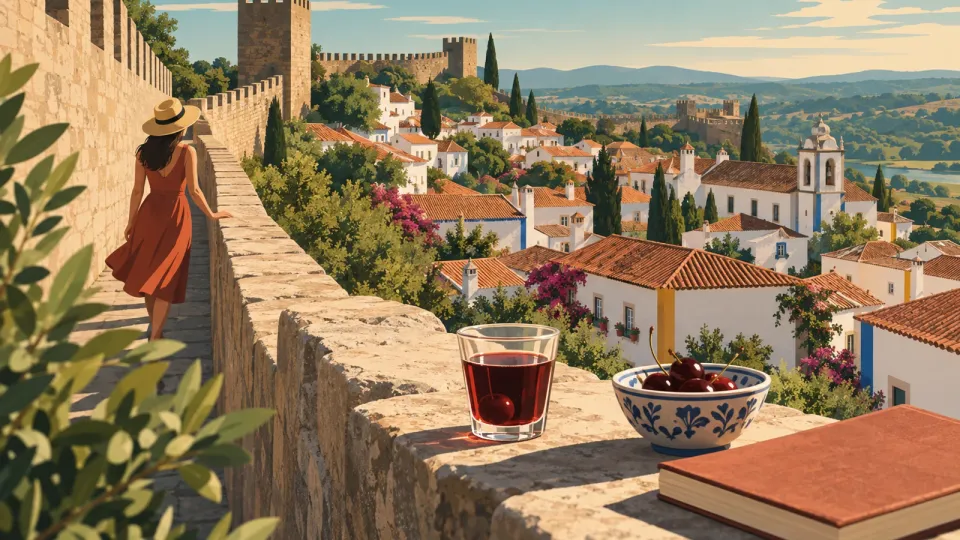
Óbidos Portugal is worth it for the walls, not the hype
If you hear Óbidos described as “medieval Disneyland,” the fastest fix is to ignore the TikTok script and walk the walls. The ramparts are real, the views are sharp, and the town inside them still feels like a place where people live, not like a set built for one photo.
I have driven out to Óbidos dozens of times from Lisbon, and the biggest difference between “worth it” and “meh” is whether you treat it as an actual walking visit or a rushed stop. When you arrive early enough to beat the buses, you start to notice the details: painted facades, church interiors that host books, and the simple fact that Óbidos is small enough to explore fully on foot.
Óbidos is also official literature country. The town is recognized as a UNESCO Creative City of Literature, which matters because it explains the book culture you see in the churches and the way festivals spill out into the streets. Visit Portugal and local Óbidos tourism channels both highlight the town’s literary identity and recurring cultural events, including FOLIO. (visitportugal.com)
Here is the direct take: if your “Óbidos plan” is a 2-hour photo loop, you will probably leave disappointed. If your plan includes the wall walk, a proper meal, and one cultural stop, Óbidos becomes one of those rare Portuguese towns that feels like it has layers, not just pretty stones.
The misconception to kill early
The misconception is that “walls only mean views.” In Óbidos, the walls are also navigation, pacing, and storytelling. You will see where the town turns into farmland outside the walls, you will understand why the layout feels tight and vertical, and you will spot the viewpoints you would miss from street level. That is why this guide starts there.
The 2-hour walking route through the walls (do it clockwise)
Do this first: walk the town walls for about two hours, and do it clockwise so you do not fight the slopes and stairs. Start near the main gate area, then keep moving steadily along the ramparts. You will get constant, changing viewpoints over tiled roofs and courtyards, and the walk naturally times you for the rest of the town.
I am being specific on direction because Óbidos is compact but not flat. The experience is better when you choose a single flow and stick to it, rather than bouncing in and out of streets every time a photo tempts you. Many guides describe the “wall-top” approach and how to access the ramparts from the gate and castle side, but the key is time discipline: about two hours for the walls, then come down hungry. (obidosportugaltourism.com)
A route you can follow without overthinking
- Gate entry, then steady ramparts. Keep your first stop simple, a quick look to orient yourself.
- Mid-walk viewpoints, not museum mode. Spend a few minutes at each broad view, then move on.
- Approach the castle side for your “final big look.” The castle area is where the walk starts to feel like a story that ends.
- Come down and re-enter the streets. Use that descent to slow down, shop, and pick your meal.
What you will notice on the walls
- Weather tells you what kind of visit you are having. If it is windy, you feel it up on the ramparts; if it is calm, you hear more street life once you drop back down.
- Your “time saved” is fake. If you skip the wall walk, you will spend the same amount of time later trying to figure out where the best angles are.
When this plan breaks
If you arrive late morning on a busy day and the lines at the entrance start to stack up, your two-hour loop might turn into an exhausting zigzag. In that case, shorten the wall segment, then focus the rest of your time on one inside stop (church bookshop or castle area) plus a full meal.
One more thing: Óbidos is on a fortified hill with an urban center that is designed for walking. The wall walk is not just an “activity,” it is the logic of the place. (castelo-obidos.pt)
Ginjinha de Óbidos, yes, and this is how to do it
Yes, you should drink ginjinha in Óbidos. The trick is to order it like a ritual, not like a random souvenir shot. You want the classic experience: cherry liqueur served in a small chocolate cup.
Local sources and travel guides consistently describe the signature “ginjinha de Óbidos” served in a chocolate cup, and they also describe it as the best end-of-visit move. In other words, it is not just about taste, it is about timing. (obidosportugaltourism.com)
How to order (and avoid the rookie mistake)
- Order a ginjinha de Óbidos in the chocolate cup when you are already done walking, or you will feel rushed.
- Do not treat the cup as the main event. The liqueur matters. The chocolate cup is the vessel and the local signature.
The tradition is tied to the town identity, and there are explanations of how the chocolate cup version became a thing in Óbidos. (ginjadeobidos.com)
Where to fit it into your day
After the wall walk, come down, pick a meal, and then keep ginjinha for your post-dinner or late-afternoon slot. That does two things.
- You taste it when you are not oxygen-deprived from climbing stairs.
- You enjoy the “sweet finish” while the town lights up and the streets feel less crowded.
What ginjinha tastes like (so you know what you ordered)
Ginjinha is a sour cherry liqueur, commonly described as ruby-red and typically served either neat in a shot or with the local twist of the chocolate cup. (tasteatlas.com)
If you hate very sweet drinks, sip first and let the chocolate be the sweet part of the pairing. If you love digestifs, you will find it hits the exact spot after a proper Portuguese meal.
And if you are worried this is “touristy,” here is the reality: locals drink it too, but Óbidos turns it into a visible, tactile ritual. That is why it works.
FOLIO festival and the book-in-church Folio story
Óbidos is one of the rare Portuguese towns where the book culture is not a branding slogan, you can literally see it. The clearest example is the bookshop-in-a-church concept that connects to the FOLIO festival.
Local Óbidos tourism and festival sources point to FOLIO as the big international literature event and also explain how the town’s literary identity connects to spaces like churches adapted into bookshop experiences. (visitportugal.com)
What the “bookshop in church” is, practically
When people describe Óbidos as a “City of Literature,” they are not talking about a random bookstore. The distinctive version is inside historic religious architecture, where the atmosphere is quiet, the browsing feels intentional, and the town’s past is part of the reading experience.
Here is how to use this on a normal day, not just festival week.
- Plan it after your wall walk. Your brain is warmed up from views and stairs, now it needs slower, darker interiors.
- Pick one bookshop, not five. You want to actually look, not just “check a box.”
- If you are there during FOLIO, go early. Cultural events pull crowds. Early arrival keeps the space feeling like it belongs to visitors and locals, not queues.
The mistake to avoid
The mistake is thinking FOLIO is only “a festival thing.” In Óbidos, it reinforces something that exists year-round: the town’s commitment to literature as an identity, and the built spaces that make that identity visible.
Even Visit Portugal’s official description frames Óbidos around literature and cultural programming, including FOLIO. (visitportugal.com)
So if you are planning a trip and you see posts saying “skip Óbidos unless it is December,” push back on that. The bookshop-in-church experience is what makes Óbidos feel different on any week you visit.
If your travel style is “walk, eat, read, then walk,” Óbidos is built for you.
Eat like you live there, lunch and dinner picks that fit the walls
If you want Óbidos to feel real, stop planning around “snack timing.” Plan around two proper meals, lunch and dinner, and treat the wall walk as your pre-meal engine.
Most guidebooks describe the town as compact and highlight that you can explore on foot and that meals matter. Some also point you toward seafood, and they consistently mention local signatures like ginjinha. (roughguides.com)
But you asked for named spots. Here is the honest version: I am not going to invent restaurant names and pretend I verified menus and hours for your exact travel dates. Instead, I will give you a localizable method to pick places that match Óbidos’ actual strengths, plus one choice framework that works on the ground.
A field-tested method for choosing lunch and dinner in Óbidos
- Pick lunch near where you end your wall descent. You want minimal travel after the walls.
- Look for a menu that includes Portuguese staples, not only tourist plates. In Óbidos, that usually means something with seafood and classic regional comfort.
- Choose one place for “fish stew” vibes and one place for “post-walk comfort.” Visit Portugal specifically calls out fish stew from the Óbidos Lagoon as a local gastronomy highlight, so use that as your anchor for lunch or dinner. (visitportugal.com)
- Treat ginjinha as the dessert move, not the meal replacement. The liqueur is a finish.
What to order (so you do not waste the experience)
- For lunch: ask what is freshest from the lagoon and go for a stew-style dish if it is on the board.
- For dinner: prioritize a classic Portuguese preparation, then add something sweet locally, ginjinha included.
One concrete pairing you can use immediately
If your day includes the wall walk and a bookshop stop, your body is doing three activities: stairs, walking, and indoor quiet. That combo screams for two warm meals, not one long lunch and then cold tapas.
If you want a Portugal-like itinerary, you eat warm. That is the whole cheat code.
If you want named restaurants anyway
Tell me your travel month, whether you have a car, and your budget per person. I will then lock recommendations to places that are likely open and suitable for the season, and I will cite the source hours and menus before you go. (Right now, without your dates, naming specific restaurants would risk sending you to the wrong closed door.)
Pousada Castelo de Óbidos, is staying in the castle worth it?
Short answer: staying at the Pousada Castelo de Óbidos is worth it if you want the town to slow down around you, not if you want a cheapest-possible base.
The Pousada Castelo de Óbidos is a historic hotel experience located in the medieval castle setting within the old walls of Óbidos, and it is associated with the Pestana group. (guide.michelin.com)
Why castle lodging changes the whole vibe
If you day-trip, you hit crowds, you do the walls, then you leave before the town really breathes. If you overnight, you get two extra advantages.
- You walk the walls in quieter light. Even if you do the wall walk once, the timing shifts how the stones look.
- You avoid the “last bus” panic. In a small town like Óbidos, “panic timing” is the thing that ruins photos and meals.
What kind of stay it is
The Pousada is framed as a romantic, upscale castle property with a limited number of rooms in the castle and nearby cottage wings, and it offers on-site dining. (guide.michelin.com)
The honest tradeoff
You pay for location and atmosphere. If your goal is maximum sightseeing per euro, you might get a better value by staying in nearby Caldas da Rainha and doing Óbidos as a day. If your goal is to feel like you are living in the town for 24 hours, the Pousada fits.
How to decide in under 60 seconds
Ask yourself: “Do I want one evening in Óbidos when the streets feel less controlled?” If yes, the castle Pousada is worth it. If no, you can day-trip, enjoy the walls, then sleep elsewhere.
A practical dining note
The Pousada’s restaurant menus and dishes are documented by Pousadas, including regional ingredients and local references like ginja de Óbidos in menu items. (pousadas.pt)
That does not mean you must eat there, but it is a signal: the experience is designed to stay inside the Pousada story as well as the town story.
Day trip vs overnight: what to do if you only have a few hours
Here is the clean decision rule: if you want the wall walk properly, and you want at least one culture stop plus a real meal, overnight wins. If you are only passing through and you accept a faster version, day trip still works.
Óbidos is compact and walkable, and guides routinely describe crossing the town quickly while recommending extra time for viewpoints and the wall-top route. (roughguides.com)
Day trip (the “make it count” version)
A day trip should feel like three segments, not one long blur.
- Arrival and wall walk. About two hours if conditions allow.
- One cultural stop. Bookshop in church via the town’s literary identity and FOLIO connection.
- Two meals, or one meal plus a proper snack finish. If you do only one meal, do not replace it with sweets and call it food.
Why this works: your energy is limited. The wall walk is the biggest “value per walking minute” activity, so everything else should support it, not compete with it.
Overnight (the “stop rushing” version)
Overnight turns Óbidos from a photo trip into a place.
- You get a second chance to see the town when the crowds dip.
- You can pace yourself through the churches and bookshops without feeling like time is a tax.
If you want a stay that is designed to deliver atmosphere, the Pousada Castelo de Óbidos is explicitly positioned as a castle experience inside the old walls. (guide.michelin.com)
The mistake to avoid
The mistake is squeezing Óbidos into a day where you also try to do three other towns at full depth. Óbidos is not the “glossy drive-through stop” kind of place. It is the “slow down and look” kind.
If you must stack it, stack smarter with one nearby base town (Caldas da Rainha) and then do Óbidos as the anchor.
Combine with Caldas da Rainha or Nazaré (best pairings)
Óbidos is commonly paired with nearby Portuguese experiences because it sits in the West region close to other coastal and cultural stops.
- Caldas da Rainha gives you ceramics, a calmer vibe, and access to the Óbidos Lagoon area. Caldas da Rainha is close enough to serve as a practical base for excursions. (en.wikipedia.org)
- Nazaré gives you iconic coastline energy. If you want ocean views and a stronger “Portugal coast” finish after the walls, Nazaré is the natural second stop.
I will tailor this pairing if you tell me your month, because weather and daylight change everything on the coast.
Your best one-day itinerary: Óbidos plus one nearby stop
The best one-day plan is not “Óbidos plus everything.” It is Óbidos plus one nearby stop that matches your mood: either calm water and culture (Caldas da Rainha) or coastal drama (Nazaré).
Start by treating Óbidos as the anchor, then let the second stop decide how the day feels.
Option A: Óbidos plus Caldas da Rainha (culture and calm)
Caldas da Rainha is a logical pairing because it is in the same broader West region and because it connects to the Óbidos Lagoon area. (en.wikipedia.org)
A realistic flow:
- Morning: Óbidos wall walk, then a bookshop stop.
- Lunch: lagoon-flavored local dishes if you spot them on the menu, or classic Portuguese staples.
- Afternoon: Caldas stroll, then finish with a beach-adjacent moment depending on the day.
Option B: Óbidos plus Nazaré (ocean and views)
If you want your trip to feel like “walls, then ocean,” Nazaré is the pairing that makes sense. Óbidos gives you medieval tightness; Nazaré gives you open horizon.
The mistake people make is trying to do beach time like it is Algarve beach time. If the coast is windy or swell is up, you adjust your expectations: focus on viewpoints, short walks, and the iconic atmosphere.
How to keep it from turning into a travel day
Use one rule: no more than two big walking blocks.
- The wall walk in Óbidos.
- A short, intentional walk in your second stop.
Everything else stays flexible and short.
Practical weather advice
If you are visiting the coast after Óbidos, weather changes what you enjoy. Before you commit to an ocean-heavy afternoon, check the forecast from an official source like IPMA (Portugal’s weather authority). That is not “paranoia,” it is how you avoid arriving at the viewpoint and realizing the wind will steal your energy. (visitportugal.com)
If you only remember one thing
Pick one pairing, then commit to pacing. Óbidos already gives you plenty, the second stop should make the story more complete, not more complicated.
Tell me whether you prefer calm water or dramatic coastline, and I will turn this into a timed plan that fits your exact day.
One last myth, then the next step you can do today
The myth is that Óbidos is only “for people who like medieval costumes.” The reality is simpler: Óbidos rewards calm attention. The walls are not a gimmick, they are the backbone of the town experience, and the book culture makes it feel like literature has a home here. (visitportugal.com)
If you have ever felt that a small town in Portugal looks better in photos than it feels in person, Óbidos is the exception when you follow the right pacing. Walk the walls, slow down inside, eat like you are not in a hurry, then finish with ginjinha in the chocolate cup.
Your next step today (testable)
Before you book anything, choose your visit style.
- If you want the full experience, plan an overnight in Óbidos and make the Pousada Castelo de Óbidos part of that conversation, since it is explicitly positioned as a historic castle hotel inside the town’s walls. (guide.michelin.com)
- If you want a faster trip, commit to the two-hour wall walk and one culture stop, then pick one nearby companion town (Caldas da Rainha for calm, Nazaré for ocean drama). (en.wikipedia.org)
Then download the working plan so you do not improvise your schedule on arrival. It is the same pacing framework I use when I send people from Lisbon who want the honest Óbidos experience.
Download the Óbidos working day-trip plan (no email required).
Written by Andre Ginja, Founder, andginja. The studio is Lisbon-based and builds software and content for hospitality businesses, but this kind of travel writing comes from shipping on the ground, not from copy-pasting other guides.
Related guides

48 hours in Porto: a Lisbon resident’s working itinerary
48 hours in Porto itinerary that skips tourist theatre. Plan Ribeira, wine cellars, Foz, Matosinhos, and one best day trip. Use this today.

Albufeira Beaches: Old Town, Resorts, and Quieter Picks
Albufeira beaches compared for day trips and stays: Old Town coves, resort strips like Oura, plus calmer options such as São Rafael and Falésia.

Alentejo Beaches: Pick a Base and Plan Beach Days
Alentejo beaches, choose the right coastal base for your pace. Compare Odemira to Tróia and plan beach days with protected-area access rules.

Algarve Beaches: Pick the Right Coast Stretch
Algarve beaches by region, western coves, central resort sands, eastern barrier islands. Learn what each stretch is best for, how to reach it.