
Praia da Arrifana guide: surf, grilled fish, zero crowds
Praia da Arrifana guide to avoid Albufeira vibes, waves by month, cliff descent, where to eat grilled fish, parking, and whether to stay in Aljezur.
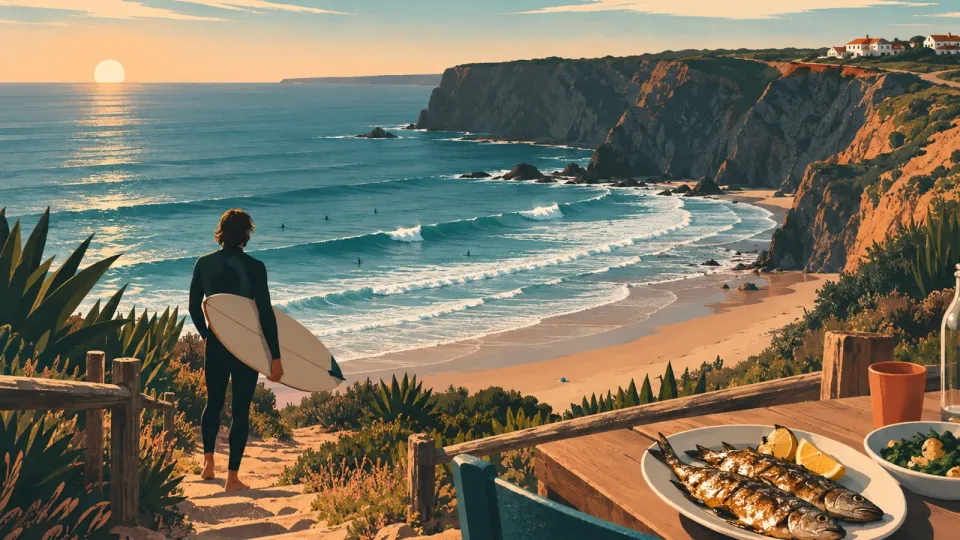
Praia da Arrifana: the best bet for surfing in the Algarve without crowds
If you want the Algarve “for real” and not the Albufeira strip, Praia da Arrifana in Aljezur is an easy, direct choice. It’s a sheltered bay with a surf and fishing feel, and the kind of Atlantic waves that separates “we paddled out” from “we’ll catch the next one.”
The most common mistake is thinking Arrifana is just like other southern beaches, only further away. It’s not. Arrifana is built on two things: exposure to the Atlantic, and a dramatic coastline layout with a real cliff face and genuine access limits. That pairing shapes your day, from what month you go to your parking plan.
And yes, Arrifana is in the municipality of Aljezur, in the far west of the Algarve, where the landscape starts to feel very much like the Costa Vicentina. There’s also a protected coastal-area framework involved, which helps explain why it never became one continuous concrete strip like so many parts of the Algarve. (If you want the official local reference through the Portuguese maritime authority, check the IPMA “Beaches” sheet for Arrifana.)
Here’s what you’ll be able to decide without improvising:
- Which month is more likely to bring beginner-friendly waves, and when it starts to get more demanding.
- Whether the cliff descent is “doable” with children, or an unnecessary risk.
- Where to eat grilled fish the right way after surfing, without falling into tourist traps.
- Whether it makes sense to sleep in Aljezur, or stay in Lagos and go back and forth.
When your priority is surfing and peace, Arrifana stops being “just a beach” and becomes a full plan. That’s exactly what most generic recommendations fail to say.
Arrifana waves by month: when it suits beginners and when it suits advanced surfers
The short answer is this: at Praia da Arrifana, your level and your tolerance for wind determine the best month more than your board choice. Arrifana gets Atlantic swell year-round, but the combination of height, period, and wind changes the “shape” of the waves.
To set expectations properly, I look at two signals at the same time:
-
Swell and wind models for the area, not “the Algarve in general.”
-
How the spot typically behaves when the swell is clean, and when side-on wind blows.
For part 1, you have a useful Portuguese source for sea state and swell monitoring from IPMA, including significant wave height forecasts. The IPMA also provides an API that explains how forecast data is delivered and how often it’s updated, which adds confidence in the numbers. In other words, you’re not relying purely on opinions, or purely on a blog.
For part 2, “spot reading” is what changes everything. Surfline, for example, has Arrifana-specific reports and forecasts and comments in surf language on how wave lines may require enough swell to “clean up,” and how intensity increases as the tide fills. What that means in practice is that the same month can be great for some surfers and frustrating for others, depending on the real setup of the day.
Season expectations (a quick rule of thumb, from a surfer’s perspective):
-
Spring (March to May): waves tend to be more consistent than February, but there are still “in-between” days (very windy, short period, or lots of foam). Good for progression, not automatically “easy.”
-
Summer (June to August): this is when Arrifana often loses some of its magic for people who want effortless surfing, because wind can cut the day short. It doesn’t mean there are no waves, it means your usable window is tighter.
-
Autumn (September to November): usually the best balance between Atlantic energy and days when wind drops off. For most surfers, it’s the time of year when Arrifana starts to feel like a real “local spot” again.
-
Winter (December to February): it can be very good, but it can also be a gamble of wind and impact. For beginners, it only makes sense if you have solid protection, patience, and proper awareness of tide, wind, and a safe exit.
An important note so you don’t get misled: good surf forecasting is more than wave height. The forecast needs to match both height and period, and wind needs to match direction and intensity. That’s why I recommend you don’t decide based on the “nice-looking” metres alone. Choose based on the coherence between swell and wind.
To wrap up the practical part, use this as your checklist before you go:
- If swell is there but the wind trend looks off, or you expect strong cross-off wind, plan a shorter session or switch to an alternative.
- If you’re going as a beginner, look for days where swell is present and the wind isn’t “scraping” the wave face.
If you want the best odds, the safest window is usually autumn and some spring windows, and your final decision is always “forecast + on-site observation.”
The cliff descent: is it really suitable for kids? A straight answer
The most honest question nobody asks before they go is: “Can we go down and back up this without stress, in the middle of fatigue, with a wetsuit in hand?” At Arrifana, the cliff descent is the part that most often turns a good day into a bad one.
There are two realities at the same time:
- Access is possible, but it requires attention to the terrain and the time you’ll spend dealing with the logistics.
- When your family shifts into “quick fatigue” mode, the descent stops being just a route and becomes a safety decision.
Most people treat Arrifana like “a beach with parking nearby.” In reality, you have to accept that the beach is a pocket with access limits. The good side is that it keeps the spot quieter and more authentic. The difficult side is that not everything at Arrifana is “pushchair and done.”
When I say it’s “doable,” I mean in real terms. With small children, the thing that usually fails isn’t the distance in metres. It’s the combination of wind, inattentive steps, and the fact that you’ll be going up and down multiple times.
So how do you decide without dramatizing it?
-
If your kids don’t yet have a steady rhythm on stairs and trails, assume it’s going to be a struggle. Bring shoes with good grip and plan an early exit.
-
If you’re thinking of staying at the top to make it easier, decide upfront on a “take it, surf, return” strategy. Don’t go in with the idea that you’ll keep descending and ascending throughout the day.
-
If family is your priority, I compare the effort with other areas of the Costa Vicentina where access is more direct. Arrifana is prettier, but it charges you in logistics.
One practical detail almost nobody considers, but it matters: gear. If your child needs everything set up for them (boogie boards, wetsuits, towels, extras), the added weight and repetition make the descent harder.
What to do on the ground to reduce risk:
- Arrive with margin. Getting to the top too close to the deadline creates rush, and rushing on trails doesn’t mix.
- Don’t underestimate the wind, at the top and along the path. Wind affects balance.
- Pick times when the light helps you see the ground. In October and November, daylight runs out sooner.
If your question is “is it for children?” I’d say it’s for kids who already bring autonomy and patience, and for adults who accept that the plan will be more “surf session” than a full day at the beach. If the child is still in “I don’t want to go down” mode, it might be better to consider another nearby beach with the same relaxed rhythm but less of an access barrier.
Where to get grilled fish for lunch, without drifting into the tourist side
Your lunch at Arrifana has to solve two things: it needs to taste good after surfing, and it shouldn’t offer “fish with urgency” just to fill a holiday day. There’s a real difference between what’s right at the cliff top, pretty for photos, and what’s in the village core, where it supports the local pace.
The typical mistake is looking for “the closest place to the beach” as if that automatically makes it the best option. In Arrifana, the closest choice can be more expensive and less satisfying, because you’re paying for convenience for passing visitors. When you want real grilled fish, convenience should be secondary.
Here’s the logic I recommend:
-
After the session, choose the lunch spot that keeps you on track for the return journey, not one that forces a big detour.
-
Look for the side that serves lunch on consistent hours for locals, not only for groups.
-
Avoid decisions based only on the smell of the grill, if the setup feels overly geared towards “pass-through tourism.”
Why do I say this with confidence? Because your day in Arrifana has its own rhythm. Swell drives the timing, tide and wind affect comfort in the water, and your appetite lands in a specific state: low energy, cold, or fatigue, and hunger for something that actually “fits” your body.
When logistics are well planned, the right lunch happens when:
- You’ve showered and regained warmth.
- You’re not rushing just to “see the sunset,” as if that alone justifies the trip.
Arrifana is a pocket beach within the Aljezur area, and there’s also the village ecosystem, shaped by visitors and fishing. Usually, the best move is to eat in the closest settlement area, not to insist on staying at cliff-top viewpoints purely for the scenery.
If you’re travelling by car, the trick is simple: think of your return journey as a straight line with one trusted lunch stop. It reduces wrong turn decisions at the last minute.
How to adjust if tide or wind delays you:
- If you stayed in the water longer than you wanted, pick a place that doesn’t depend on you eating early. Find somewhere where the kitchen can handle peaks.
- If you had a very cold session, warm up first. Then choose grilled fish. It’s not a gourmet meal, it’s recovery.
I’d rather have a consistent, local-feeling meal than something that’s “Instagram-worthy.” Arrifana doesn’t need more spectacle. It needs a break that leaves you ready for the next wave (or the next beach, if tomorrow you feel like a different spot).
Parking and access: where it makes sense to stop, at the top or down below
In Arrifana, parking isn’t only “where there’s space.” It’s “how much work you’re carrying, literally,” between the car and your session. The difference between parking at the top and parking closer to the descent changes your whole day.
Most people arrive and assume they’ll somehow find the ideal point, as if you were in an urban beach car park. Not here. The top spot is usually more obvious, but it’s also more prone to filling up and to last-minute decision making.
Without inventing anything, here’s the practical rule:
- If you want to reduce walking and carrying, try to park as close as possible to the access point that lets you descend with less repetition.
- If there’s no space nearby, your plan has to change. It’s not “insist until miracles happen.” Decide early whether you’re going for a short session, or giving Arrifana a pass and going tomorrow.
By car, access to beaches in the area is via roads to landmark points, and Arrifana follows that same pattern of following signs towards Vale da Telha and similar routes. There are route descriptions for arriving via Vale da Telha, and that lines up with the reality for travellers coming from Lagos to the north and then entering the Aljezur axis.
So what does that look like on the day?
-
Arrive early if you truly want Arrifana. Midday hours turn everything into a negotiation with space.
-
If you get a day with serious wind and swell, you’ll want more control and less rushing. Rushing logistics on the cliff is where problems start.
-
Don’t plan your session as “I’ll just go look at the water.” If you descend, you need to be ready to stay long enough to justify the effort.
Parking in Arrifana is especially sensitive because the layout of the access is part of the spot. And when access gets tighter, the invisible cost shows up in your energy and your time.
What I’d do today if it were my first visit:
- First visit, park with margin, choose a point that lets you descend without rushing.
- Do a short session and evaluate, not only the waves but also the route.
- On the second day, you can adjust your “confidence point.”
If you’re going with a group and different levels, agree on this beforehand. A group that shares responsibilities, who brings towels, who handles kids, who sets the meeting point, protects the plan.
Final tip to avoid mistakes: if the wind at the top is strong and the sky is changing quickly, consider that the descent may feel worse than it did on the way back down. Wind on the path is the detail you only notice after you’re already down there.
Stay in Aljezur or do a day trip from Lagos: honest trade-offs
The honest answer is: stay in Aljezur if you want surf and peace on the same day. Do a day trip from Lagos only if you’re willing to accept two things, waking up early or running the logistics.
There’s a simple reason. Arrifana isn’t a “one hour stop.” Surf dictates the rhythm. If you plan an early start for a longer session, you’ll use the morning, and that affects lunch, the return journey, and your second plan of the day.
When you sleep in Aljezur, the decision stops being “go and come back” and becomes “I’m going for a session.” That matters a lot for anyone trying to avoid crowds. The calm of the morning, before people arrive in full force, is worth more than the difference of a few euros in accommodation.
When a day trip makes sense:
- You’re going in casual mode, without a strict commitment to being in the water at exact times.
- Your priority is simply to get close and experience it, not to control the swell.
- You’re comfortable reorganising your plan if the wind drops or picks up.
When it makes more sense to stay in Aljezur:
- You want to go twice a week, or do an end-of-day session.
- You want to explore more than Arrifana, for example other beaches in the area (Bordeira, Amoreira, Monte Clérigo). The whole region works best like a network, early mornings and returns without drama.
There’s another layer, psychological this time. Sleeping in the right place reduces friction. You stop thinking “I’ll miss the car” and start thinking “I’ll chase the next wave.”
To help you decide with some structure, without making up numbers, do this:
-
Calculate the extra cost of the extra night of accommodation.
-
Add up fuel, travel time, and the risk of missing the best part of the day because of parking and queues.
-
If your real surfing plan is at least two sessions over the trip, staying in Aljezur usually wins.
One more geographic context point worth repeating: Aljezur is part of the Costa Vicentina idea, and the municipality connects you to several beaches with very different identities. Praia da Arrifana is tied to the coastal pocket and local surf style, and that’s what makes staying in Aljezur feel more coherent in practical and emotional terms.
My final recommendation for your anti-Albufeira approach is simple: if your trip is 3 to 5 days and you want to surf calmly, stay in Aljezur. If you only have 1 to 2 days and you’re really tied to Lagos, do the day trip, but plan an early morning as the rule, not as a hopeful exception.
Best swell windows at Arrifana, with forecasting that respects your day
The best swell window at Arrifana isn’t only “when there are waves.” It’s when you get the right wave shape for your level, and wind doesn’t ruin the face. If you use forecasting only by wave height, you risk showing up to a flat or awkward day, or to impact you don’t want.
To choose with your head, I use a combination of two sources:
-
Portuguese forecasts for significant height and sea state base, via IPMA.
-
Spot reading and a dedicated surf forecast, via a surf service such as Surfline.
IPMA has maritime forecast pages and services that help you understand the base state of the ocean. Their “Significant Wave Height” pages are organised by area, giving you proper context. And if you’re using the IPMA API to integrate data, the API itself describes how data comes in and how frequently it’s updated, which helps you trust the model consistency.
Surfline, meanwhile, provides an Arrifana-specific report and forecast, with notes reflecting how swell behaves at the spot when it’s filling, or when it needs extra size to clean up the line. Those kinds of comments are gold, because they stop you from judging purely by scale.
Now, to turn this into useful decision windows, think in time ranges:
-
24 to 72 hours window: check swell direction and consistency, then confirm with expected wind. If the wind looks like it will turn against you, adjust your session.
-
Seasonal window (autumn and parts of spring, with extra attention to wind): when you’re inside the time of year when the Atlantic delivers energy and days are more stable, forecasts tend to be more usable.
-
Day window: even when swell is good, tide and timing change how the wave feels. A great session can still fail if you paddle in at the wrong moment.
Best practice, no magic:
-
The night before or early morning, open IPMA for the area to understand the general sea state (significant height and the trend).
-
Open Arrifana’s report and forecast on a dedicated surf service, and look for consistency between swell and wind.
-
If both point to a good window, go.
-
If swell is there but the wind seems aggressive, make a conscious choice: either a shorter session, or a different beach.
And here’s a reality few people say out loud: Arrifana is demanding with wind. If wind direction is wrong, the same swell that gives you long, clean walls on another day becomes a chaotic surface with foam.
One last practical detail to save time: when you head to Arrifana, build your session plan with margin. If your forecast misses, you need a Plan B, and a Plan B isn’t something you invent on the fly.
Your golden rule for getting it right at Arrifana is simple: bet on coherence between models (IPMA) and spot behaviour (Surfline). When both say “yes,” that’s when Arrifana truly delivers on the anti-Albufeira promise, and gives you real surf.
Anti-failure checklist for your day at Praia da Arrifana
If you want to leave Praia da Arrifana with that rare feeling of “it was worth the trip,” treat the day like a small operation. It doesn’t need to be complicated. It needs fewer wrong decisions.
Use this short checklist, tested mentally on the days when wind tried to take over the plan:
- Before leaving home, validate the sea forecast on IPMA (significant wave height and trend) and confirm Arrifana’s specific forecast on a surf service.
- Go early, because access and parking matter. Arriving late turns logistics into stress.
- Wear grippy footwear for the descent, and plan the return like you’re carrying extra time, because often you will.
- Decide your “day objective”: a short and honest session, or a full session. Mixing the two almost always ends badly.
- For lunch, don’t let your view beat your practicality. Choose the most functional side of the settlement to refuel and still make it back in time for the next decision.
Now, the part that usually fails: people decide based on cliff-top photos and “it looks nice.” Arrifana is beautiful, but beauty doesn’t guarantee the face is working and the wind is on your side.
Another correction you need: for beginners, Arrifana shouldn’t be chosen only because it has “famous waves.” Your month and day selection has to be more careful. If you’re learning, the best scenario is when swell gives structure and wind doesn’t cut the session, even if it means giving up on a few days.
For surfers who already know what they’re doing, the correction is different. You might handle more impact, but you need consistency. If the swell is “full” but misaligned, your training becomes wear and tear.
If you’re going with family, the cliff descent is the critical point. If you have small kids, assume the best plan is fewer repeats, a more organised session, and more time when everyone knows what’s happening.
And about “zero crowds”: Arrifana does better than more touristy parts of the coast, but it’s not a museum. On good swell days, there will always be more people. The trick to keeping the anti-Albufeira spirit is choosing the right hours and supporting your plan with logistics, not hope.
As a next concrete step today, do this:
Pick a real date from your trip and check, for that window, the significant wave height on IPMA and Arrifana’s specific forecast on a surf service. If both indicate a good alignment, lock in your plan, and stay in Aljezur if your trip is more than two days.
FAQ about Praia da Arrifana, surfing, access, and where to stay
What’s the best time to surf Praia da Arrifana?
The best time is usually autumn and some spring windows, when the Atlantic brings more energy and there’s a better chance of days with more controlled wind. To dial in your day, use IPMA’s sea state forecast (significant wave height) and confirm what the spot is doing in a dedicated Arrifana surf forecast.
Is the cliff descent at Praia da Arrifana feasible with children?
It’s feasible for kids with some autonomy, and for adults who are comfortable with logistics and paying close attention to wind. If a child struggles on steep routes, the day can get heavy because of repetition, gear, and the risk that fatigue leads to rushing.
Where’s better to park, at the top or closer to the access?
A practical rule is to park in a way that reduces walking and the carrying between the car and the descent. If there isn’t nearby space, don’t “insist” until you waste time and energy. Arriving early is what makes that decision simple.
Is it worth staying in Aljezur or doing a day trip from Lagos?
Stay in Aljezur if you want to surf the same day without running around. A day trip from Lagos usually only works when you accept an early start and you have a flexible plan if wind or swell don’t align.
Where should you eat grilled fish in Arrifana and the surrounding area?
The best choice is usually on the more practical side of the settlement near the beach, not only at the point that’s most “in view.” The priority is a consistent meal after surfing, one that helps you recover without forcing big detours.
What are the most useful sources for checking sea forecasts for Arrifana?
For an official baseline, use IPMA (maritime forecast and significant wave height by area). For local surf reading, use an Arrifana-specific report and forecast on a dedicated surf service. Combining the two reduces wrong decisions.
Do I really need to check the forecast, or can I trust “weather in general”?
You do need to check. Arrifana changes with wind and swell alignment. A forecast for “the Algarve” doesn’t tell you how the spot responds when it’s filling, or whether wind will ruin the wave face.
Next step: secure your swell window and reduce the risk of a failed day
Your best move for enjoying Praia da Arrifana with minimal friction is to treat the day’s choice like a surf decision, not like luck.
Do this today in 10 minutes:
-
Choose the date you want to go.
-
Open the IPMA forecast for sea state, and look at significant wave height for the relevant area as your baseline.
-
Then open Arrifana’s specific forecast on a surf service, and confirm that the direction and spot interpretation match your level.
If both align, the plan is good. If they don’t, the “not going” is also part of success. That’s how Arrifana keeps being anti-Albufeira for you.
Once you have a date and a plan, the next thing that’s really worth doing is preparing the logistics for access and parking. For that, tomorrow, do a second validation, this time with a focus on timing and route: set an arrival time before midday and decide in advance what your lunch plan will be.
Related guides
Praia da Bordeira: Costa Vicentina without crowds
Praia da Bordeira guide: how to get there, what to pair in one day, and how to choose windy surf conditions. 3-day plan.
Praia da Nazaré surf, the North and the sea like cinema
Praia da Nazaré: Praia do Norte for giant waves and Praia da Vila for swimming. Safety guide, best time, and seafood.
Praia do Tonel, Sagres: big waves & serious surf
Praia do Tonel in Sagres for surfers, when to go, when not to enter, and how to choose Tonel vs Mareta vs Beliche. Plan your day.

Lagos Beaches: Meia Praia, Porto de Mós, Dona Ana, Camilo
Compare Lagos beaches by access and trip needs: flat Meia Praia, easy Porto de Mós, scenic Dona Ana, and the 200-step Camilo. Pick your base.