
Praia da Bordeira: Costa Vicentina without crowds
Praia da Bordeira guide: how to get there, what to pair in one day, and how to choose windy surf conditions. 3-day plan.
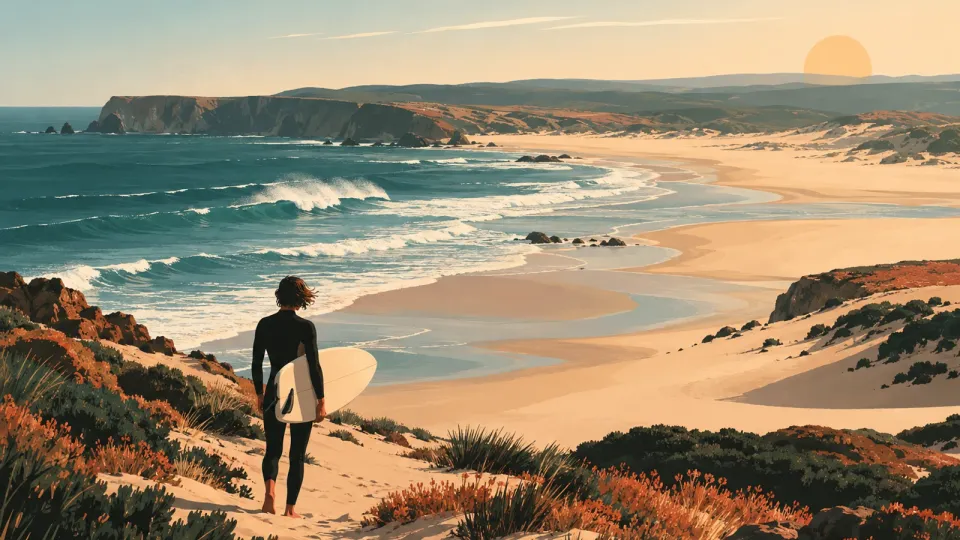
Arrive in Costa Vicentina mode, not the Algarve postcard version
A Praia da Bordeira is the opposite of “Algarve Pine Cliffs”. Here, the star is the wind, the soft sand, and the stream that meets the sea. It is the kind of backdrop that changes everything, from your surf session to how comfortable you feel on the towel.
If you are heading from Lisbon looking for the “Algarve of easy beaches”, reality kicks in fast. Bordeira is built into the rhythm of the Southwest coast and the Southwest Alentejo and Vicentine Coast Natural Park, where there is little immediate infrastructure, less development right at the shoreline, and more nature calling the shots. The park covers, among other areas, the municipality of Aljezur and the parishes of Bordeira and Aljezur, with the coastline as the organising axis of the territory. Southwest Alentejo and Vicentine Coast Natural Park (Turismo de Portugal/Digital Portal)
When it comes to “why it is worth the trip”, there is a practical detail many people miss: Bordeira is shaped by the mouth of the Ribeira da Bordeira. That is part of what explains the feel of the place, from the moisture in the sand to the way the beach “responds” to the sea. The local parish describes the beach as one of the longest in the municipality of Aljezur, with about 3 km of sand, and located “by the mouth of the Ribeira da Bordeira”. Parish Council of Bordeira, “Beaches” section
And here is the part that matters most for the expectations you bring. Instead of aiming for “zero wind”, Bordeira demands planning: the right clothes, a time strategy, and a backup plan 20 minutes away by car.
Yes, it can be “no crowds”. The Vicentine Coast, by design, has fewer resorts, and Bordeira fits right into that. Algarve Portugal Tourism, Vicentine Coast guide
I write this as someone who spends the whole year between Lisbon and the coast, and who has already seen vans parked in the wind while people argue about whether it is “worth staying”. It is, but you will enjoy it more if you treat it as the Vicentine Coast, not as “summer Algarve”. "},{
How to get from Lisbon to Praia da Bordeira (without losing the whole afternoon)
Here is the honest calculation: from Lisbon, 4 hours or more on the road, depending on traffic and your exact starting point. I plan this way because on the late-afternoon stretch, time does not forgive you.
The practical route is usually Lisbon, south to the axis that takes you toward the west Algarve region, then on to Aljezur/Carrapateira and from there to the Bordeira area. What matters, more than the map, is your logistics decision: leave earlier, or accept that your first stop will be “quick photo and a drink”, not a full day.
Two simple rules that prevent wasted time:
-
Do not plan “Bordeira for lunch” if you leave late. The place works best when the wind has stabilised, or when you have good light for a proper walk.
-
Take less risk with the car, more with the schedule. Bordeira is not the spot where you want to arrive late afternoon already low on energy.
For navigation context, the area sits inside the Natural Park, which has rules and typical limits for protected zones. That helps explain why the “experience” here is more about road time and trails than about an instant terrace-and-drinks moment. Turismo de Portugal/Digital Portal, Natural Park information
If you want to minimise friction, do it like this in practice:
- First check before you leave: confirm swell and wind forecasts (we will get to that).
- Last check before parking: decide whether it really makes sense to go down to the main beach, or if you would be better on another bay along the route.
And one more tip people often learn on site: when the wind turns strong, the difference between “staying on the sand” and “doing the trail to a more sheltered spot” can be enormous.
When I say 4 hours or more, I am not being dramatic. It is just realistic. That is why your first goal on arrival is not “getting on the sand”, it is positioning yourself properly for whatever the day gives you.
The ideal combo: Arrifana, Amoreira, and Castelejo on the same route
Bordeira gets a lot better when you place it in the centre of a short coastal run, with Arrifana, Amoreira and Castelejo as the pieces of the same puzzle. The key idea is simple: these spots help you deal with Bordeira’s biggest challenge, which is the wind.
Here is the logic of the route. You are in an area where beaches can be exposed in very different ways, and timing changes everything. The same trip can feel like “annoying wind” or “perfect wind”, depending on how you split your day.
How it fits in real life: get in, surf, and change the scenery. Instead of forcing it at Bordeira when the sea is restless, rotate through your plan:
- Start with a spot that is more “friendly” for your state early in the day (often Arrifana, because access is easier and it feels like a different face of Aljezur’s coast).
- If conditions are good, Bordeira becomes your main piece.
- When the wind starts to dominate on the sand, switch to a nearby beach with a different exposure profile.
To help you orient yourself with the neighbours people commonly group into the same trip, the Vicentine Coast logic places Bordeira alongside other beaches such as Amado and Vale Figueiras. It gives you a mental “north-south” map to adapt to what the sea is doing. Algarve Portugal Tourism, Bordeira Beach and nearby beaches guide
And the plan gets even better when you accept that “combo” does not mean “each beach for 20 minutes”. It means being ready to stay long enough to actually feel the place, while also not getting stuck waiting for a day that will not improve.
There is a reason for this: Bordeira has extensive sand and is close to the river mouth. When the wind increases, comfort changes quickly. The local parish describes the beach as extensive and tied to the river’s dynamics, which is exactly the kind of environment where wind creates discomfort and reshapes how you use space. Parish Council of Bordeira
If you are doing the trip over 2 to 3 days, the combo becomes an advantage. One day surfing, another day nature and trails, and the third day slots in the beach that worked best for you. That is how most of the people I have travelled with, with a rental car and no rush, ended up enjoying the Vicentine Coast without stress.
Surf at Praia da Bordeira: level, waves, and what the wind does
Praia da Bordeira is well known locally, but the English translation of the vibe is straightforward: it is not “easy beginner surf in any conditions”. Wind and the way the ocean enters the bay change everything about the experience.
If you want a practical compass, think like this:
- Wave direction and swell define the real “size”.
- Wind defines the “texture” of the waves. It can make the sea feel chaotic, and at certain times it can make your board more usable.
So the right tool is not guessing or “it looks good” advice. The correct move is to consult forecasts and warnings from IPMA, because they are meteorological data based on official methodology.
IPMA provides warnings and information for the coast and the sea, with sections like Sea State and Wind. IPMA, online warnings in a time line
And because this is the Vicentine Coast, where atmospheric dynamics shift in a visibly noticeable way, I always treat surf as a decision by window. The common mistake is getting “stuck” at the peak for hours, even when the wind organises itself from a different direction.
On skill level and conditions, without inventing numbers, this advice usually works:
- For beginners, the best bet is to look for days with controlled wind and moderate swell, and be ready to come back another day. What looks “just a bit bigger” can become current and impact.
- For intermediates and advanced surfers, Bordeira can deliver some of the best the coast has to offer, because the wind-and-space mix suits reading the ocean and surfing with patience.
How to adapt your day when wind becomes a problem, in practice:
- Confirm wind and sea state before you head down with your wetsuit and board.
- If the wind is aggressive, swap your session for a nearby spot along the same route. That keeps the day “surf-focused”, even if the main peak is not.
- If you have less experience, keep sessions short and repeat them. At Bordeira, the risk is a long session once the sea starts to turn.
A detail that helps explain the “why” behind the conditions: Bordeira is linked to the mouth of the Ribeira da Bordeira, and the beach is described as extensive, with dune systems and distinct natural conditions. That means the seabed and entry into the water are not “perfect clean pool” conditions all year round. Parish Council of Bordeira
If you are planning to surf the Vicentine Coast, your advantage is not “getting lucky on the day”. Your advantage is using the wind as a signal, not a surprise. Bordeira rewards quick plan adjustments.
When wind is the issue: a backup plan that does not ruin your day
Wind at Bordeira is not a detail, it is the main character. The question is not “will there be wind?”, it is “will the wind ruin how you use your time, or will you adapt?”.
On the Vicentine Coast, exposure is built into the territory. Being inside a natural park and on a coastline with its own dynamics leaves less room to pretend today will be the same as yesterday. The park’s own description highlights a mix of environments, and how the territory organises itself between hills, dunes, and river valleys. Turismo de Portugal/Digital Portal, Natural Park
Here is what works when wind hits you as soon as you park:
- Do a quick sky-and-breeze check before you grab everything from the boot. If wind stops you feeling comfortable for two minutes, you will suffer on the sand, not on the beach.
- Work in “blocks”. Instead of “stay until evening”, do 60 to 90 minutes on the beach, then swap to a second, more interesting point nearby.
- Protect your logistics, not just your body. Secure your towel, close your rubbish bag properly, and switch layers when wind starts drying you out too much.
The backup plan I recommend for this trip fits two ideas: (1) rotate to a nearby beach, (2) replace sand time with a trail or a viewpoint. The Vicentine Coast has short enough distances for that to work.
To make the rotation seamless, you need to choose beforehand what you will alternate. For example, Bordeira is often paired with nearby beaches like Amado and Vale Figueiras in visitor guides. Even if you do not use those exact names, the concept stays the same: switch beaches in the area. Algarve Portugal Tourism, Bordeira and nearby beaches
And when I say consult conditions, I am not doing it for aesthetics. IPMA publishes warnings and meteorological context for sea and wind. I treat that as part of the ritual, just like checking parking before you head down. IPMA, online warnings in a time line
If you want an objective decision, use this simple rule: when the wind is strong and constant, pick a spot where you can stay in natural shade, or do a quick trail and return to the car to warm up.
The biggest mistake I see is people bringing a “soft summer holiday” mindset to a place like the Vicentine Coast. If you accept that the wind sets the pace, you can keep your mood and still enjoy the scenery, even when your towel is fighting the tide of air.
Where to eat in Carrapateira: the right stop when you want to escape the trend
Carrapateira is the kind of base where you get the best of the Vicentine Coast without turning it into a “one photo only” attraction. And in the context of your route, eating well here is what rounds off the day.
I do not like recommending places in “trend” mode. In Carrapateira, the advantage is balance, food that makes sense after surfing and walking, and a small-town atmosphere where quality tends to show up more than the staging.
What I tell you is to avoid the common trap: choosing a restaurant just because it is “on the way”, when in reality it is behind a wall of wind and sea. Carrapateira gives you the option to return from outside, eat calmly, and get back on track.
To avoid the “only beach” feeling, there is also a local identity piece that can complement a quiet meal. Nearby, the Museu do Mar e da Terra da Carrapateira is a museum space focused on the village’s relationship with the sea and the territory. It can fit before or after eating, as a break between sessions. Museum of the Sea and Land of Carrapateira information
And here is my practical rule: choose a place where you can make a “surf-ready” order, soup, fish of the day, or a hot plate, with enough time to cool down or warm up. If you are cold, the meal is recovery, not just pleasure.
How to match food to your beach itinerary:
- If the day involved strong wind and your surf session was short, dinner should prioritise comfort.
- If it was a good, long day, choose a lighter meal and save the heavier plate for lunch.
- If you are travelling with kids or you are in “slow mode”, Carrapateira is easier to adjust to than trying to repeat the adrenaline of the road at the end of the day.
In general, the Vicentine Coast does not have the kind of resort infrastructure right by the beach. You get towns and villages. That means dining out is a choice, and the choices work best when you set that meal in Carrapateira. Algarve Portugal Tourism, note about the lack of resorts along the coast on the Vicentine Coast
Next action: plan your dinner time in Carrapateira before you head out to the beach. If your afternoon goes off track, having a commitment helps you avoid improvising while hungry and dealing with wind.
When to go: the marine window, light, and respect for the park
Bordeira is not a “single season” destination. It works at several times of year, but what changes is your relationship with wind, sea conditions, and comfort. The rule that never fails is: plan by the weather window, not by the date on the calendar.
The Vicentine Coast is part of a natural park, and that creates a landscape that does not behave like “domesticated” beaches. The park covers the coastline between areas such as Cape St. Vincent and nearby zones, including Aljezur and parishes like Bordeira. Turismo de Portugal/Digital Portal, park information
So when you decide “go now”, what you really need to look at is the sea and the wind. IPMA has warnings and information for sea state and wind, and that is the first filter before you decide whether to go to Bordeira or rotate to another spot. IPMA, online warnings in a time line
If you are travelling by car and not rushing, here is the approach I recommend:
- If you want to surf, set your day by the time windows when wind and swell look more “usable”.
- If you want nature and trails, pick days when wind does not drain all your energy. The scenery is worth it, but walking needs balance.
- If you want photo time and beach time, remember that “pretty light” depends on the sky. Wind changes the texture of clouds and how your body feels temperature-wise.
A common mistake is thinking that “no crowds” means “always easy”. No. It can still be empty and uncomfortable if wind is turning the sand into a mess.
Beyond the weather, respecting the park also means respecting your own pace. The Vicentine Coast has a nature-first logic, and trails and access are part of the package. Environments vary between dunes, flooded areas, heaths, and river valleys, which changes how the place receives you. Turismo de Portugal/Digital Portal, environment descriptions
And what should you do on the ground?
- Bring an extra layer, wind can make temperatures feel lower.
- Have a replacement plan within your route (Arrifana, Amoreira, and Castelejo are your adjustment valve).
- Close the day with Carrapateira to recover.
If you want to do one thing today to get your trip right, open IPMA and read the warnings for the coastal zone before you confirm your session. It is the kind of step that saves you a poorly spent afternoon. IPMA, online warnings in a time line
Bordeira rewards you when you work with the sea, not against it.
10-minute checklist before heading down to the sand
Before you head down to Praia da Bordeira, run a short checklist. This is not ritual, it is risk management, so you arrive on the sand with less friction and more useful time.
The idea is simple: instead of “going and seeing”, go with information and make decisions in 10 minutes. That is especially important at Bordeira, where wind and wave texture can turn a “good idea” day into a “time to go back to the car” day.
The checklist that works in practice:
- 1) Check IPMA for wind and sea state. If there is a relevant warning, adapt your plan. [IPMA, online warnings in a time line](https://www.ipma.pt/pt/otempo/prev-sam?p=coastalevent)
- 2) Decide your day goal: surf, or beach plus nature.
- 3) Prepare wind-proof clothing and protection: an extra layer, something that does not pull cold air straight onto you.
- 4) Adjust your session time. If conditions are not top, cut it early and switch spots.
- 5) Protect your logistics: towel and bags closed tight, because wind does not forgive.
- 6) Do not park far from the point that lets you leave quickly. On the Vicentine Coast, losing 15 minutes on the way back can ruin the rest of your day.
- 7) Keep water and a planned meal. Carrapateira closes the circle.
- 8) Think about the light. If you are photographing or just walking, light and wind go together.
- 9) If you are surfing, bring a same-day alternative (swap beaches in the area).
- 10) Respect the park and the terrain. The beach and dune zones have practical rules, and nature is not a backdrop.
Why insist on this? Because the biggest mistake at destinations like Bordeira is assuming the experience depends only on the “place” and not on the day. Bordeira has its own identity, but wind and sea state determine your comfort and safety.
And here is an objective reference to anchor you: Bordeira is described as an extensive beach, around 3 km of sand, connected to the mouth of the Ribeira da Bordeira, which helps explain the behaviour of the place. Parish Council of Bordeira
If you have 10 minutes, this is what makes the difference between “we went to the beach” and “we enjoyed the Vicentine Coast”.
A 3-day mental map: no rush, the right route
The best way to enjoy Praia da Bordeira is to treat the visit like a three-day route, focused on two things: (1) surf and nature at your pace, (2) rotating to handle wind.
Day 1, base in Carrapateira: arrive early, do a first short loop, and have lunch that does not drain you. Late afternoon, go to Bordeira to “check the scene” and understand how the wind is working. If it is not good enough to stay, the approach still works because it gives you a read on the territory.
Day 2, surf and windows: choose the day based on IPMA. If there is sea state and wind in workable conditions, Bordeira becomes your main piece. If not, do “surf the same day” at another spot on the route. The point is the same: you are not stuck in a plan the sea has already dismantled. IPMA, online warnings in a time line
Day 3, combine beaches and rest: this is where neighbours like Arrifana, Amoreira and Castelejo fit in, because the goal is no longer only “waves”. It becomes scenery, walking, and good food without rushing. Bordeira stays in the mix, but now as part of the itinerary, not an obligation.
This plan works because the Vicentine Coast is not made for constant running around. It asks for energy management. And there is a territorial reason for that: the area is framed by the Southwest Alentejo and Vicentine Coast Natural Park, with a logic of environments and limits that does not behave like a resort corridor. Turismo de Portugal/Digital Portal, natural park information
If you want an on-the-spot decision method, use the golden rule you already applied earlier:
- When wind makes the sand uncomfortable, change beaches.
- When the sea lines up for surfing, stay longer at the peak.
And for the “food” part, finish in Carrapateira so you can recover properly. Your energy matters more than your photo schedule.
This approach also protects you from a common illusion: “if it is off-peak, it is always calm”. Not necessarily. You might have few cars and still get wind that forces you to adapt. That is why a three-day mental map works, because you have room for the day to change.
If you want a next, testable step, plan Day 2 today using IPMA, and pick the two alternative beaches on your route in case wind makes you rotate quickly. The goal is simple: leave with decisions already made, not with luck.
Conclusion: make your sea and rotation plan today
Praia da Bordeira is one of those experiences that only works well when you respect the logic of the place: wind, soft sand, a river mouth, and the sea setting the pace. If you try to visit it like “easy Algarve”, you will miss comfort and, likely, waste time.
What you take from this route is practical:
- You arrive with real driving time, 4 hours or more from Lisbon.
- Pair Bordeira with Arrifana, Amoreira, and Castelejo so you have rotation when wind calls the shots.
- For surfing, decide by the weather window and use IPMA before you head down.
- Carrapateira rounds off the day with food and recovery.
Now, here is the next action you can do today that tests your planning without relying on guesswork:
- Open the IPMA, online warnings in a time line.
- Choose your “Day 2” surf day.
- If there are relevant warnings, set your two alternative beaches along your route now, instead of deciding on the spot.
That is how you avoid a day trapped by wind.
Vicentine Coast map (Arrifana, Bordeira, Amoreira) in 3 days, with rotation logic for windy days and surf windows, no spam email. You can download at the end of your next trip step
Related guides
Praia da Arrifana guide: surf, grilled fish, zero crowds
Praia da Arrifana guide to avoid Albufeira vibes, waves by month, cliff descent, where to eat grilled fish, parking, and whether to stay in Aljezur.
Costa da Caparica Beaches Day Trips From Lisbon
Costa da Caparica beaches, picked for your day from Lisbon. Compare town vs further south, learn transport options, and plan your return.
Carcavelos Beach, Lisbon-easy without clichés
Get to Praia de Carcavelos in 30 minutes by train, stress-free. Where to board, which station is calmer, parking tips, and where to eat seafood.
Lagos Beaches: Meia Praia, Porto de Mós, Dona Ana, Camilo
Compare Lagos beaches by access and trip needs: flat Meia Praia, easy Porto de Mós, scenic Dona Ana, and the 200-step Camilo. Pick your base.