
Praia do Tonel, Sagres: big waves & serious surf
Praia do Tonel in Sagres for surfers, when to go, when not to enter, and how to choose Tonel vs Mareta vs Beliche. Plan your day.
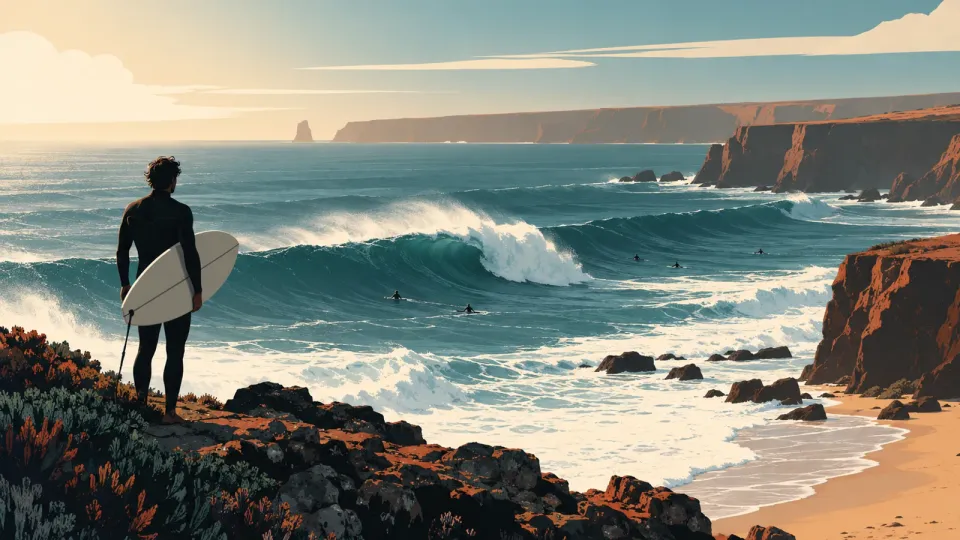
Praia do Tonel in Sagres is for big surf, but not always for going in
If you’re coming to Sagres looking for serious surf, Praia do Tonel is usually the most straightforward answer. It’s the most exposed face to the Atlantic, with swell that can still give you that “film-like” look even when the other bays seem calmer.
Now, the part that many people overlook: Tonel can also be too much for your level. The current can get awkward, the break can hit drier and harsher than the forecast makes it seem, and shorebreak can be brutal for anyone “learning the day” in full sun. My simple rule is this, Tonel is where you get waves for surfing, but your job is to confirm that the water is safe for your head and your time in that spot.
To help you choose your day, think of Tonel, Mareta, and Beliche as a triangle of intensity. Tonel is often the most open and demanding side; Mareta is more “filtered” and works well for training and lessons; Beliche is usually a more sheltered alternative with a different break pattern. The differences are real, and they matter a lot when the Atlantic decides to show up with force.
As a baseline, I always check three sources before deciding. IPMA for sea state and beach parameters, and surf forecasts to read the spot’s “behaviour” (not just the cold number for swell height). IPMA has a dedicated page for Tonel, Sagres, and it’s the kind of official reference that helps you avoid relying only on what “looks right” in a picture.
If your goal is to have a good day without drama, the right question isn’t “Tonel or not?”. It’s “Tonel, but under what conditions, with what plan, and what alternative within 10 minutes?”.
Tonel vs Mareta vs Beliche, which one to pick for your level and the day
The best way to choose between Tonel, Mareta, and Beliche is to think about the type of day you’re going to have, not just which spot is the most famous. In Sagres, the same swell can teach you in Mareta and turn Tonel into a lottery.
Praia do Tonel: normally the choice for surfers who want more consistent waves, with extra room for aggressive manoeuvres when the sea rises. The whole vibe is “cliffs and wall”, the break has that open, wind-facing feel of Cabo and the Atlantic. It’s also one of the spots in Sagres that most reliably catches size when the swell comes in with intent.
Praia da Mareta: sits on the more sheltered side and usually feels more friendly for getting in and learning. If your goal is to enter, catch, repeat, and not spend the day “negotiating” with the current, Mareta tends to be the pragmatic option. In local guides, Mareta is often described as more sheltered than Tonel, and that’s exactly what matters on a windy day.
Praia do Beliche: is often described as a bay with more protection than Tonel, and a steady flow of surfers. The reading here is different, the break can be more “manageable” for most levels, and it’s a strong backup plan when Tonel is simply too intense.
A simple way to decide, without overthinking, is this:
- If you’re in “learn, build confidence, and get sessions” mode, start with Mareta.
- If you already have autonomy, you can handle quick takeoffs, and you don’t panic when the spot gets heavy, Tonel is your game.
- If Tonel is right on the edge, but you still want waves with an adventurous feel, take a look at Beliche.
This isn’t theory. When the swell is building, you can see it immediately in how people behave in the water. Tonel pulls in the more prepared surfers, Mareta attracts those who want to control the rhythm, and Beliche tends to sit somewhere in between, with its own kind of energy.
To confirm the logic with real info, guides describe the orientation and key traits of each beach, often comparing the spots side by side (for example, putting Tonel on the more Atlantic-exposed side, and Mareta as more filtered). Use that to align expectations, but in the end, your decision is always made on location, in daylight, and with the wind as your reference.
Surf conditions by season in Sagres, how to predict Tonel without getting fooled
Tonel is an Atlantic spot. That means two things. First, you’re more likely to get consistent swell when the sea is genuinely active. Second, your forecast has to respect not just the numbers, but the full “package” (direction, wind, and sea state).
In Sagres, IPMA provides coastal information by beach, including parameters such as swell for places like Tonel. It’s a useful way to understand whether the sea is actually “connected” and whether the swell is showing up where it matters. Even when surf forecasts promise waves, I use IPMA to reduce the risk of assuming “there’s swell” when the sea state is working against you.
For reading surf, the trick is to look at consistency and the spot’s behaviour. Multiple forecast pages and surf guides describe Tonel as a known spot in the area, close to the core of Sagres, and they also mention nearby alternatives like Mareta and Beliche. That helps you build a plan with options, because in Sagres you can almost always switch beaches within minutes.
Now, about “by season”, here’s the truth without marketing. When you’re outside the months of peak swell activity, Tonel can look almost like the real thing. And when a window of more energetic days opens up, the same Tonel can turn heavy, with a more aggressive break.
A practical model that works before you head to the Cape is this:
- Check IPMA to confirm swell presence and sea state at Tonel, Sagres.
- Then cross-check with a surf forecast for Tonel (and importantly, for Mareta and Beliche).
- If the forecast suggests good swell but the wind alignment looks off, Tonel can become a tiring session, while Mareta may offer better “workability”.
There’s also an operational reality you can’t ignore. Often, a neighbouring beach has more quality than the “dream spot” when conditions are only partially good.
And if your goal is to minimise risk, don’t get stuck on pretty weather pictures. Always prioritise these indicators, in this order:
- Official warnings and sea state information, when available.
- Spot behaviour, about half an hour before your first attempt (watch the break, feel the wind, and see how the current is working).
- A ready Plan B (Mareta or Beliche), because Sagres is a place where switching makes sense.
If you want a practical reference for what IPMA publishes, start with the “Beaches and Ports” page, where you’ll find “beach information: Tonel, Sagres”.
When not to go into Tonel, current and shorebreak signs that fail more often than the forecast
The classic mistake at Tonel isn’t choosing the wrong spot. It’s getting in too early, with the ocean getting bigger, and trusting that “it will get better later”. In Sagres, the water doesn’t negotiate with unlikely plans.
When you shouldn’t enter Tonel: if you notice a combination of three warning signs at the same time, your best surf is the one you avoid, safely.
- Visible rip current or outflow: the water looks like it’s “pulling”, and people drift out of the safe zone easily, even without strong paddling. Also watch whether the line of breaking waves is moving away, like the spot is shifting.
- Irregular break and aggressive shorebreak: if the foam arrives hard in short intervals, and surfers in the water are constantly being pushed sideways, your window isn’t stable.
- Wind turning the surface up: wind that lifts the face and creates a “spitfire” look across the water usually makes your takeoff harder and your reading of the wave more unreliable.
The reason is simple. Forecasts usually model swell and wave height, but what you actually surf is the real breaking zone, shaped by local seabed depth, current behaviour, and wind effects. Tonel, being more exposed, turns small deviations into a big problem.
There’s also a governance angle that helps your decision. IPMA, as the national meteorological and maritime authority, publishes warnings and coastal information. There are also updates that reference sea state and the regime direction, which is exactly what you want to confirm before you approach the Cape.
A no-glamour, effective procedure:
- Wait 10 to 20 minutes with your feet out.
- Watch whether the break “fills in” and whether foam is drawing a consistent line.
- Read the current by looking at the first people who enter, and whether they can get out of the peak zone without fighting.
If there’s real doubt, the smart choice is to go to Mareta the same day. Yes, that means accepting that your beach day has to be flexible. In Sagres, flexibility is a skill.
And if you’re surfing with a group, set a rule. Nobody decides “yeah, now it’s good” without first checking the reality in front of them. That’s where forecasts fail, and that’s where risk shows up.
How to plan your day, Tonel in the morning and Cabo de São Vicente at sunset
The combination that almost always works in Sagres is simple, Tonel in the morning, and Cabo de São Vicente at sunset. It’s not just aesthetics. It’s about managing your energy, the light, and the logistics.
In the morning, the swell and the spot’s rhythm are usually more “organised”, and you get more margin to be wrong and still adjust. Later in the day, toward the evening, the goal stops being the perfect session and becomes the landscape. Cabo de São Vicente is that end-of-the-world finish that automatically redeems any rough hour in the water.
Some Sagres visit guides explicitly suggest planning an early-evening walk around Ponta de Sagres, then heading to Cabo de São Vicente to watch the sunset. That flow makes sense because it lines up with the light and how your body feels after surfing.
A straightforward plan for a full day:
- Morning in Tonel: arrive early, observe the water, and decide whether to go in.
- Lunch in Sagres: take a real break, not just “grab a coffee and go”.
- Late afternoon, Ponta de Sagres and Fortaleza: you can walk, breathe, and keep moving without relying on reservations.
- Sunset at Cabo de São Vicente: finish the day with the view.
If you want one detail that changes everything, it’s this. When you do this plan, don’t schedule Cabo for a fixed time before you know the conditions. Make Cabo the consequence of how the day and the ocean turn out.
I like this order because it avoids Sagres’ classic scenario. The group gets into the water late, the session falls apart, and sunset happens to them like it’s just another random sunset. With Tonel in the morning, the risk drops.
There’s more to it. Cabo de São Vicente sits in the same symbolic territory as Sagres, and it’s described as part of the far south-west of mainland Portugal, with a lighthouse and a striking landscape. That’s exactly why the sunset feels like an event, not just another activity.
Where to eat in Sagres without tourist traps, what to order, and how to avoid “tourist menus”
In Sagres, eating well is simpler than it looks, because the foundation is predictable. Grilled fish and Atlantic-style local cooking. The trap is usually the same. A restaurant with overly touristy messaging, and prices that don’t translate into freshness.
The practical way to avoid it is to choose places that fit the local rhythm. Look at what’s happening during lunchtime, and check whether the menu makes sense for what’s actually available from the sea, not just what sounds “nice”.
Three orders that typically work in Sagres:
- Grilled fish of the day.
- Seafood, when the restaurant’s choice matches what’s realistically on offer, not what “sounds fancy”.
- A local option that isn’t just “tapas for English eyes”.
And how to spot traps without asking the staff member to give you a full lecture:
- If the menu reads like a generic catalogue for any coastline, be suspicious.
- If the plate list is huge and never changes over time, that’s a weak sign.
- If the restaurant has too many “special occasion” promotions and not enough consistency in what actually lands on your table, I skip it.
As a reference for what makes Sagres feel like Sagres, the port and local eating areas around fishing are part of the environment. Visiting Sagres is also about that contrast, history up high and maritime life down below.
If you’re passing by Cabo de São Vicente later in the day, plan to eat in Sagres first. Not because there aren’t places there, but because logistics and service pace are often less predictable. Since Sagres is the base, that’s where the kitchen tends to be most consistent, so you can refuel before or after surfing.
And a golden rule. If you’re tired from the sea, pick dishes that won’t leave you stuck in a digestion coma. A heavy meal can kill the rest of your afternoon. Instead, go for straightforward food, grilled options, and trust what locals order again and again.
Getting around Sagres, how not to waste time between beaches
The key to enjoying Tonel, Mareta, and Beliche on the same day is to cut down travel time and keep some margin. Sagres is small, but the coastline is not. You’re always dealing with viewpoints, footpaths, and quick decisions.
If you have a car, the flexibility is huge. If you don’t, plan a little more calmly, because switching beaches depends on local timing and logistics.
Even when you’re moving within the area, think about the order of your day. Use this system:
- First beach, where conditions might suit you best.
- Second beach as a Plan B, in case Tonel isn’t right for your level.
- Finally, Cabo de São Vicente to close the route.
This kind of planning reduces Sagres’ classic holiday problem. You change beaches, but you don’t have time to adjust, and it ends up being wasted effort.
There’s also a useful cultural factor. Sagres is in a protected landscape area (Costa Vicentina), and that affects how long your walks and routes on foot can take. In other words, even when you’re “near”, the path can take more minutes than your city-brain expects.
If your base is Lisbon, the easiest approach is to plug into the travel loop and treat Sagres as a complete block, without rushing to fit in “one more stop”. Your mind needs time by the coast to notice details, and those details are what help you surf better.
For forecasts and what you see in front of you, use the beaches as logical alternatives. For example, Tonel and Mareta are described in many Sagres guides as nearby options that complement each other, and that’s the kind of information that helps you plan your route.
And if you want a safety habit that also saves time, here it is. Before you carry all your gear to a spot, confirm the water first. If Tonel isn’t for you today, go to the right beach early and you’ll get an entire session. That is time, not “planning”.
A short packing list for Tonel, plus alternatives in Sagres
Want a Tonel session without improvising? Here’s a short checklist, the kind that reduces silly decisions when the ocean is changing.
- Wetsuit and extra protection: Tonel can look like “just chilly”, then the exposure to wind gets you. If you’re at the edge temperature-wise, go for more protection.
- Bring cash for local food: Sagres is convenient, but it isn’t always “ATM and card everywhere”. Plan meals without stress.
- A windproof, waterproof layer: when wind picks up, your body cools fast. The right layer is worth more than any conversation.
- A mental Plan B, Mareta or Beliche: decide before you get in. If you don’t, your brain picks out of desperation.
The part almost nobody writes down. Tonel is the spot most likely to trap you in the idea that you must “stick it out”. When conditions aren’t right for you, your skill is to leave with dignity and go to the beach that gives you waves at your level.
If you need a guide to compare spots, look for descriptions that explain how Mareta works as the more sheltered option and how Tonel is more exposed. The contrast is there on the ground, and guide descriptions help align expectations.
And to confirm conditions, keep it simple. Use IPMA for the beach, then check a dedicated surf forecast for the spot.
My habit is straightforward. After watching for 15 minutes, if there’s still any doubt, I cut the Tonel session. The point of the trip isn’t to prove courage, it’s to come home with good stories.
Today, tomorrow, or any day with swell in Sagres, this stays true. The list is short because the decision is big.
FAQ about Praia do Tonel in Sagres (surf, safety, and conditions)
FAQ about Praia do Tonel in Sagres (surf, safety, and conditions)
Which beach should I choose, Tonel, Mareta, or Beliche?
If you want more exposed waves and you have the level to handle them, Tonel is your pick. For a more friendly day, Mareta tends to be easier, and Beliche is usually an alternative with a different kind of shelter. Use the comparative descriptions in local guides to set your expectations, then confirm on the spot.
How can I check conditions before getting in at Tonel?
Start with the IPMA coastal information for the beach (Tonel, Sagres). Then cross-check with a surf forecast for Tonel, and make the final call by observing on location, especially the wind and how the current behaves.
When should I NOT go into Tonel?
When the break is irregular and the shorebreak looks strong, and when the current pulls visibly, it’s better not to insist. If there are official sea-state warnings for your zone, treat that as a red flag and choose another option.
Is Tonel good for beginners?
Tonel can be good for surfers who are building autonomy and understand how an exposed spot behaves. For beginners, the safest route is to start at Mareta (or with a lesson in the right setting) and move up to Tonel once your body already knows how to read wind and break conditions.
Can I combine Tonel with Cabo de São Vicente on the same day?
Yes, and it’s a winning combination. A common flow is to do Tonel in the morning, rest and explore Sagres late afternoon, then watch the sunset at Cabo de São Vicente, following the suggestions from Sagres and Cabo visit guides.
Where can I eat in Sagres without falling for tourist traps?
Choose places in Sagres where the menu makes sense for fish and seafood, and avoid giant boards that feel generic. Eating before Cabo de São Vicente is usually more predictable, so you can refuel without risking your evening.
Do I need a car to reach the beaches in Sagres?
With a car, switching between Tonel, Mareta, and Beliche is simple and quick. Without a car, it can still be done, but you need to plan better and accept that some switches may take more time.
Next step today, build your “Tonel or alternative” plan for tomorrow
If you’ve got a trip booked to Sagres and you want to use Praia do Tonel with a level head, do this today. Set up a two-layer plan.
Layer 1, Tonel: confirm the coastal information for Tonel, Sagres in IPMA, then open a surf forecast for Tonel.
Layer 2, Plan B: choose your alternative now, Mareta or Beliche, and check the forecast for both beaches. That way, when you arrive, your decision is about execution, not improvisation.
Then on location, use a 15-minute protocol. Observe the break, wind, and current, and only go in if the signs match your level. If they don’t, save your day and go to the option that gives you the session.
This is the difference between “I surfed in Sagres” and “I had a good day in Sagres”.
The right map for this trip is your 2-day plan, with Tonel and Cabo de São Vicente built in as the finale. I’ll leave you with a simple offer you can download and sort out right now. Sagres surf + sunsets in 2 days map (no email).
CTA configured:
- Text: Download the map “Sagres surf + sunsets in 2 days” (free, no email)
- Link: /guides/mapa-sagres-surf-sunsets-2-dias
Written by Andre Ginja, Founder, andginja
Related guides
Praia da Arrifana guide: surf, grilled fish, zero crowds
Praia da Arrifana guide to avoid Albufeira vibes, waves by month, cliff descent, where to eat grilled fish, parking, and whether to stay in Aljezur.
Praia da Nazaré surf, the North and the sea like cinema
Praia da Nazaré: Praia do Norte for giant waves and Praia da Vila for swimming. Safety guide, best time, and seafood.

Lagos Beaches: Meia Praia, Porto de Mós, Dona Ana, Camilo
Compare Lagos beaches by access and trip needs: flat Meia Praia, easy Porto de Mós, scenic Dona Ana, and the 200-step Camilo. Pick your base.
Praia da Bordeira: Costa Vicentina without crowds
Praia da Bordeira guide: how to get there, what to pair in one day, and how to choose windy surf conditions. 3-day plan.