
São Martinho do Porto Bay: Beach, Walks, and a Short Stay
Plan a short stay in São Martinho do Porto. Learn bay and beach layout, access by train and car, and safe swimming habits before you go.
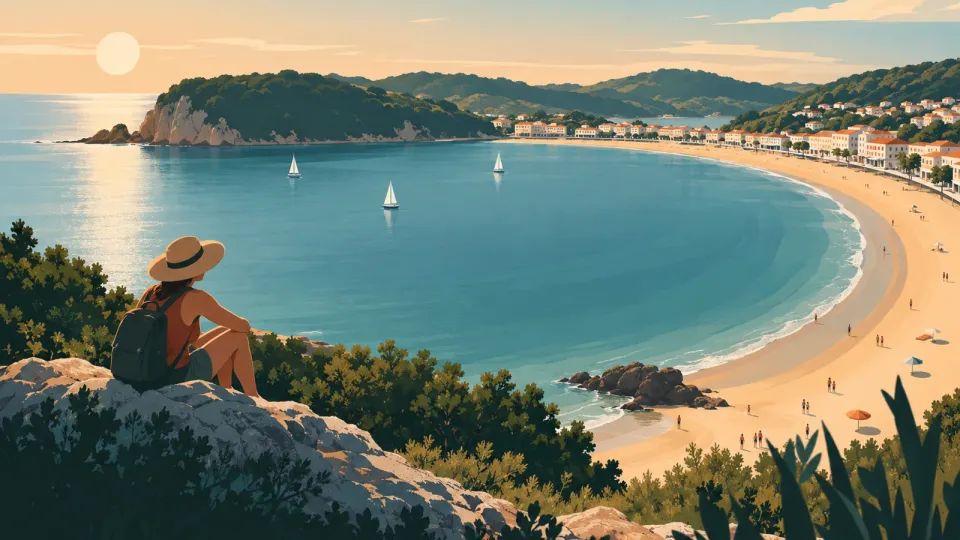
A shell-shaped bay can still change the sea, even on calm-looking days
São Martinho do Porto is famous for one thing you can see in minutes: a conch-shell bay with a wide sandy beach wrapped around it. It is a sheltered setting, and the water is often calmer than on the open coast. Visit Portugal describes the beach as a bay with about 3 km of sand and “calm sea” conditions. (visitportugal.com)
Here is the useful twist for your planning: a sheltered bay does not automatically mean guaranteed bathing safety. The sea can still be affected by wind, tides, currents, and changes in visibility. Even if the surf looks friendly from the promenade, you should treat safety signage and lifeguard rules as the final word.
A second planning misconception is the “Blue Flag equals always safe” idea. São Martinho do Porto is listed under Bandeira Azul (Blue Flag). (visitportugal.com) But Blue Flag focuses on criteria like water quality and management practices, not on a promise that every moment is suitable for every swimmer.
So use this simple rule set when you arrive:
- Swim only when you see active lifeguard coverage (if present) and follow the posted instructions.
- Treat red and no-entry style signals as strict limits, even if the water looks calm.
- Choose the easiest entry zones near the shore, and avoid deeper edges where sandbars drop off.
For general beach safety, the UK Met Office advises: do not enter when a red flag is flying, and swim between lifeguarded flag zones when available. (weather.metoffice.gov.uk) This applies well to Portugal too as a mindset: conditions can change, and signage exists for a reason.
If you want photographs and film-friendly scenes, start with early light along the bay edges. Then, while you scout the best angles, keep safety in view, because the best view is not always the best swim location.
Where to base: choose your day by the bay edge you want to walk
For a short stay, your location choice is basically a decision about walking style. São Martinho do Porto is not large, and the bay makes it easy to move between the main beach and the calmer edges. The Visit Portugal description focuses on the bay layout and its calm sea reputation, and that is exactly what shapes how you move around. (visitportugal.com)
Instead of searching for “the closest accommodation to the beach” and stopping there, use this practical filter:
- Pick “bay promenade access” if you want photos and evening walks
- You will spend more time on the waterline and along the curves of the bay.
- You get the best chance to catch the bay’s shell shape from different angles.
- Pick “estuary and nature access” if you want a nature-first itinerary
- You will plan one or more short trips to nearby wetland areas.
- You can combine beach time with birdwatching style walks.
- Pick “train convenience” if you hate parking
- São Martinho do Porto has a railway station on the Linha do Oeste, shown as part of regional connections on CP’s Linha do Oeste route pages. (cp.pt)
- That can matter if your schedule is built around fixed train times.
A concrete planning step: decide whether your “main activity hours” are morning beach, midday beach, or late-day promenade. If you want late-day light, base closer to the bay walkways and accept a slightly longer trip for nature.
If you drive, your route plan also changes. You may be tempted to park right by the shore, but during peak beach periods you will likely find easier access by using accommodation nearer the town core and walking the last stretch. For events and temporary changes, municipality notices exist online. For example, Alcobaça’s municipal page lists documents under “São Martinho do Porto” for 2026, including items related to circulation and parking. (cm-alcobaca.pt)
That document list is not your itinerary, but it is a reminder to check local updates if you are visiting close to a special date.
Bottom line for choosing where to base: select for your walk preference and for your transport friction (walking vs parking), then build your beach plan around that.
The beach plan that avoids disappointment: bay shape, entry zones, and timing
Your best day on Praia de São Martinho do Porto comes from treating the bay like a map, not like a single beach point. The “shell” shape is the clue. Visit Portugal describes the beach as a 3 km sandy arc in a protected bay. (visitportugal.com) That geometry changes wind exposure and wave energy as the day moves.
Here is a simple, film-and-photo friendly beach plan you can use immediately:
-
Start with the morning shoreline sweep
-
Walk along one side of the bay edge to see how the waterline behaves.
-
Look for the cleanest sand texture and the least clutter near the entry point.
-
Choose your bathing entry zone by ease, not by “calm looks”
-
Calm water near the shore is not the same as safe footing.
-
If you see people clustering along a specific shallow stretch, that is often where entry is easiest.
-
Return later for the best angles, not for the safest swimming
-
Late light can be gorgeous, but conditions can also shift with wind.
-
Recheck any visible flags and signage before you enter.
This is where the common mistake shows up: people equate “protected bay” with “always safe.” But safety is a combination of water conditions, currents, wind, visibility, and signage. The Met Office beach safety guidance says never go in when a red flag is flying and follow lifeguarded areas. (weather.metoffice.gov.uk)
You can also plan for the “Blue Flag” info without over-trusting it. São Martinho do Porto appears on the Blue Flag program listing. (visitportugal.com) Blue Flag supports beach management and water quality monitoring, but it still does not remove the need to check what is happening at the beach right now.
Use the bay to create natural scene variety too:
- Bay-wide shots from higher points or promenade edges
- Water texture close-ups at lower tide moments
- Wind and light contrasts on the opposite side of the bay edge
If you are planning a short stay, set one strict rule for yourself: do one beach swim attempt only after you have done a five-minute “observe first” loop (people, signage, wind, and where the shallow entry really is). That protects both your plan and your gear schedule.
How to get there and get around: train first, then use the town on foot
For many travelers, the smoothest approach is train to São Martinho do Porto, then walk the bay and town. CP shows São Martinho do Porto as part of the Linha do Oeste route network. (cp.pt) That matters because it gives you an option that does not rely on parking.
When planning “get there” logistics, separate two things:
- Intercity travel to the Oest e region (where you start)
- Local movement once you are in São Martinho do Porto
Even without printing exact train times here, you can still build a robust plan.
Train planning checklist
- Confirm the station you will use (São Martinho do Porto station on Linha do Oeste). (cp.pt)
- Plan your day so you do not depend on a last connection if you are doing a long photo walk.
- If you are also visiting other coastal places like Nazaré, check both directions before you commit.
Road travel in one sentence, then the real point
If you drive, parking and vehicle access become part of the itinerary, because beach areas can have temporary traffic rules.
Alcobaça’s municipal “2026” document index shows that São Martinho do Porto has recurring items related to circulation and parking changes. (cm-alcobaca.pt) That is evidence that local arrangements can change, especially around events.
Where walking wins
Walking wins for these specific tasks:
- Moving between accommodation and the bay for sunrise or sunset
- Repositioning for shots along the curving shoreline
- Doing a “safety recon” walk before swimming
Visiting versus waiting: do you go to Nazaré instead?
Nazaré is a classic name on Portugal itineraries, but it is not the same experience as São Martinho do Porto. Plan it as a distinct day trip, not a substitute for your beach base.
If you want a planning shortcut, treat Nazaré as your “bigger coastal energy” day, and São Martinho do Porto as your “bay geometry and calm shoreline” day.
One more useful transport detail: when you shop or compare local prices online, double-check whether you are mixing up nearby towns on the same coast. São Martinho do Porto has its own station, but the Lisbon to Oeste to coast connections can look similar at first glance.
Your best planning habit: decide train or car first, then design everything else around that decision. It makes your short stay feel effortless.
Local walks you can do in 2 to 4 hours: bay edge to wetlands
For a short stay, you want walks that feel complete even if you do not have a full day. In São Martinho do Porto, the bay itself is a walk, and the nearby wetlands create a second, nature-focused loop.
Walk 1, The bay edge loop (beach-first, then promenade)
Start at the main beach area and walk along the curve to notice how the bay changes in character. Visit Portugal emphasizes the bay’s sheltered setting and the beach’s shell-shaped arc. (visitportugal.com) Use that to your advantage: your “walk route” is basically exploring the bay’s different edges.
Immediate benefits you can apply on your trip:
- Find the easiest entry stretches for later (without committing to swimming first)
- Shoot the bay from multiple angles with the light shifting across the arc
- Build a short safety habit, observe first, enter second
Walk 2, Paul de Tornada nature trails (wetland bird and landscape focus)
If your trip includes wildlife moments, aim for a visit to Reserva Natural Local do Paul de Tornada.
The Municipality of Caldas da Rainha region pages describe the Paul de Tornada as about 54 hectares, a humid zone that supports many species, and it is linked to a visitor center. (mcr.pt) Another conservation-focused source places it as a local nature reserve and highlights that it is classified as Reserva Natural Local and discussed as a nature refuge. (resources.natural.pt)
For access and trail planning, a conservation association notes that you cannot enter the interior of the wetland directly, but it is possible to observe from trails on the side, with access routed from the Centro Ecológico e Educativo in Tornada. (avesdeportugal.info)
A second source reiterates the “observe, do not enter” pattern by describing viewing from existing trails and giving the starting point as the interpretive center. (avesdeportugal.info)
So do not plan a “walk through the reserve like a park.” Plan it as a guided or observation-focused trail experience.
How to fit both walks into a short stay
Use a two-day model:
- Day 1: Bay edge walk in the morning, beach in the afternoon
- Day 2: Paul de Tornada trail in the morning, relaxed bay promenade in the late day
Even without publishing exact trail distances, you can still plan time responsibly:
- Give the bay walk 60 to 90 minutes including stops
- Give Paul de Tornada 90 to 150 minutes including the observation pace
When you are filming or photographing, also budget for water pauses. The bay can tempt long sessions, but you will move faster if you take short repositioning breaks rather than long “stand still” stretches.
São Martinho do Porto vs Nazaré: calm bay day or big-coast day
The easiest way to avoid trip disappointment is to stop treating São Martinho do Porto and Nazaré as interchangeable beaches. They are coastal experiences with different energy.
São Martinho do Porto is built around the sheltered shell-shaped bay. Visit Portugal describes it as a bay with calm sea conditions and a sandy beach around 3 km long. (visitportugal.com) That shape is why it feels family friendly for many travelers and why it is a strong choice when you want an easy shoreline day.
Nazaré is where you go for the dramatic open-coast mood. Even if you enjoy beaches there, the waves and coastal exposure are more likely to feel “seaside intense,” not “wrapped in a shell.”
So how should you choose, if you only have a short stay?
Choose São Martinho do Porto if you want
- A bay walk that is visually varied along the curved shoreline
- Swimming plans based on calm water proximity, while still following safety rules
- A calmer schedule that leaves time for a second activity like Paul de Tornada
Choose Nazaré if you want
- A “big coastal day” with more visual drama
- A distinct day-trip feeling (different town, different mood)
Make it concrete: how to combine without overload
If you are doing both, use this sequencing:
- Base in São Martinho do Porto
- Do Nazaré as a separate day
- Return to the bay late day for promenade shots and relaxed pacing
That sequencing matters because Nazaré can take up more of the day with viewpoints and timing. Then São Martinho do Porto becomes your recovery and shoreline session.
For transport planning between the two, one travel-planning aggregator lists routes by bus, taxi, and car. (rome2rio.com) Treat that as an overview, not a schedule promise, and confirm details on the day of travel using official operators if you are planning tightly.
A safety note for the comparison: do not use “Nazaré waves” as a reason to ignore safety at São Martinho do Porto. Calm water and sheltered shapes can still include risk factors. Use the same decision habit at both places: observe, check flags and rules, then enter.
If you want one actionable rule for your packing list: bring one set of swim shoes or sandals that work on uneven sand and a separate pair you can wear for wet promenade walking. Both towns can have traction needs, and you will reuse the same kit for fewer outfit changes.
Beach safety that works in Portugal: flags, lifeguards, and where people actually swim
Here is the most important planning skill for São Martinho do Porto: build a safety habit that starts after you arrive. The bay’s sheltered shape is a real advantage, but it is not a safety guarantee.
Start with two evidence-based anchors.
-
For general flag-based safety, the Met Office advises: never enter when a red flag is flying, and follow lifeguarded guidance, such as swimming between lifeguarded flag zones when that system is in place. (weather.metoffice.gov.uk)
-
For Portugal beach management context, Portuguese documentation around beach safety describes that the monitoring of bathing areas includes ensuring surveillance of water area equipped with rescue means, and it references non-compliance with established information signs like flags and instructions given by lifeguards. (amn.pt)
Now apply that to what you actually see in São Martinho do Porto.
A practical “5 minute safety scan”
Do this before you put your feet in the water.
- Look for lifeguards and signage at the beach.
- Check flags and follow them, even if the bay looks calm.
- Observe entry behavior: where are people going in, and where are they staying?
- Watch for sudden changes: wind shift, choppy water near certain edges, or visibility drop.
- Choose depth gradually. Do not race to deeper areas just because you can stand there.
Where people swim is useful, but not enough
It is a good indicator for shallow entry and social comfort. But do not assume “busy means safe.” People may be in the water for many reasons: they underestimated conditions, they are strong swimmers, or they are under lifeguard cover. Flags and lifeguard instructions are still the rule.
Family and less confident swimmers: use the bay geometry, but keep boundaries tight
São Martinho do Porto is widely described as having calm conditions and good conditions for children. Visit Portugal says the calm sea offers excellent conditions for children and nautical sports. (visitportugal.com) You can use that to plan, but keep these boundaries:
- Stay close to shore.
- Avoid entering if signage restricts bathing.
- Always keep children within arm reach.
A note about “guaranteed water temperature” claims
Many travel sources loosely imply consistent comfort. Avoid that mindset. Instead, dress for variable breezes. Even in calm bays, wind can make it feel colder than the sunshine.
If you want a single takeaway you can act on today: plan your first water entry time after you have done a scan and checked the flags. Then treat every swim attempt like a fresh decision, not a one-time assumption.
Photography and filming-friendly spots: get the bay shape without losing your schedule
São Martinho do Porto rewards visual planning because the bay shape creates strong composition lines. Visit Portugal’s description of the bay and its protected layout helps explain why you can get different looks without traveling far. (visitportugal.com)
For a film, photography, and digital studio planning style, the trick is to use your day like a shot list, not like a random wander.
Shot idea 1: the bay shell curve from a higher promenade angle
Your goal is the “embrace” geometry, where the sand wraps the water. The bay’s shell shape is a defining feature. (visitportugal.com)
Planning tips:
- Shoot before or after peak crowds for cleaner backgrounds.
- Move a few meters along the promenade edge to get a different curvature in frame.
Shot idea 2: water texture close-ups where the sand line meets the sea
Calm water tends to create readable gradients and fine ripples. But still apply the safety habit, do not go out into water for shots you have not planned.
Shot idea 3: use “light shift” for a second look
Reposition later for different contrast. This reduces the temptation to wait in one spot while the bay changes.
Shot idea 4: nature day textures at Paul de Tornada
Paul de Tornada adds wetlands textures and bird activity to your visual story. The reserve is described as around 54 hectares and as a habitat for many species, with an educational and interpretive visitor center context. (mcr.pt) Another source emphasizes that you observe from trails rather than entering the wetland interior. (avesdeportugal.info)
That matters for filming and photography because you should plan gear and shot length around viewing points.
Avoid these common photo planning mistakes
- Mistake 1: Only shooting “one side of the bay.” The bay edges create different visuals as the light changes.
- Mistake 2: Treating calm water as an automatic permission slip to swim for shots. Use the same flag and lifeguard rules you would anywhere.
- Mistake 3: Planning one massive day drive between towns. If you base in São Martinho do Porto, you can keep your schedule stable and still do Nazaré as a separate day trip.
For a short stay, your practical deliverable is this: schedule one morning bay geometry session, then one nature or walk session (Paul de Tornada), and keep late day for flexible promenade shots.
If you are building a content calendar for your trip, this approach keeps you productive without sacrificing safety checks.
Your 2-day plan for a short stay in São Martinho do Porto (with one Nazaré option)
Use this as a plug-in schedule for a short stay. It keeps your beach time connected to real safety habits and adds one nature or day-trip element.
Day 1, Bay geometry and a relaxed beach afternoon
Morning, bay edge walk
- Walk the curved shoreline to observe water behavior.
- Use the bay’s shell shape as your navigation marker. Visit Portugal highlights the protected bay and about 3 km of sand. (visitportugal.com)
Midday, beach break with the 5 minute safety scan
- Check signage and any lifeguard rules before you enter.
- Follow general flag safety guidance, do not enter under a red flag and swim only in lifeguarded safe zones when that system is active. (weather.metoffice.gov.uk)
Late afternoon, promenade photos
- Reposition along the bay edge for light shift.
- Keep it flexible. If wind changes, adjust your plan rather than forcing a swim.
Day 2, Choose one nature walk or a Nazaré day trip
Option A, Nature-first with Paul de Tornada
- Plan a morning visit to Reserva Natural Local do Paul de Tornada.
- Treat it as observation and trails from the access points. One conservation association notes that you cannot enter the wetland interior, but you can observe from existing trails, with access from the Centro Ecológico e Educativo in Tornada. (avesdeportugal.info)
- Another source describes the reserve size as about 54 hectares and positions it as a nature jewel near Caldas da Rainha. (mcr.pt)
Option B, Nazaré day trip
- Choose Nazaré as your “different coastal energy” day, not as an extension of São Martinho do Porto.
- Keep your base return planned so you do not compress everything into one rushed schedule.
For the Nazaré route overview, a travel planning aggregator lists ways to travel between Nazaré and São Martinho do Porto by bus, taxi, and car. (rome2rio.com) Confirm details with official operators when you book or on the day, especially if you are timing a filming segment.
A simple booking and packing checklist
- Pack swimwear plus a change layer for wind on the bay.
- Bring water-friendly footwear for sand texture and promenade stability.
- Bring a small bag for essentials so you can do quick safety checks and reposition without stress.
If you want one “do it today” action, it is not to search for accommodation again. It is to pick your two-day activity split (Day 1 bay, Day 2 Paul de Tornada or Nazaré) and then map walking routes from where you plan to sleep to the bay promenade and your next destination.
Conclusion: make safety and timing your trip superpower
São Martinho do Porto gives you a rare combination: a visually distinctive bay and an easy walking environment. Visit Portugal describes the beach as a protected bay with about 3 km of sand in a shell-like shape. (visitportugal.com) That is why it works for short stays, families, and anyone who wants strong visual geometry.
Your main planning win is to separate these two ideas:
- Protected shape helps comfort, it can reduce wave energy.
- Safety is still conditional, flags and lifeguard rules matter at the moment you enter the water.
Use general beach flag guidance like the Met Office recommendation not to enter under red flags and to follow lifeguarded zone advice. (weather.metoffice.gov.uk) Portuguese beach safety documentation also emphasizes respecting established information signs, like flags and lifeguard instructions. (amn.pt)
Action you can do today:
- Write down two time blocks for your next trip day: morning bay walk and late-day promenade photos.
- Pick your Day 2 add-on: Paul de Tornada for wetlands observation (with access from the interpretive center trails) (avesdeportugal.info) or Nazaré as a separate day trip.
- Commit to one safety habit: do a five minute safety scan and only then decide whether anyone swims.
If you do that, your trip stays light, flexible, and realistic, even when the sea looks calmer than expected.
Related guides

Lagos Beaches: Meia Praia, Porto de Mós, Dona Ana, Camilo
Compare Lagos beaches by access and trip needs: flat Meia Praia, easy Porto de Mós, scenic Dona Ana, and the 200-step Camilo. Pick your base.

Porto beaches: Foz, Matosinhos and day trips by coast
Compare Porto beaches in Foz and Matosinhos, plus coastal day trips. Learn bathing seasons, local rules, and transport tips so you swim smarter.

Where to Stay in Porto: Neighbourhoods, Hills and Transport
Where to stay in Porto: neighbourhoods, hills and transport, choose the best base for Ribeira views, Baixa access, Boavista ease, Foz sea air, or Gaia crossings.

Porto with kids: short routes and rainy-day plans
Porto with kids: short routes, breaks and rainy-day choices for toddlers, school-age kids, and teens, with wet-day backups and practical pacing.