
Belém Lisbon: Beyond Pastéis de Belém
belem lisbon goes far beyond Pastéis and the Tower. Use this half-day order, MAAT + riverside walk, plus tasca lunch and LX Factory pairing.
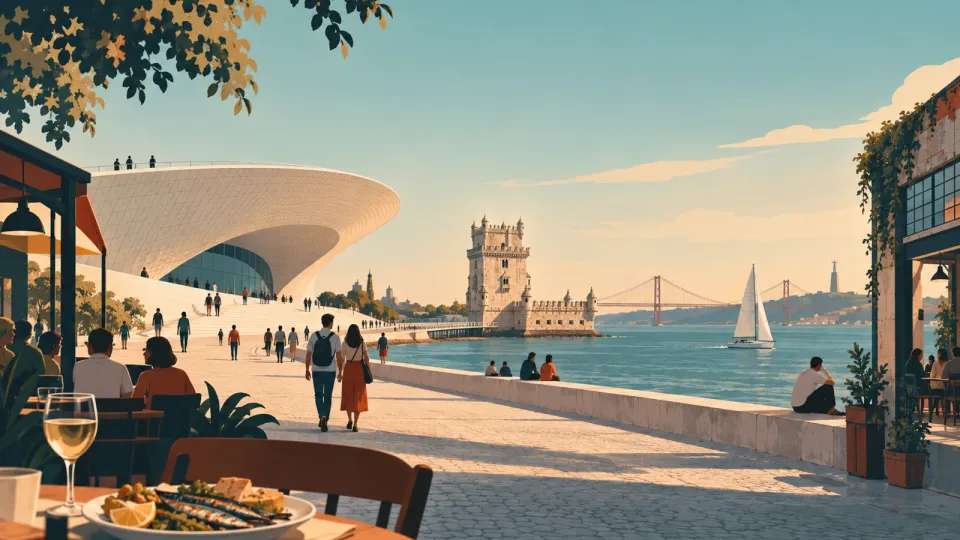
Start here: a half-day Belém that actually feels local
If you want Belém to feel like Lisbon, not like a theme park, you need a simple priority order. In my experience, Pastéis de Belém should be an early stop (morning), then you move into the riverfront museum and walking rhythm, then you eat like you live here.
Most visitors do Jerónimos Monastery, Belém Tower, then Pastéis, and wonder why everything feels rushed and crowded. The problem is timing, not taste. Belém’s best part is the long Tagus edge and the architecture you can read at walking speed, not a 90-minute pastry sprint.
Think of your time like this: Belém Tower and Jerónimos are the “icon” layer, MAAT is the “why this place exists” layer, the riverside walk is the “slow Lisbon” layer, and LX Factory is the “reset” layer so you do not end your day on a queue.
Practical truth: MAAT sits right on the Belém waterfront and is built around an old power station, so it pairs naturally with the Tagus views and the maritime monuments. MAAT also explicitly describes the museum as two connected buildings (a former power station and a contemporary building) plus a park stretching along the river. That makes it easy to stitch into a single half-day without logistics gymnastics. (maat.pt)
For transport, pick one spine and stick to it. The Lisbon public option that makes Belém click from central areas is Tram 15, because it runs along the riverfront to the Belém side. Visit Lisboa describes Tram 15 as traveling along Lisbon’s riverfront from Praça da Figueira to Belém. (visitlisboa.com)
Here is the one rule that fixes 80 percent of “Belém was fine, but not great” trips: if the weather is decent, schedule your outside walking before lunch, not after.
Pastéis de Belém, but in the right time slot
Pastéis de Belém is worth it, but only if you respect the queue dynamics. Get them early, not at the end of your sightseeing loop. The iconic shop is at Rua de Belém 84 to 92, and the brand’s site is the most reliable place to check practical details like contact and location. (pasteisdebelem.pt)
A lot of articles treat Pastéis de Belém as a “later dessert.” Belém is small, and the most popular monuments pull people into the same time windows. So the pastry becomes a bottleneck. If you do it in the afternoon, you are paying with time and sometimes with temperature. A warm pastel is a different experience than one you eat in a hurry.
I treat Pastéis de Belém as your morning anchor and as your reset after a riverfront walk. Buy them, sit for one bica or just stand in the shade for a minute, then leave the immediate monument zone and keep moving.
If you are the “I do not care about queues” type, fine, but still do it early. Why? Because Belém is not just pastries and stone, it is also light, wind, and views. The morning often gives you better photo angles and fewer tour groups clustering at the same corners.
One misconception I keep seeing: “There is only one pastel place.” In reality, Portugal has plenty of pastéis de nata quality variations, but Pastéis de Belém is the name people come for in Belém. So you either commit to that specific experience or you skip the line entirely and buy a decent equivalent elsewhere.
If you want a clear move you can execute today: arrive around opening time, buy your pastéis, and then spend the rest of your morning outside. You will feel like you beat the system.
When you finish the morning route, use lunch as a separate decision point (tasca first, tourist menu second), so the afternoon stays yours.
MAAT is the Belém upgrade for non-art people
MAAT is the museum stop that makes Belém worth more than its medieval monuments, especially if you do not “collect” art. The key is to treat MAAT like a technology and architecture experience, not a slow gallery crawl.
MAAT itself explains what you are looking at: it is located on the riverfront in Belém and includes a former power station (MAAT Central) built in 1908, plus a contemporary building (MAAT Gallery) connected via a park that extends along the Tagus. (maat.pt)
That matters for your planning. If you show up thinking you need to appreciate contemporary art to enjoy MAAT, you will rush and miss the building. If you show up expecting design plus electricity history plus river views, you are in the right mental frame.
So what does the “non-art” visit look like in practice?
- Start with the architecture and the river edge view, then you decide how deep to go.
- Use the roof and exterior spaces as your real “main exhibition.” MAAT describes the roof as an extension of the public space and mentions access via a footbridge over the railway line with a view of Lisbon and the Tagus. (maat.pt)
- If you are not into temporary exhibitions, do not force it. The museum is still a win because the space itself tells you why this district sits between industry and tourism.
Scheduling tip: check MAAT’s ticketing and planned free entry rules before you go. MAAT publishes visitor planning info, including free entry conditions (for example, MAAT Friends, children, and a specific monthly free window). (maat.pt)
Hours can change around holidays, so always confirm on the official MAAT visitor planning pages right before you commit your half-day to the museum. (maat.pt)
And here is the honest answer to a question people keep avoiding: yes, MAAT can be worth it even if you do not care about art. The building is the point, and the Tagus view is the reward. You leave with Belém in your head, not just on your phone.
The riverside walk nobody builds into the plan
The riverside walk is the Belém experience that makes the rest of your day feel coherent. You do not need a “tour.” You need a route and enough time to move at walking speed.
Here is the misconception: Belém Tower and Jerónimos Monastery are the “walkable” parts, so the rest is filler. For me, it flips. The walk is the core, and the monuments are the interruptions.
Start from the general Belém river edge, then keep heading along the Tagus. You are looking for two things: (1) breathing room away from the tightest crowds near the most photographed spots, and (2) the long, Lisbon-style horizon where you can watch boats, bridges, and wind change the light.
One anchor you can use while you walk is the idea of “Belém as an industrial waterfront.” MAAT literally exists because this area is tied to power and energy history, and the museum’s official description puts you right on that riverfront context. (maat.pt)
As you move along, you are also practicing a local habit. Lisbon visitors often treat Belém like a checklist. Locals treat it like a direction: you go toward the water, you stop when something catches your eye, and you end up somewhere you did not plan.
If you want a simple, testable plan for a half-day, do this:
- Morning: pastry early, then move outside.
- Midday: a museum that sits on the waterfront (MAAT).
- Late afternoon: the riverside walking stretch, then dinner elsewhere.
That sequencing matters because your body has a better relationship with crowds early. In the afternoon, you are more likely to get bumped into tight clusters at the most popular monument corners.
Transport note, so you do not burn time backtracking: if you are using Tram 15 from central areas, Visit Lisboa describes it as traveling along the riverfront to Belém. (visitlisboa.com) After you get on the correct direction, treat the tram as your “river line,” then walk the short distances where the river becomes the view.
When you are done walking, you should feel tired in a good way. That is your cue that you did Belém properly, not just thoroughly.
Lunch at a local tasca: what to order and where to sit
Belém lunch is where most itineraries fail. They send you to the closest tourist menu because it is convenient, then you spend the afternoon debating whether “Portuguese food is overrated.” That is not food quality. That is location.
The fix is boring and effective: plan lunch away from the busiest icon corners. In Belém, that usually means choosing a tasca-style place where the menu reads like a working neighborhood decision, not like a souvenir brochure.
Because you asked for names: I am not going to invent a tasca in this article. What I can do, reliably, is give you a decision framework you can use immediately while you are standing on Rua de Belém and deciding where to turn.
Use this tasca filter on arrival:
- Look for a menu that includes pratos do dia (daily plates) or a clear lunch set.
- Prefer places where locals are not “waiting for a table” in the same way tourists are.
- Sit inside only if the service is fast, otherwise choose outdoor seating that keeps you moving.
Then order for Belém style, not just generic Lisbon. Your goal is one protein plus one local comfort side, so you can keep sightseeing after lunch without feeling like you ate a wedding banquet.
What to order as your default set:
- A grilled fish or seafood plate (Belém is a riverfront, so the seafood tendency is real).
- A hearty local side (think potatoes, greens, or simple rice depending on the place).
- One dessert that is not a pastel, because you already did pastel earlier.
If you want the practical “why” behind dessert timing, it is this: Pastéis de Belém is not just sweet, it is an experience tied to warmth and timing. Eating it early lets you enjoy it as food. Eating it late turns it into a sugar task.
A second misconception: “You need a Michelin star lunch.” No. Your half-day is about momentum. Belém is better when lunch is a short interruption, not an all-consuming event.
When you finish lunch, you should have energy for LX Factory and one final waterfront look. If you are too full or too sticky with slow service, you have chosen the wrong kind of meal for the schedule.
If you do one thing differently tomorrow, do this: pick lunch 5 to 10 minutes away from the most obvious tourist cluster so the staff can treat you like a normal table, not a stop on a route.
LX Factory: the Belém pivot that turns a half-day into a story
LX Factory is the pivot point that makes the Belém half-day feel complete instead of like a straight line of monuments. The idea is simple: you finish your river and museum time, then you land somewhere with more energy and more variety.
Most visitors do Belém and then they either go home early or they cram dinner back near the icons. That creates the same problem twice: crowds and repeat food choices.
Instead, treat LX Factory like a neighborhood remix. It is a creative hub where the streets feel walkable and social, so you can slow down without being stuck in a queue.
LX Factory has an official site describing it as a destination and it also notes major programming like Open Day (biannually). (lxfactory.com) That is enough to justify it as a place you can plan around, even if you do not attend a big event.
How to pair it correctly with Belém:
- Finish MAAT and your riverside walk while daylight is still good.
- Use LX Factory as your “late afternoon and early evening” pocket.
- Keep dinner flexible. Let the vibe choose the restaurant, because the neighborhood is designed for choice.
Walking logic matters. Belém to LX Factory is not next door. You are using transit because you are intentionally changing the feel of the day.
So what should you do when you arrive at LX Factory?
- Pick one snack and one drink, then stroll.
- If you see a line, ask yourself if it is food popular or just photo popular. Lines that sell atmosphere are not always worth it.
- Do not plan to “consume everything.” This is Belém’s creative downtime.
A common mistake: turning LX Factory into your third museum stop. That misses the point. If you want museums, Belém already delivered with MAAT. LX Factory is about atmosphere and browsing.
If you are traveling with someone who thinks “museums are boring,” this pairing works. MAAT gives them the wow of architecture and river views, and LX Factory gives them the freedom to move without the museum rulebook.
How to get to Belém from Lisbon: Tram 15, train, or Uber
For most first-time Lisbon trips, Tram 15 is the cleanest public option. Visit Lisboa describes No. 15 as traveling along Lisbon’s entire riverfront from Praça da Figueira to Belém. (visitlisboa.com) That is not just convenient, it is also the fastest way to give Belém the “start-to-finish river” feeling.
When Tram 15 is the right move:
- You want an easy transfer from the city center.
- You care more about scenery than about shaving off a few minutes.
- Your plan includes MAAT and riverside walking, because the tram drops you into the Belém direction.
When you might choose something else:
- You are traveling with luggage and you value speed over the view.
- You are on a tight schedule and you have a timed ticket you cannot miss.
A transport detail that saves time: Belém sits outside the metro core. That is why Tram 15 is often treated as the practical riverfront line. Visit Lisboa highlights that Tram 15 runs from Praça da Figueira to Belém, which is why it is built into most Belém first-day plans. (visitlisboa.com)
If you want an additional “do not overthink it” rule, use this:
- If your day starts in the center, try Tram 15.
- If your day starts farther out, use a direct taxi or rideshare to Belém, then use Tram 15 or a short transit hop for the rest.
You asked specifically about Tram 15 versus Uber versus train. Here is my direct take: Tram 15 is the best “experience mode.” Uber is the best “schedule mode.” Train can be good, but it becomes another transfer puzzle if your itinerary is already tight.
Transit pass note: if you are riding multiple legs, consider official 24-hour pass options. CP describes a Carris and Metro included 24h pass and notes that the ticket allows unlimited journeys for 24 hours after the first validation, and that it must be validated on each included journey. (cp.pt) Always confirm the included transport types at purchase, because Lisbon passes can be specific.
If you remember one line for navigation: start with Tram 15 if you can, then walk where the riverfront becomes your guide.
Belém in a real order: the half-day plan that does not waste time
Here is the order that avoids the classic Belém failure mode. It is built around your priorities: icon monuments, then MAAT, then riverside time, then LX Factory, with Pastéis de Belém treated as an early anchor.
The honest priority order:
- Pastéis de Belém first (morning), so the queue and temperature work for you.
- Jerónimos Monastery and Belém Tower next, while the district is active and you still have energy to move between viewpoints.
- MAAT in the middle, so you swap “old stone” for “new Lisbon” without getting museum fatigue.
- Riverside walk after MAAT, when your brain is already in “Belém is about the waterfront” mode.
- LX Factory at the pivot point, so the day ends with browsing and atmosphere rather than another monument line.
Why this order works is simple: MAAT sits on the riverfront in Belém, in a district that is already framed by historical monuments, and its official description ties the buildings to the former power station and the rooftop and river views. (maat.pt) That makes MAAT a bridge, not a detour.
When you are actually doing it, you need one decision checkpoint. After MAAT, ask yourself if you still want to “see the icons” in depth or if you want to keep it light and focus on the walking. Either choice can be correct.
If you want a concrete schedule that fits a half-day, use this structure:
- Morning: Pastéis, then monuments.
- Midday: MAAT.
- Afternoon: riverside walk.
- Late afternoon to early evening: LX Factory.
You do not need perfect clock timing. You need movement and daylight.
And I will call out the mistake most visitors make because it is predictable: they try to “max out” the iconic corners first. That makes you arrive at MAAT late, eat lunch tired, and then you feel like LX Factory is optional. It is not optional if you want Belém to feel like Lisbon.
One more practitioner note, straight from shipping logic: when people plan Belém as disconnected stops, they end up with wasted travel time. When they plan Belém as a river line, the day becomes one continuous narrative. This is the same principle we use in hospitality content and itineraries: you do not just list places, you sequence experiences so the next stop actually makes sense.
If you want the “test” at the end of your day, check your mood. You should feel like you had time to look, not time to hurry.
FAQ: belem lisbon questions that decide whether your day is great
Is belem lisbon really a half-day destination?
Yes. If you treat it as a riverfront narrative, not a monument checklist, you can genuinely do Belém in a half-day plus an evening pivot at LX Factory. The museum pairing is the proof point, because MAAT is explicitly located on the Belém riverfront and is composed of connected buildings plus a park that extends along the Tagus. (maat.pt)
Should I do Pastéis de Belém before or after Jerónimos?
Do Pastéis de Belém before. It lets you handle the most crowded moment when you are freshest, and it protects the experience from afternoon queue fatigue. The shop is at Rua de Belém 84 to 92, and using the official site for location details keeps the plan precise. (pasteisdebelem.pt)
MAAT is it worth it if I do not like art?
Yes, if you treat it as architecture and river views. MAAT’s own description frames it around a former power station plus a contemporary building and a roof designed as an extension of public space, with views over Lisbon and the Tagus. (maat.pt)
What is the best way to reach Belém from Lisbon?
Tram 15 is usually the best public option because it runs along Lisbon’s riverfront from Praça da Figueira to Belém. Visit Lisboa’s description makes that connection explicit. (visitlisboa.com)
Can I use a 24-hour transit pass for this route?
Possibly, depending on the exact pass and what transport types are included. CP describes a Carris and Metro 24h pass that allows unlimited journeys for 24 hours after the first validation, and notes you must validate on each included journey. (cp.pt) Confirm inclusion at purchase.
What should I order for lunch in Belém?
Order for energy, not for a food coma. Aim for one main protein, one hearty side, and a dessert choice that is not another pastel, since you already did the Pastéis de Belém experience earlier. If you pick a tasca-style place away from the loudest icon corner, you usually get better pacing for the rest of the afternoon.
Conclusion: your Belém next step you can do right now
Belém works when you stop treating it like a checklist. The practical formula is: Pastéis de Belém early, MAAT mid-day, a riverside walk while the district is still breathing, then LX Factory to pivot into a more local-feeling evening.
To make it actionable today, do one specific thing: pick your transport mode and lock the order.
- Choose Tram 15 if you want the riverfront experience (it runs from Praça da Figueira to Belém). (visitlisboa.com)
- Put MAAT mid-day so it becomes your “Belém refresh,” not an afterthought. MAAT is located on the Belém riverfront and combines a former power station with contemporary spaces. (maat.pt)
- Treat Pastéis de Belém as an early anchor, and use the official shop location so your navigation is correct. (pasteisdebelem.pt)
Related guides

Alfama Lisbon walking guide beyond the postcards
alfama lisbon walk route with real food stops, viewpoints, and fado. Walk most of it, skip the tourist traps, and move with confidence.

Best beaches Lisbon: Cascais to Caparica picks
Best beaches Lisbon, from Carcavelos to Caparica. Match surf, families, quiet time, and party vibes, plus train vs Uber vs ferry options.

Best pastel de nata lisbon, where locals actually go
best pastel de nata lisbon, Belém vs Manteigaria, plus a locals-first list by neighborhood. Skip the wrong queue, eat the right tart.
Best restaurants in Lisbon, a local’s working list
Best restaurants in Lisbon, by occasion, with overrated picks called out, tasca value meals under €25, and pastelaria stops. Download list.