
Miradouros de Lisboa viewpoint guide: the best spots
Miradouros de Lisboa, honest times-of-day ranking, Senhora do Monte vs Graça, when Portas do Sol falls short, plus a secret spot.
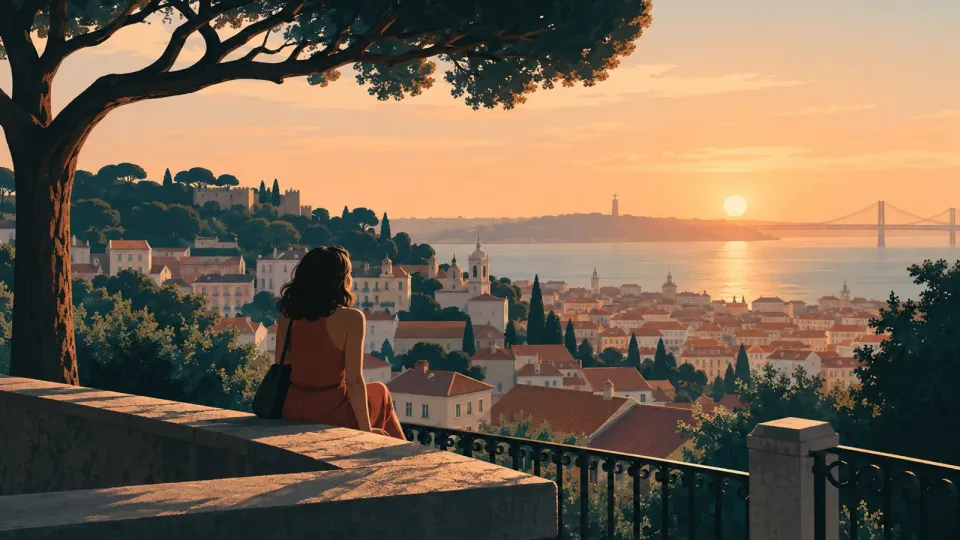
Lisbon viewpoints are not all the same, and the timing matters
If Lisbon has a “standard feature”, it is its viewpoints. But the uncomfortable truth is this: not all of them deliver the same experience, and many visitors book the wrong time, then blame the place.
This guide organizes the viewpoints by purpose, not by fame. Some viewpoints perform best at sunrise (clean light and calmer air), others are made for lunch (shade and a place to sit down), and a few really work only at sunset (when the city starts to glow). That is why the “best viewpoint” changes depending on your plan.
One myth to drop right away: “Miradouro” automatically means a great view and the right atmosphere. In Lisbon, some spots are mainly a stage (lots of people, noise, quick photos). Others are a breath (fewer lines of thought, more conversation, more time). Your goal should be to match the viewpoint to your day, not to collect postcards.
To avoid getting lost, think like this:
- If you want to start the day calmly, pick a viewpoint that looks east over Alfama and the river, and arrive early.
- If you want to eat and linger, choose a spot where you can pop into a nearby café or tasca.
- If you want the “wow” of sunset, pick the right viewpoints for August and avoid the peak rush.
In the next few minutes, you will get an honest ranking of 8 key viewpoints, by time of day and by the type of experience. And yes, the comparison everyone makes is included: Senhora do Monte vs Graça.
Sunrise in Lisbon: where the view feels brand-new (without crowds)
Sunrise in Lisbon has an advantage most tourists never use: the city is awake, but it is not crowded yet. If your goal is photos without people blocking the horizon line, choose a viewpoint early and do it with intention.
For sunrise, the Alfama-side viewpoints that look east and south over the rooftops and the Tagus, Santa Luzia and Portas do Sol, catch the early light before the crowds. Senhora do Monte and Graça look west across the Baixa and work better later in the day. The Miradouro da Senhora do Monte, next to the chapel of Senhora do Monte, looks across the castle, the Baixa rooftops and the river, according to Visit Lisboa. (lisboa.pt)
How to use this in practice:
- Go early, not “mid-morning”. The light changes quickly.
- Stay for 20 to 30 minutes. Lisbon rewards you when you are not rushing.
- Before or after, grab a breakfast stop nearby (tascas and cafés around Graça tend to work well early).
For a garden setting later in the morning, try the viewpoint-garden. The Jardim do Torel works both as a viewpoint and as a more breathable space than a typical stone terrace. There are official references to the place as a point of interest, and the urban setting is excellent. (revelar.lisboa.pt) The result is a sunrise that does not feel like a “tourist visit”. It feels like a walk break.
Lisbon’s hills mean the light changes quickly from one viewpoint to the next. That is why the most common mistake is choosing a sunset viewpoint for sunrise, then feeling that the atmosphere never quite happens. If you want calm at sunrise, start with Santa Luzia or Portas do Sol.
Ground-level note: on clear days, the views gain contrast. On coastal haze days, viewpoints still work, but your expectation should shift from “perfect postcard” to more “urban texture”.
Midday: shaded viewpoints with a good pace and easy nearby food
At lunchtime, a viewpoint that is only for looking becomes inconvenient. You want shade, you want time, and you want that when the view ends, there is a place to eat where you do not need extra planning.
The Miradouro de São Pedro de Alcântara is the clearest example of a viewpoint with the “structure” for midday. Visit Lisboa describes it as one of the widest and most iconic viewpoints, and it is a wide, two-level garden terrace with benches. (visitlisboa.com)
That helps a lot with a simple logic: while many people focus on the narrower hills, São Pedro de Alcântara gives you more room to breathe and shape your lunch around the viewpoint.
How to combine things without overcomplicating:
- Plan a meal nearby in the same area (Bairro Alto/Príncipe Real). If your lunch is light, you can still follow it with a short walk.
- On hot days, assume your day runs in sessions: 15 to 25 minutes of views, a food break, then you re-enter.
For contrast, the Miradouro de Santa Luzia is another solid midday option, because it is integrated into the historic space of Alfama and close to streets and corners that make you want to wander. Lisbon City Council treats Miradouro de Santa Luzia as a point of interest, and that shows up in the official details of the site. (lisboa.pt)
In short: Santa Luzia is not a “quick stop”. It is a low-intensity stop. If you are in a hurry, it will cost you.
The common mistake at midday is trying to “fit in” three viewpoints before 3:00 p.m., because Lisbon rises and falls all day. The result is getting tired before you even properly see things. Instead, pick one bigger viewpoint for lunch, then do a second mini circuit close to your route.
And yes, you can build in a practical detail: if you want the viewpoint to complement lunch, choose one where you can reach a café or restaurant in a 3 to 5 minute walk. That is the difference between “I turned into a tourist” and “I am actually living the city”.
Senhora do Monte vs Graça: pick the feeling you want
This is the debate that never ends: “Senhora do Monte or Graça?” The truth is that they are very close, but the vibe is different, and your plan should choose based on that.
The Miradouro da Senhora do Monte is associated with the Capela da Senhora do Monte, and Lisbon City Council describes it as an emblematic, sought-after viewpoint with a wide panorama. (lisboa.pt) What you feel there is “wide view”, with multiple urban elements appearing in layers.
“Graça”, in practice, points to the Miradouro Sophia de Mello Breyner Andresen (the old name was Miradouro da Graça). Wikipedia notes the name change and the location in the parish of São Vicente, in the courtyard of the Convento da Graça. (pt.wikipedia.org) Graça sits in the churchyard of the Convento da Graça and has a more neighbourhood-patio feel.
So how do you choose, without getting pulled into fan wars?
- If you want a more “total” view with a more dramatic framing, go to Senhora do Monte.
- If you want a neighbourhood environment and a slower experience, go to the Sophia de Mello Breyner Andresen area (Graça).
Now for the part that matters for your time in Lisbon: on busy days (especially August), capacity makes a difference. A simple strategy: do not choose both at the same time. Do one in the morning and the other late afternoon, or alternate based on your meal plan.
A useful note if you are visiting for the first time: Senhora do Monte sits by the chapel and is organized like a viewpoint space with views over areas such as Castelo de São Jorge and Baixa, which appears referenced in descriptions of the site. (lisboa.pt) That means when the horizon starts to darken, you get a highly photogenic composition.
And one practical tip if you are hopping on and off viewpoints: use the neighbourhood as your base. Graça and São Vicente work like a mini city within the city. If you start early, do a short loop, head for lunch, then return for a second spot. The experience stays cohesive, not like a marathon.
The goal is not to get the perfect photo, it is to make your afternoon actually make sense.
The right sunset: viewpoints that genuinely deliver the “wow”
Sunset in Lisbon is a show, but only if you choose the viewpoint that matches your kind of “wow”. There are viewpoints for photos and viewpoints for crowds. And there are viewpoints where sunset gives you enough time to really feel it.
For a late-afternoon wow, there are three main picks.
First, Miradouro de São Pedro de Alcântara. Visit Lisboa describes it as one of the widest and most iconic, which translates into an experience where the view is great and the space can handle the energy of more people without instantly overwhelming you. (visitlisboa.com)
Second, Miradouro da Senhora do Monte, because Lisbon City Council positions the viewpoint as an emblematic space, with a rich panorama and several visible points of urban interest. (lisboa.pt) When the light drops, that layered richness becomes an advantage.
Third, Miradouro de Santa Luzia. The reason is simple: Alfama gives you texture. Miradouro de Santa Luzia is listed as an emblematic point and a must-visit in official descriptions. (lisboa.pt) By the end of the day, the historic area feels like a living set.
Now comes the honest point many people skip: the “best” sunset viewpoints can struggle in August. It is not that the site gets worse, it is that your access to the site gets harder. Lines and density reduce the time you have to look.
How to avoid the crowds, without inventing magic tricks:
- Arrive 25 to 35 minutes before the peak time everyone talks about.
- Watch the sunset in two phases: first the horizon, then the city as it starts to light up.
- If you are travelling with family, pick a wider viewpoint (like São Pedro de Alcântara) to reduce stress.
And here is a detail few visitors think about: wind and temperature. By the Tagus, late afternoon can bring a cooler breeze. Pack a light layer, because sunset does not last, but the chill appears quickly.
If you are trying to maximize a 48-hour itinerary, use this logic: one viewpoint for “wide views”, one for “historic texture”, and save Alfama for when the light starts adding colour to the rooftops. That is how sunset stops being “just a stop” and becomes a memory.
Portas do Sol: the viewpoint that does not always earn its reputation
Portas do Sol is famous, and that reputation did not appear out of thin air. But it is also true that this viewpoint can fall short in specific conditions, and many visitors only realize it once they are already stuck in the middle of the chaos.
The Miradouro das Portas do Sol (linked to Largo das Portas do Sol) has a historic setting connected to the old Portas do Sol gates, and the spot lets you observe Alfama and the visual line all the way to the Tagus, according to historical and informative descriptions. (pt.wikipedia.org) In other words, there is content, and there is a view.
So why is it “not always worth it”? Because the experience tends to turn into a kind of photo queue. On very busy days, the viewpoint becomes a passage corridor, and that supposed “space to stay” disappears.
When does Portas do Sol work well?
- When you want a central stop that fits naturally into a walk through Alfama.
- When you are happy to stay less time and accept that the photos will be quick.
- When your energy is “exploring streets”, not “staying in one place”.
When does Portas do Sol not work?
- In August, late afternoon, when everyone has decided, at the same time, that it is the right moment.
- If you want silence or a slower experience.
A practical solution, to keep the Alfama spirit with fewer crowds, is to change the order. Instead of relying on Portas do Sol as your only late-afternoon stop, use Santa Luzia or São Pedro de Alcântara as your sunset anchor, and leave Portas do Sol as an in-between stop.
And here is another comparison worth making: if you enjoy a historic setting but want less density, look at the quieter viewpoint below. Lisbon rewards visitors who choose pacing.
A quieter viewpoint near the castle: Miradouro do Recolhimento
If the main viewpoints are crowded, a smaller one nearby is often calmer.
Miradouro do Recolhimento is that kind of place. It sits just below Castelo de São Jorge, off Rua de Santa Cruz do Castelo, and looks over Alfama towards Santa Apolónia and São Vicente. (lisbonportugaltourism.com) (delete)
How to use the “secret” without making the common mistake:
- Add it as your second stop, after a more obvious viewpoint.
- Go before mid-afternoon if you can. The gate closes at 19:00 in summer and 17:30 in winter (Time Out), so it is not an evening or sunset stop. Use it to extend the experience when the city has already slowed down.
- Pair it with a nearby café or tasca, so the visit does not end with that climb back into the rest of your day.
This is also where it matters if you are doing a 1 to 5 day trip: secret viewpoints are worth it when they are part of a walking circuit. If you end up relying on Uber and random transfers, you lose the point.
A simple way to design a circuit without overthinking it is:
- Choose an “anchor” viewpoint (one of the main ones).
- Take a short walk through the neighbourhood (20 to 40 minutes at a tourist pace).
- Finish at the calmer viewpoint for a “second wind”.
If you are visiting in August, this is gold. The city will still be busy, but your experience can feel more human.
And, one more style recommendation: when you find your viewpoint, do not think “photo”. Think “time”. A 15-minute stay, sit down, observe. Lisbon is built to reward people who slow down.
If you want an even more aligned experience, pick this viewpoint on days when the “perfect” sun is not guaranteed, because the urban texture often looks better than the expectation of a postcard shot.
Honest ranking by purpose (plus suggestions for eating nearby)
Your question should be simple, and this answer is too: which viewpoint should you choose for each moment? Here is a ranking by purpose to guide your day without collecting stress.
First, the list below is not “the 8 best” as a competition. It is “the 8 most useful”, because they fit real-life plans.
- Sunrise (calm, clean light)
- Miradouro de Santa Luzia: looks over Alfama’s rooftops and churches to the Tagus. (visitlisboa.com)
- Miradouro das Portas do Sol: next door, same eastward view, best before the tour groups arrive. (pt.wikipedia.org)
- Lunch (shade and proximity to eat)
- Miradouro de São Pedro de Alcântara, wide and iconic, great for turning the visit into a lunch-time stop with a good pace. (visitlisboa.com)
- Miradouro de Santa Luzia, tied to Alfama’s historic experience, good for an unhurried lunch. (lisboa.pt)
- Sunset (the city starts to light up)
- Miradouro da Senhora do Monte: layers and horizon, thanks to the panorama Visit Lisboa highlights. (lisboa.pt)
- Miradouro de São Pedro de Alcântara: wide space to handle the late-afternoon energy. (visitlisboa.com)
- Miradouro de Santa Luzia: Alfama with colour, because the location is one of the most emblematic. (lisboa.pt)
- Drinks and the “end of walk” moment (one last drink, no stress)
- Graça, at Miradouro Sophia de Mello Breyner Andresen (the former Miradouro da Graça): great when you want neighbourhood energy and conversation. (pt.wikipedia.org)
- Miradouro do Recolhimento, as a calmer daytime stop near the castle (gate closes 19:00 in summer, 17:30 in winter). (lisbonportugaltourism.com)
Now comes the practical part about food nearby, because a view without food does not make a story.
The combination that works almost always in Lisbon is:
- 1 viewpoint, 1 neighbourhood base, 1 nearby meal.
Example (not a strict recipe): if you pass through Graça and São Vicente, plan lunch in the area and use your second viewpoint as an extension, not a reset. That reduces unnecessary walking and avoids that “I keep hopping between hills” feeling.
On August crowds: if you only have 1 sunset to choose, pick a wide viewpoint first (like São Pedro de Alcântara), then decide whether you want to close with Santa Luzia or Senhora do Monte. Portas do Sol can work as a short stop, but do not make it your plan base, because the risk of getting stuck in the corridor is real. (pt.wikipedia.org)
When you use the purpose-based ranking, the city feels coherent. And in Lisbon, that matters more than guessing the “single best spot”.
How to avoid queues in August, without ruining the experience
In August, Lisbon does not get “prettier”, it gets fuller. And when a viewpoint becomes a destination instead of a place you pass through, your problem becomes logistical, not aesthetic.
What almost always fails in August is the strategy “let’s go before sunset, it will be fine”. It will not be, at least not the way everyone imagines. During peak hours, the flow is so concentrated that a 10 to 15 minute difference can completely change your experience.
A rule for August viewpoints:
- Arrive 25 to 35 minutes before your “photo peak”.
- Stay longer before the sky looks “perfect”, not after.
It feels counterintuitive, but it works because when it is the time everyone wants, you are already looking. And looking, in Lisbon, is different from waiting.
In terms of which viewpoints work best for August, the winners are the ones with enough space for use and circulation. Miradouro de São Pedro de Alcântara is described as one of the widest and most iconic, so it usually handles the energy better. (visitlisboa.com) The Miradouro da Senhora do Monte keeps the richness of the panorama, but density can be higher because it feels more like a “visit” space. (lisboa.pt)
And here is a useful comparison if you are reading this in a rush: Portas do Sol is central and beautiful, but it is easy to get pulled into a tourist rhythm. Historic descriptions connect the place to the old Portas do Sol gates and to views over Alfama and the Tagus. (pt.wikipedia.org) In August, that means two things, lots of people and little margin to “stay”. If you are interested in the scenery, use Portas do Sol as a short stop.
How to structure your circuit (simple step by step):
- Choose 2 main viewpoints for the day, not 4.
- Do the first early morning and the second close to late afternoon.
- Add a calmer viewpoint earlier in the day (Recolhimento closes at 19:00 in summer). (lisbonportugaltourism.com)
And if it is hot, do not assume “the sun” is just discomfort. Sun affects how easily you can walk and stand around. Bring water, and choose comfortable shoes, because Lisbon charges you on steep streets.
Final realism note: some viewpoints may have access restrictions due to maintenance or safety. So if you are visiting in August and deciding on the day, check the day before you set off.
If you do this, Lisbon in August will not be a fight for space. It will be the city you wanted to see, with a plan that actually works.
Next step: plan your visit by time of day
After all of this, your next step should be concrete, and today. It is not worth “seeing more things” if your real challenge is choosing what actually fits.
Pick one goal for the day:
- If you want to start calmly, schedule Santa Luzia or Portas do Sol in the morning.
- If you want a view-led lunch, lock in São Pedro de Alcântara or Santa Luzia.
- If you want a sunset with less stress, pair a wide viewpoint with something historic, and keep Portas do Sol for a quick in-between stop.
And a quick final check before you finalize:
- Is there a place to eat or drink nearby (or can you get there without resetting your day)?
- Does the timing match your energy, not just the “7:30 p.m. photo” you saw on your feed?
Written by Andre Ginja, Founder, andginja.
Sources
- Lisbon City Council, detail for Miradouro da Senhora do Monte
- Visit Lisboa, Miradouro de São Pedro de Alcântara
About the author
Andre Ginja is the founder of andginja, a studio based in Lisbon since 2018, building Content, Software, and AI for hospitality businesses. Portfolio partnerships include work with Etihad Airways, TAP Air Portugal, Duval, and PBH Group. NEEDS_ANDRE_INPUT: confirm the bio. Remove the employer line and the personal email unless André wants them on a travel guide.
Related guides
Best beaches Lisbon: Cascais to Caparica picks
Best beaches Lisbon, from Carcavelos to Caparica. Match surf, families, quiet time, and party vibes, plus train vs Uber vs ferry options.

Lisbon Airport to City Centre Routes: Metro, Bus, Taxi
Choose the best Lisbon airport route to the city centre: metro, airport bus, licensed taxi, and app-based rides. Compare fares, luggage, and late arrivals.
Lisbon coffee shops: specialty scene worth visiting
Lisbon specialty coffee: 8 cafés and roasters by neighborhood, how to order espresso vs filter, laptop-friendly spots and where to buy beans.
Michelin restaurants Lisbon: the actual list
Every Lisbon restaurant in the 2026 MICHELIN Guide: the three two-star tables, the 12 one-stars and the Bib Gourmand picks, plus how to book and what tasting menus cost.