
Wine bars Lisbon: natural wine and Portuguese pours
Wine bars Lisbon guide for natural wine and Portuguese bottles. Taste Vinho Verde, Alentejo, Douro, and smart port picks.
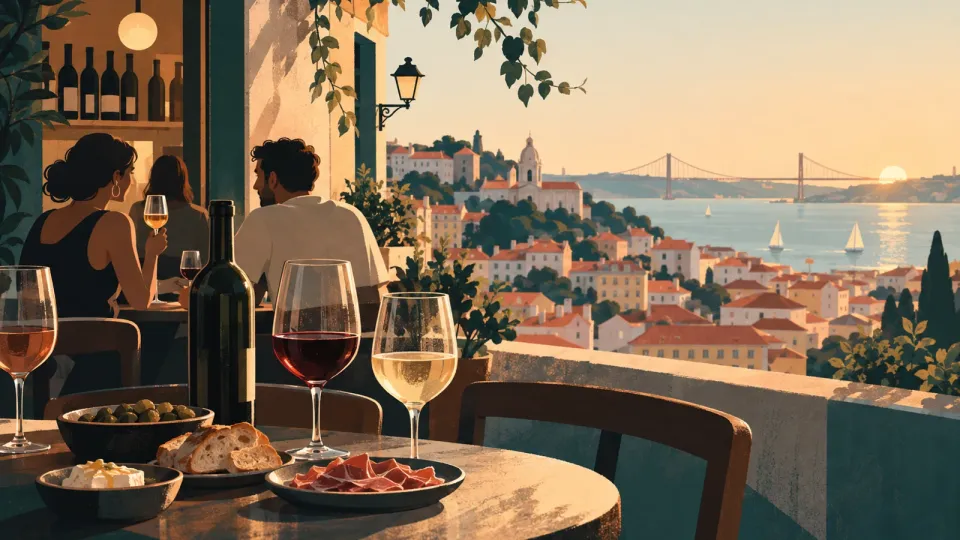
Wine bars Lisbon: start with natural, then branch to Portuguese regions
Most travelers treat Lisbon wine as a warm-up for Porto. Don’t. If your first night is in Lisbon, the best play is to do natural wine first, then let the next glass ladder you into the regional classics: Vinho Verde, Alentejo, Douro, and finally port.
Lisbon has a small, lively natural-wine scene alongside classic Portuguese wine bars. The fastest way to avoid tourist-trap bottles is to pick places that are clearly curated, not just “a bar with wine.” In practice, that means you ask one question when you sit down: “What are you pouring tonight from Portugal that tastes alive?” Then you order based on what you hear, not on what the menu says.
Here is a simple decision framework. If the bar talks about natural wine and you see small producers on the list, you are in the right lane. If it is “Portuguese wine bar” but the menu looks like generic mass-market labels, switch lanes. If you want port, decide up front whether you want a Lisbon pour experience (easy, educational) or a Porto pour experience (cellar immersion).
Below are six Lisbon wine bars, ranked by what they specialize in, plus the one tasting rule that keeps the evening fun instead of confusing. You will also get a reality check on bottle versus glass pricing, because Portuguese wine bars can be generous, or they can quietly trap you into buying a bottle you did not mean to.
Practical tip for your first night: book or arrive early at the natural spots. The best ones turn into “everybody in Lisbon suddenly discovered it” lines, and natural wine does not always move fast from bottle to glass.
6 Lisbon wine bars, ranked by what they pour best
This is the short version of the list that matters. Each pick is chosen because the bar has a clear identity in what it pours, not because it is “near a viewpoint.”
-
Pinot, from the team behind Senhor Uva Senhor Uva, long one of Lisbon's best-known natural wine bars, has closed. Its team now runs Pinot, a wine bar and shop facing Jardim da Estrela (Rua João Anastácio Rosa 4-B), open daily 16:00–23:00. (senhoruva.com)
-
Bloco, natural wine bar with a seasonal, Lisbon pace Bloco (Rua Nova da Trindade 11L, Chiado) is another place where the bar identity is not vague. The listing descriptions focus on natural wines and seasonal food, so you can expect the glass list to make sense with what you eat. (raisin.digital)
-
Salty Floor Natural Wine Bar, for the pure natural vibe If you want low intervention drinking without the “we also have a few naturals” compromise, Salty Floor is explicitly framed as a natural wine bar. It is in Belém (Rua dos Jerónimos 18C), so pair it with a Belém afternoon. (corner.inc)
-
By the Wine, Portuguese regions plus a defined producer angle By the Wine positions itself around a structured Portuguese wine selection (and not a random grab-bag). In particular, it states it presents the range of wines from Sogrape, alongside Portuguese icons and port houses. (bythewine.pt)
-
Taylor’s Port wine shop and tasting room, for Lisbon port education If you decide to do port in Lisbon, make it an educational tasting rather than a glass by accident. Taylor’s has a dedicated tasting room in Alfama, and it is explicitly described as a shop and tasting room where you can sample their ports. (taylor.pt)
-
Salla Bar in Palácio Chiado, if you want a polished bottle list Salla Bar is in a high design setting, and the bar identity is tied to the Palácio Chiado venue. If your group wants wine, cocktails, and atmosphere in one place, it is a decent “compromise” pick without pretending it is natural first. (palaciochiado.pt)
A common misconception: people assume a “central” bar means watered-down wine. Not always. But you have to pay attention to how specific the venue is about producers and styles. The more exact it sounds, the less likely you are to end up with a safe but boring pour.
Bottle versus glass reality, as promised: many wine bars do offer by-the-glass options, but natural wine often makes the “by glass” list the most interesting part. If the menu only pushes bottle sizes, you should treat the bottle as a tasting commitment, not as a default purchase. If you want control, start with one glass, then decide whether you want the bottle at the table.
Natural wine Lisbon: how to order so it tastes intentional
Natural wine gets an undeserved reputation for being unpredictable. In Lisbon, the better venues make it intentional, but you need a simple ordering ritual.
Here is the direct answer: order by style cues and by food pairing, not by grape name alone. Natural wine bars usually curate around producers and low intervention methods, so the “what should I drink” question matters more than “what is the vintage.”
The one ordering mistake to avoid is treating natural wine like a souvenir. If you order a red because the color looks dramatic, you will miss the point when the acidity and texture do not match your meal.
Use this 3-step script at the bar:
- Ask what they are serving from Portugal today. Venues that specialize in natural wine will typically know their lineup and can point you to the “drink now” pour.
- Ask for the bottle style that matches your mood: crisp and fresh, lightly chilled, or more structured.
- Confirm the food match: “If I do this with something salty or something creamy, what should I pair it with?”
Why this works in Lisbon: the city’s natural scene is built around restaurants and wine bars that treat the whole evening as one experience.
Now the practical part, bottle versus glass. If you are with two people, order one glass each, then share a second glass before deciding on a bottle. Natural wine can be complex, and sharing removes the pressure of committing to a full bottle too early.
If you want to “book the natural wine experience,” do it like this: pick your natural wine bar first, then plan your neighborhood walk around it.
Bottom line: natural wine in Lisbon is not random, it is curated. Your job is to ask for what is alive today, then let the staff match it to your meal.
Portuguese wines to drink in Lisbon (and the ones to skip)
If you want Portuguese wine in Lisbon that feels like Portugal, not like imitation, focus on region-driven styles.
Start with the direct answer: skip “entry-level branded rosé” and order region-led pours that match Portugal’s geography, Vinho Verde for freshness, Douro for depth, and Alentejo for warmth.
What makes this better than generic advice is that Portugal’s regions are not interchangeable. Vinho Verde is “green wine” by name, but not by color, it is defined by youth and drink-now freshness, often with a light effervescence. (turismocastillayleon.com)
Douro is the home base for port, but it also produces serious wines. Port in particular is legally defined as a fortified wine produced under specific conditions in the Demarcated Region of the Douro. (ivdp.pt)
Alentejo is different again, it is warm, and it often brings ripe fruit with a more relaxed, sun-drenched character. Even when you are not drinking Alentejo reds only, Alentejo often shows up in Lisbon wine lists as a dependable “safe but not boring” region. (theweek.com)
Now, what you should actually order by region:
- Vinho Verde: ask for something crisp, slightly spritzy, and food-friendly. It is the most “Lisbon summer evening” style.
- Alentejo: order a red that feels warm, not jammy. If the wine bar offers “red from Alentejo” without describing it, ask what the house style is.
- Douro (non-port, if available): ask for a structured red with a bit of grip. If your bar is focused on Portuguese producers, they can usually suggest a Douro wine that is not just “port tasting in disguise.”
- Lisboa region: for lighter Portuguese bottles that still feel local, look for Lisboa DOC and ask if it is closer to fresh and floral or more rounded.
One misconception: people think they need to know every grape variety to order well. You do not. Lisbon wine bars will guide you if you use regional language instead of grape trivia. Say “Vinho Verde that is crisp,” “Alentejo that is warm but not sweet,” or “Douro that has depth.”
If you want an easy, staff-friendly fallback: By the Wine publicly positions itself as showcasing a structured set of Portuguese wines, including well-known Portuguese producers and port houses. (bythewine.pt)
And yes, there is a reason Porto often hogs the spotlight. Port is the iconic fortified export from the Douro region, and it has a legal framework around what “port” means. (ivdp.pt)
But Lisbon can still be your best night for Portuguese wine variety. Treat Lisbon as a “Portugal sampler,” and use Porto for the full port ritual.
Vinho Verde vs Alentejo vs Douro: the glass-by-glass cheat
You do not need to be a sommelier to order Portuguese wines correctly. You need one mental model: each region behaves differently on your palate.
Here is the direct answer: Vinho Verde is the “fresh and drink-now” pour, Alentejo is the “warm and ripe” pour, and Douro is the “serious structure” pour.
Let’s make that real.
Vinho Verde is defined by freshness and youth. Even when it is not literally sparkling in every bottle, the idea is to drink it young and enjoy it as lively. It is exported widely, and it is recognized as a Denominação de Origem associated with the Vinho Verde region in Portugal. (turismocastillayleon.com)
Alentejo is the south-facing counterpoint. It is larger, warmer, and it often gives you wines that feel sun-warmed even when you keep the glass chilled appropriately. A recent travel piece on Alentejo wine describes it as a distinctive range with a landscape of cork oaks and vineyards. (theweek.com)
Douro is not just “red wine,” it is the same geography that produces port. Port wine is legally defined as a fortified wine produced in the Demarcated Region of the Douro under specific conditions, and it stands out with higher alcohol and residual sweetness depending on style. (ivdp.pt)
So what do you do at the bar?
- If your dinner is seafood or something bright, start with Vinho Verde. Your palate will thank you.
- If your dinner is grilled meat or richer flavors, go Alentejo. Ask for a red that is ripe but balanced.
- If your dinner is slower and you want depth, go Douro, then consider port only after you finish your “regular wine” segment.
Now the port question that travelers always dodge: should you do port in Lisbon or wait for Porto?
Direct answer: do a small Lisbon tasting if you want education and convenience, wait for Porto if you want the full cellar immersion.
Port houses in Porto are a whole experience, but Lisbon has dedicated tasting rooms that make port easy to understand. Taylor’s Port wine shop and tasting room is explicitly described as a public tasting experience in Alfama. (taylor.pt)
If you do it in Lisbon, keep it disciplined: choose one style, like a white port or a ruby/tawny style, and pair it with dessert or a slow snack.
Bottle versus glass pricing, without guessing: port and natural wine by the glass can vary heavily by venue. That is why your best “control move” is to ask for two glass pours of the same wine style instead of defaulting to a bottle. You will learn quickly whether you actually want another glass or whether you should switch regions.
One more misconception: “Douro equals port, end of story.” Not true. Douro produces wines beyond fortified styles, and if the bar gives you a chance to taste a Douro table wine, you should take it.
If you follow the palate model (fresh, warm, structured) you will order faster, waste less money, and enjoy Lisbon more.
Port in Lisbon vs Porto: pick the right ritual
Port is the one drink where geography actually matters. The question is not “where is port cheapest,” it is “where will you enjoy it the right way?”
Direct answer: in Lisbon, do a tasting that teaches you. In Porto, do a tasting that immerses you.
Port wine is a fortified wine, defined as port, produced in the Demarcated Region of the Douro under specific conditions, and it is known for its range of styles, sweetness levels, and typically higher alcohol. (ivdp.pt)
That legal definition matters because it changes what you should taste. “Port” is not just a sweet wine you drink randomly at night.
Lisbon port ritual (smart and compact): Taylor’s Port wine shop and tasting room in Alfama is built as a place to sample their ports directly in Lisbon. Taylor’s describes it as the first shop and tasting room of its kind in Lisbon. It is at Rua Cais de Santarém 8 in Alfama and opens 11:00–13:00 and 14:00–19:30. (taylor.pt)
This is ideal if:
- you only have 1 night to dedicate to port
- you want the staff to explain styles before you commit later
- your group will not wake up early for Porto’s cellar schedule
Order discipline for Lisbon:
- Ask which style is best “for first timers,” then pick one.
- Do not pair port with the heaviest possible meal first. Start with something medium, then go richer.
- If you are also doing natural wine earlier, leave port as the last act. Natural wine and port can either sing together or fight. Ending with port is usually smoother.
Porto port ritual (the full immersion): In Porto, the classic move is to visit port lodges and cellars in Vila Nova de Gaia, where tastings are paired with history, aging, and production context. Sandeman, for example, markets cellar visits in Gaia. (sandeman.com)
You should go to Porto for this if you want:
- a “walk into the cellar” experience
- a multi-style tasting flow that feels like a guided story
- the option to buy bottles once you understand them
Now, booking and pricing reality. You cannot assume that “a tasting” is one fixed format. Different houses structure experiences differently, and prices vary by length and inclusions. Because I do not want to guess for your specific dates, treat Lisbon and Porto tastings as separate budgets and confirm the exact format on booking.
One misconception: “Port is only for old people.” Port can be fresh, dry-ish in character depending on style, and it can be incredibly food-friendly if you choose the right one.
If you want a practical rule you can use today: if you are staying in Lisbon and you have only one free evening, book the Lisbon tasting. If you are doing Porto as well, save your “first port” for Porto, then do a smaller Lisbon port glass only if you still care.
Bottle vs glass pricing in Lisbon wine bars: don’t get surprised
The biggest money leak in Lisbon wine bars is not the average price, it is buying too early.
Direct answer: order two glasses first, then buy a bottle only if you want the rest of the evening to taste like that first glass.
Here is why. Lisbon wine bars are built on curation. That means the best item on the menu might not be the bottle, it might be a specific by-the-glass pour from Portugal. In natural wine spots, the glass list is often where the freshest bottles end up first.
At the same time, central neighborhoods can create a pricing trap. You sit down thinking you will “just do one bottle to share,” and then the staff brings out a bottle price that assumes you are committing to a full table meal.
What you do instead:
- At arrival, ask what the house glass pour is for Portugal this week.
- If there are multiple natural options, try one red and one white (or one fresh style and one richer style).
- Only then decide whether a bottle is the right move.
If you are with two people, the control math is simple. Two people, two glass pours each, equals four glasses total. If that is too much for your night, reduce to three glasses total. If you love it, that is when you buy the bottle.
In Lisbon, the “best by-glass moves” usually show up in places that specialize in Portuguese curation. For instance, By the Wine describes its approach around a defined producer portfolio, including both Portuguese wine brands and port houses. (bythewine.pt)
When a venue has a producer-centric list, the glass selection is typically coherent and you are less likely to stumble into a weird bottle.
Now the port add-on: port tasting pricing can differ drastically depending on whether you do a dedicated tasting room, a quick pour, or a guided cellar experience. Taylor’s Port explicitly describes its Lisbon tasting room setup, and Porto lodges like Sandeman market cellar visits. (taylor.pt)
So treat port like a planned segment, not an afterthought.
One practical example of a safe evening flow:
- Start with natural wine glasses in a natural-focused venue.
- Move to a Portuguese region bottle share that matches dinner.
- Finish with one port tasting glass in Lisbon (if you still want it), or reserve port for Porto.
If you follow that flow, you will not just “spend money,” you will buy the right experience.
If you want to reduce spending without reducing quality, do this one thing: ask for the bar’s “best glass value” option. Staff who curate their list will usually answer honestly, and you will learn what the venue actually stands behind.
Plan your Lisbon wine bar night by neighborhood, not by “top 10” rules
Lisbon is a city of micro-moods. Chiado feels like polished evenings, Alfama feels like old stone and late walks, Estrela feels like locals decompressing, and the rest of Lisbon rewards you for moving with intent.
Direct answer: choose one neighborhood anchor, then pick your next bar within a 20-minute walk or short ride, so your night stays smooth.
A traveler mistake is to zigzag across the city based on a random list. You spend energy on transit and lose time to actually tasting.
Here is a neighborhood-first plan that fits the bars named above.
Night 1: Chiado and Baixa (easy, central, wine-forward) Start with a wine-focused venue in Chiado, then keep the evening close to where you are staying.
- If you want “Portuguese wine bar but with structure,” By the Wine is based in Chiado and positions itself around defined Portuguese producer ranges. (bythewine.pt)
If your group wants a place that can handle multiple tastes, Salla Bar in Palácio Chiado is a venue in the same vibe zone. (palaciochiado.pt)
Night 2: Natural wine night, choose your reservation-first spot Natural venues can get busy because people are actively hunting the scene.
- Put Bloco (Rua Nova da Trindade 11L, Chiado) at the centre of the plan. Listings give Tuesday to Saturday from 18:00, so check before you go. (raisin.digital)
- If you prefer a different natural vibe, Salty Floor Natural Wine Bar is framed explicitly as natural wine. (corner.inc)
Day 3 (if you are in Lisbon long enough): an Alfama afternoon for port If you want port in Lisbon, go to Alfama in the afternoon. Taylor’s tasting room closes at 19:30, so treat it as a pre-dinner stop.
- Taylor’s Port wine shop and tasting room in Alfama is explicitly described as a public tasting experience. (taylor.pt)
One misconception: “Port in Lisbon is not real port.” That is the wrong question. The real question is whether you want a short, guided introduction or a multi-hour cellar immersion.
If you are also visiting Porto, do Porto for the immersion and use Lisbon for the compact lesson.
Night logistics shortcut:
- Book natural wine first, then pick dinner around it.
- Walk between bars only if the second bar is within a neighborhood radius.
- End with port only if you planned it, not if you feel “maybe one last thing.”
The outcome is simple: you taste more, you spend less by accident, and you end the night with the right kind of wine story.
FAQ: wine bars Lisbon, natural wine, and Portuguese pours
Which wine bars Lisbon should I book if I want natural wine?
Book natural wine bars first if you want a smooth evening. Bloco in Chiado and Salty Floor in Belém both build their lists around natural wine. Pinot, from the team behind the now-closed Senhor Uva, is a wine bar and shop by Jardim da Estrela. (senhoruva.com)
What is the easiest way to choose between Vinho Verde, Alentejo, and Douro?
Use the palate model: Vinho Verde is fresh and drink-now, Alentejo is warm and ripe, Douro is structured and serious. Vinho Verde is recognized as a Denominação de Origem, and Douro is tied to port as a Demarcated Region wine with fortified styles. (turismocastillayleon.com)
Should I do port in Lisbon or in Porto?
Do Lisbon for education and Porto for immersion. Taylor’s Port has a dedicated tasting room in Alfama in Lisbon, while Porto tastings are built around port lodges and cellar visits in Gaia. (taylor.pt)
Is “natural wine” always unpredictable?
Not at the venues that specialize in it. Staff at specialist natural-wine bars expect questions and will steer you to what is drinking well that night.
What should I order if I only have one night in Lisbon?
Start with natural wine glasses in a natural-focused bar, then pick one Portuguese region bottle to match dinner, and skip extra port unless you still want the taste story. The region model helps you avoid ordering a second wine “just because it is on the list.”
Bottle versus glass, what is the smartest move?
Order two glasses first. If you love them, then buy a bottle. This prevents the most common Lisbon wine bar overspend, committing to a bottle before you know which pour actually hits your palate.
Where can I get Portuguese wine without falling into generic labels?
Choose bars that describe curation clearly. By the Wine positions itself around a structured producer range (Sogrape) and includes Portuguese icons and port houses, which makes its Portuguese bottle list more coherent. (bythewine.pt)
What is “port wine” legally, so I am not guessing?
Port wine is a fortified wine defined as produced in the Demarcated Region of the Douro under specific conditions. The Institute of Wines of Douro and Porto describes it as a fortified wine made under that demarcated framework. (ivdp.pt)
Written by Andre Ginja — Founder, andginja.
Conclusion: your next step is a timed wine route, not another screenshot
Here is the direct takeaway: in Lisbon, natural wine is your best opening move, Portuguese regions are your structure, and port is your planned finale.
If you remember only one thing, remember this order:
- Natural wine in Lisbon, pick a place that specializes in natural, then ask what is on right now.
- Portuguese region bottle for dinner, use Vinho Verde for freshness, Alentejo for warmth, Douro for structure.
- Port last, and only if you picked the right Lisbon tasting room or you are saving it for Porto.
Your biggest risk is the default mistake: doing a “top 10 wine bars” scramble and ordering a random bottle early. Natural wine and Portuguese wine reward patience. You will spend better if you test first.
Action you can do today, no waiting: Pick two bars from this guide: one natural-wine spot and one Portuguese-region bar for dinner. That is the entire plan for a great wine night.
Sources
- Taylor’s Port wine shop and tasting room in Lisbon, Visit Lisboa
- Instituto dos Vinhos do Douro e do Porto, Introduction to Port Wines
About the author
Andre Ginja is the founder of andginja (since 2018), a Lisbon-based studio building Content, Software, and AI for hospitality businesses. Past tier-1 partner work includes Etihad Airways, TAP Air Portugal, Duval, and PBH Group, with 20M+ content views. He is also a Senior Software Engineer at AvaLabs (Custody product). [email protected]
Related guides

Best beaches Lisbon: Cascais to Caparica picks
Best beaches Lisbon, from Carcavelos to Caparica. Match surf, families, quiet time, and party vibes, plus train vs Uber vs ferry options.

Lisbon Airport to City Centre Routes: Metro, Bus, Taxi
Choose the best Lisbon airport route to the city centre: metro, airport bus, licensed taxi, and app-based rides. Compare fares, luggage, and late arrivals.

Lisbon coffee shops: specialty scene worth visiting
Lisbon specialty coffee: 8 cafés and roasters by neighborhood, how to order espresso vs filter, laptop-friendly spots and where to buy beans.
Michelin restaurants Lisbon: the actual list
Every Lisbon restaurant in the 2026 MICHELIN Guide: the three two-star tables, the 12 one-stars and the Bib Gourmand picks, plus how to book and what tasting menus cost.