
Praia do Camilo from Lagos: stairs, space, weather
Plan Praia do Camilo from Lagos with clear stair access tips, what space feels like, and how to check water and wind conditions before you go.
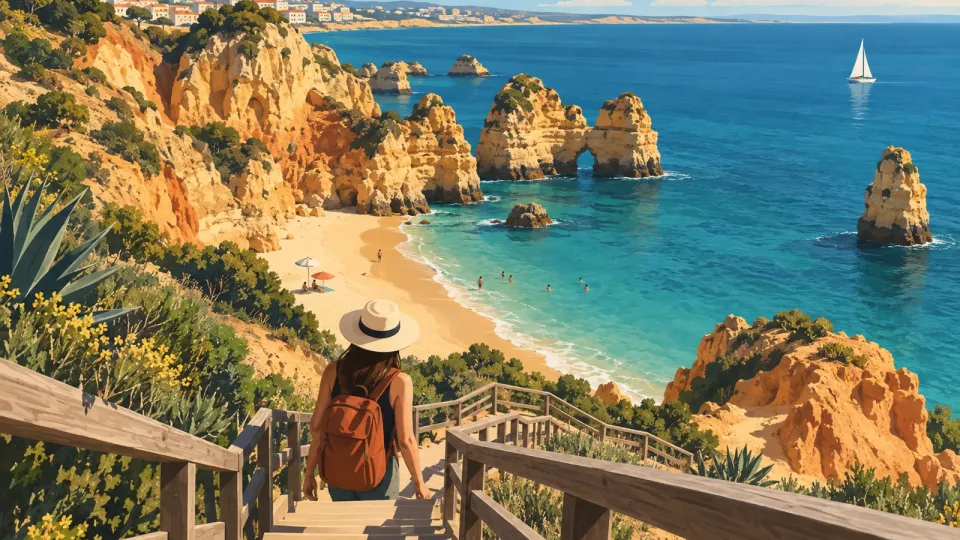
Why Praia do Camilo feels tiny, even when the sea looks calm
Praia do Camilo is short on beach space because it is a small, cliff-hugging cove. When the tide rises or the sea is stirred up, the usable sand can shrink quickly, while the dramatic rock edges stay the same.
The most common mistake is treating Camilo like a standard “big-sand” beach. Lagos has larger options, like the long, open Meia Praia, where space changes more gradually. On Camilo, the geometry is the story: you go down a wooden staircase to a compact bathing area that can feel crowded faster than you expect. Local comparisons are often framed as Camilo versus Praia de Dona Ana, where Dona Ana’s access is generally easier and the bay can feel roomier for many visitors. See the Dona Ana versus Camilo practical differences discussed by Discover Lagos. https://www.discoverlagos.com/en/blog/dona-ana-vs-camilo
Another reason Camilo can feel “tight” is timing. In peak season, the walk down is part of the experience, so many people arrive in similar windows. Even when you see other groups at the stairs, the actual sand area may still be scarce because it is a managed, stair-only access beach.
Here is a simple way to predict how crowded the sand will feel before you even reach it:
- Look at the sea state from Ponta da Piedade direction, not from the town side. If waves are breaking near the rock line, you will likely get less calm water.
- Assume higher tide means less usable sand. Camilo is compact, so the “tide effect” is more obvious.
- Choose off-peak time if your priority is beach space for photos. Early arrival is often the easiest path to breathing room.
For water quality and swimming conditions, rely on official data rather than visual guesses. The Portuguese Environment Agency (Agência Portuguesa do Ambiente, APA) provides water quality information through its InfoÁgua platform. https://infoagua.apambiente.pt/en/beaches and https://infoagua.apambiente.pt/pt/praias
Camilo can be a brilliant photo spot and a great swim when conditions align, but it rewards planning. If you treat it as a small-cove experience, you will be happier with your time and expectations.
Stairs to Camilo: what the route really means for you
Your main question is not “How do I get there?” It is “How much staircase effort fits my day?” Praia do Camilo access is famously stair-based, which changes everything about timing, luggage, and even water sports gear.
Municipality of Lagos guidance explains that the beaches of Praia da Dona Ana and Praia do Camilo have terrestrial access via “escadarias” (winding staircases). Because the approach is through long and curving steps, there are rules that limit carrying bulky equipment during the bathing season, for safety and comfort. The Municipality states this regulation entered into force on 16 August, with effect during the bathing season, and it specifically refers to restricting access via the staircase by people who carry boards and other equipment for nautical sports (the rule is time-bound). Source: Câmara Municipal de Lagos. https://cm-lagos.pt/municipio/noticias/12752-acesso-as-praias-dona-ana-e-camilo-passou-a-estar-regulamentado
What this means for your visit from Lagos, in practical terms:
- Pack light. A small day bag is fine, a heavy load is harder to manage and can attract attention if it resembles regulated equipment.
- Wear shoes you can trust. The staircase can be slippery after rain, or when the rock area is damp.
- Plan your photo workflow upward, not only downward. Many visitors shoot the beach and the rock line below, but the best framing often involves pausing on the way up or down for viewpoint angles.
A common misconception is that stairs are “bad access,” so people avoid Camilo entirely. In reality, stairs are part of Camilo’s charm and its limitation. The staircase helps create a more intimate feel, so the beach does not behave like a wide, walk-up sand area.
If you are doing beach hopping in one day, decide your order:
- Go to Camilo when you want the staircase experience and the small cove mood.
- Pair it with a nearby beach that supports longer lounging later.
For your safety planning, also note the official reminder from APA materials that information about bathing water conditions exists, but beach access and bathing rules are still subject to local conditions, signage, and lifeguard presence when available. APA explains its InfoÁgua data is paired with daily forecasts and tide information. https://apambiente.pt/en/node/986
Bottom line: the stairs are the access system. Treat them like part of the activity plan, not a minor detail, and your Camilo visit will feel smoother.
Beach space and timing: how to choose the right window
If you want more beach space at Praia do Camilo, your best tool is timing. The beach is small, and the staircase funnels people into a compact landing area.
A helpful way to think about it is “arrival synchronization.” In peak season, groups often arrive before the light shifts or before people feel tired from the walk. When that happens, you may see the stairs busy while the sand still feels limited.
Also, sea conditions can change your available space even when the tide is not extreme. If waves are breaking against the rock edges, the water gets less inviting, and people cluster higher along the calmer zone.
Here is a simple, low-effort framework you can use the day you go:
- Arrive early if you prioritize photos and open sand.
- Arrive later if you prioritize dramatic atmosphere and do not mind more people.
- After rain or strong wind, expect different water behavior. APA’s water quality and beach condition monitoring is designed for exactly this kind of uncertainty, so check it before you commit. https://infoagua.apambiente.pt/
Camilo versus Dona Ana is often described as a practical choice between “smaller, more stair-dependent” and “more all-around” experiences. Discover Lagos discusses the key practical differences between Camilo and Dona Ana, including how the staircase experience changes flow and comfort. https://www.discoverlagos.com/en/blog/dona-ana-vs-camilo
If you are building a photo day, use the rock-line idea:
- Start with wide frames that include the rock framing and stair context.
- Move down to tight beach and waterline shots.
- Keep your gear minimal so you can move when the light changes.
For official safety conditions, do not rely on memory. Use APA’s InfoÁgua for water classification and updated bathing context, then follow on-site signage about swim conditions. APA describes that its platform includes bathing water quality information and complements it with forecast data and tide hours, so it is built for day-of decisions. https://apambiente.pt/en/node/986
One more misconception to avoid: “Camilo is always good at sunset.” It might look perfect from viewpoints, but the bathing area can become less comfortable when wind and wave patterns shift. Camilo is a weather-sensitive small cove.
Choose a window based on your goal. If your goal is space, prioritize early. If your goal is mood, you can be flexible, but still check conditions.
Weather-dependent swimming: check water and wind before you go
Praia do Camilo is a place where weather-dependent conditions really matter. Even if the beach looks calm from above, wind and wave direction can make the bathing area feel rougher or more exposed.
To avoid guessing, use two official-style checks before departure:
- Water quality and bathing context via APA’s InfoÁgua platform. APA explains that it monitors bathing waters and assigns classifications based on multi-year monitoring data and ongoing evaluation. https://infoagua.apambiente.pt/pt/praias
- Daily context via APA materials that pair its data with forecasts and tide hours. APA describes that InfoÁgua includes information such as water classification and also uses daily forecast and tide data to help you plan what conditions you might find. https://apambiente.pt/en/node/986
What to look for in practical terms:
- If the wind is strong, the surface can look shiny but choppy. That can reduce comfort for swimming and increase splash in a small cove.
- After rough weather, water can be murkier. Use InfoÁgua and on-site flags, not just visibility.
- Tide can affect where the safest, calmest waterline sits. In a compact beach, that difference is more noticeable.
Common mistake: relying on “it is a sheltered cove, so it must be safe.” Camilo can be protected compared to fully open beaches, but it still faces Atlantic conditions and can change quickly.
If you want a rule of thumb that fits many beach days in Lagos:
- If you see active breaking near the rock edges and foam patterns moving strongly, treat it as a “view and paddle” day rather than a full swim.
- If the waterline looks smoother and wave energy is lower, it can be a better bathing day.
For the safety system itself, the APA materials emphasize that beach classification and safety assistance are not the same thing as “water looks clean.” APA notes that some beaches are not classified as bathing beaches, and swimming should be guided by local rules, flags, and lifeguard presence where applicable. https://backoffice.afpop.com/sites/default/files/2025-06/update-june-2025.pdf
Finally, remember that Camilo is a small-cove experience, so if conditions are not right, you can still salvage the visit. Use it for photos from the stair path and nearby viewpoints, then shift your bathing to a larger, more flexible beach later.
Treat InfoÁgua like your “go or no-go” dashboard. You will spend less time disappointed by conditions you could have checked first.
From Lagos to Praia do Camilo: choose your route and effort level
From Lagos, Praia do Camilo is reachable by walking access and by car-based approach toward the Ponta da Piedade direction. The exact “best route” depends on whether you want a low-effort plan or a beach-hopping plan.
Because this is a stair beach, your transportation plan should minimize stress before you start the descent. People often waste energy searching for parking or walking long loops at the wrong time, then arrive at the stairs too tired to enjoy the day.
Here are practical ways people structure this trip:
- Walking-oriented day: Use Lagos centre as your base, then walk toward the coast in stages. The Portugal Guides’ Lagos city overview states that the main beaches, including Praia Dona Ana and Praia do Camilo, are walkable from the centre in roughly 15 to 25 minutes. Source: The Portugal Guides Lagos city page. https://www.theportugalguides.com/city/lagos/
- Car-oriented day: Follow the coastline approach toward Ponta da Piedade. A “Beach guide” style PDF for Lagos mentions access by road from Lagos, following signs for “praias” and Ponta da Piedade, and it lists support infrastructure such as a restaurant and WC. Source: Lagos beach guide PDF (Sunlighthouse). https://www.sunlighthouse.pt/_files/ugd/1cb347_c8ed4cf312234b5d9e0719ede19debdb.pdf
What to do if you want a precise plan for today: look at your starting point (Lagos historic centre, marina area, or a hotel). Then choose:
- If you are staying in the old town area, walking can be simple.
- If you have limited mobility for stairs, you may want to reconsider Camilo for another beach. The Dona Ana and Camilo regulations and the staircase nature are key context, as outlined by the Municipality of Lagos. https://cm-lagos.pt/municipio/noticias/12752-acesso-as-praias-dona-ana-e-camilo-passou-a-estar-regulamentado
Also, treat equipment differently. If you are carrying bulky water sports gear, local rules restrict certain uses via the staircase during bathing season hours. The Municipality specifies the time-bound restriction and explains it targets safety because the access is via winding staircases. https://cm-lagos.pt/municipio/noticias/12752-acesso-as-praias-dona-ana-e-camilo-passou-a-estar-regulamentado
A realistic day-of decision checklist:
- Can you keep your bag light enough for the stairs?
- Are you arriving when the weather allows comfortable walking on the steps?
- Will you need beach supplies, or can you buy them nearby once you reach the area?
Remember, this article scope is Praia do Camilo from Lagos. If you are deciding between Camilo and Dona Ana, use the differences in access and comfort to guide your choice. Discover Lagos compares them directly. https://www.discoverlagos.com/en/blog/dona-ana-vs-camilo
Plan your transport like it is the warm-up for the staircase. Make the descent the highlight, not the struggle.
Camilo essentials for small-cove comfort: gear, beach space, photos
You do not need a lot of gear to enjoy Praia do Camilo, but you do need the right kind of gear. The stairs decide what works, and the small cove decides what you will actually use once you are there.
A smart packing list for Camilo:
- A compact beach bag with only what you will use in the first hour.
- Non-slip footwear (especially if you visit after a shower).
- A lightweight towel and a small layer for windier moments.
- Sunscreen and water because the beach is small, and you do not want to scramble once you are down.
About beach space: Camilo has limited sand length. A listing on Praias.pt describes the beach length as approximately 50 meters, which helps explain why the space can feel tight when several groups arrive. Source: Praias.pt. https://praias.pt/algarve/lagos/praia-do-camilo/
Photos without clutter is the real advantage of a small-cove beach. When your background is built by limestone rock edges and staircase geometry, you can get strong images with less staging.
If you are photographing, try this sequence:
- Stairline frames: Shoot from above or halfway down to show context (stairs plus cove).
- Tight waterline: Focus on texture, foam, and the boundary where calm water meets rock.
- Wider composition from a safe viewpoint: Capture the cove and the rock forms without crowding your position.
When you compare Camilo with nearby choices like Praia de Dona Ana, the practical differences often come down to how the staircase affects visitor flow and comfort. Discover Lagos highlights these differences in its comparison. https://www.discoverlagos.com/en/blog/dona-ana-vs-camilo
Essentials for comfort also include restroom and basic facilities planning. A Lagos beach guide PDF notes support infrastructure such as a restaurant and WC and mentions lifeguards on duty in the summer holiday season. Source: Sunlighthouse Lagos beach guide PDF. https://www.sunlighthouse.pt/_files/ugd/1cb347_c8ed4cf312234b5d9e0719ede19debdb.pdf
Do not build a plan on “lifeguards are always there.” Instead, combine the presence of facilities with your own readiness to shift plans. APA’s InfoÁgua is designed to give you official context about bathing conditions and services that can exist at each beach. https://apambiente.pt/en/node/986
One more misconception to avoid: “Small beach means always calmer water.” Small cove does not automatically mean calm conditions. Wind and wave direction can still make it lively.
If you want a clean, low-stress Camilo visit, keep your kit minimal, shoot early or late depending on your tolerance for crowds, and check the official bathing water and condition context using InfoÁgua before you commit.
Praia do Camilo and Dona Ana: fast comparisons so you pick the right beach
Pick Praia do Camilo when you want the staircase-to-a-small-cove experience. Pick Praia de Dona Ana when you want a more all-around bay visit with easier comfort for many visitors.
The best comparisons are practical, not theoretical. Discover Lagos lays out a direct Camilo versus Dona Ana difference, with emphasis on the biggest “on the ground” factors, especially how the staircase experience changes comfort and flow. https://www.discoverlagos.com/en/blog/dona-ana-vs-camilo
Here is a fast, decision-style comparison you can use without overthinking:
- Beach size feel: Camilo is smaller and can fill up faster. Dona Ana often feels roomier for lounging.
- Access effort: Camilo is very stair-forward. Dona Ana also has stair access, but the general comfort and flow differ, as described in the Camilo versus Dona Ana comparison.
- Photo mood: Camilo is especially associated with the visual drama of the staircase approach and the compact cove.
- Day plan flexibility: Dona Ana can be a better “main beach” if you want to stay put, while Camilo can work as a second stop for a different angle.
A key rule that affects both beaches is local regulation around access via the staircases during bathing season. The Municipality of Lagos explains that the regulation entered into force on 16 August and restricts, during certain hours, access via the staircase by people who carry boards and other bulky equipment for nautical sports. https://cm-lagos.pt/municipio/noticias/12752-acesso-as-praias-dona-ana-e-camilo-passou-a-estar-regulamentado
So if your group includes surfers, divers, or people with stand up paddle boards, this is not a “maybe” detail. It can change what you can carry and when.
Another misconception is to treat these beaches as identical “cliff beaches.” They share the same general coastline character, but they behave differently in terms of access effort and how quickly people reach the sand.
A simple planning recipe:
- Choose one beach as your main lounge.
- Choose the other as your photo and viewpoint stop.
- If weather turns windy, shift your main lounge to the beach where you can tolerate the conditions better, and use the other beach for short sessions.
This article focus is Camilo, but the choice logic matters. When you understand Camilo as the smaller, stair-forward option next to Dona Ana, your day becomes easier to design.
If you want one last check before you decide, use APA’s InfoÁgua for official bathing water context and services at each beach. APA provides bathing water monitoring and classification data, plus daily information that helps you interpret what conditions might feel like at the shore. https://apambiente.pt/en/node/986 and https://infoagua.apambiente.pt/
Weather-ready itinerary: where Camilo fits in a Lagos day
Camilo works best when you treat it as a targeted stop inside a Lagos itinerary, not as the one beach that carries the whole day. That is how you avoid disappointment when conditions change.
Build your day like this:
- Morning, or early afternoon: Camilo for the small-cove experience
- Late afternoon or evening: nearby viewpoints and cliff-line walking
- If swimming is not ideal: swap beach time to a more flexible option later
Why this order helps: Camilo is compact, so you either get the bathing window you want, or you use the time for photos and viewpoints. If wind and wave energy increase, you can stop the swim plan quickly.
To keep it grounded in reliable context, remember that APA monitoring provides official bathing water information, and InfoÁgua is designed to help you interpret day-of conditions. APA describes that InfoÁgua provides bathing water quality classification data and uses daily forecast and tide information. https://apambiente.pt/en/node/986
Camilo also pairs naturally with the cliff and rock-formation area associated with Ponta da Piedade. A Lagos beach guide PDF places Camilo access in relation to road signs for “praias” and Ponta da Piedade and notes support infrastructure such as a restaurant and WC. https://www.sunlighthouse.pt/_files/ugd/1cb347_c8ed4cf312234b5d9e0719ede19debdb.pdf
A common mistake is to plan “one long beach session” at Camilo. The staircase effort makes it better for shorter, focused time blocks. You can still relax, but you should give yourself enough buffer to climb back up comfortably if conditions change.
A weather-ready template you can copy into your notes:
- If conditions look calm: 60 to 90 minutes at Camilo, then head to viewpoints.
- If conditions look windy but safe: 30 to 45 minutes for photos and a quick paddle.
- If conditions look rough: skip the swim, do short stairline photography, then move your bathing to a larger beach area.
For safety rules that can affect beach access and equipment, remember the municipality regulation affecting Dona Ana and Camilo access via staircases. It includes time-bound restrictions during bathing season for certain bulky equipment. https://cm-lagos.pt/municipio/noticias/12752-acesso-as-praias-dona-ana-e-camilo-passou-a-estar-regulamentado
If your trip is photography-first for a Portugal-based film, photography, and digital studio like you, this flexibility is even more valuable. Light and weather can shift quickly along the coast.
Actionable next step in your itinerary planning today: open the APA InfoÁgua page, find Camilo in the beach list, and check the current bathing-water context plus the daily forecast and tide hours it pairs with. Use that as your “go window,” then choose Camilo as your first beach stop only if the conditions match your priorities. https://infoagua.apambiente.pt/
FAQ: Praia do Camilo from Lagos, stairs, space, and conditions
How do I know if Praia do Camilo is a good swimming choice today?
Use APA’s InfoÁgua platform to check bathing water conditions and related context. APA explains it monitors bathing waters and provides official information and includes daily supporting context such as forecasts and tide hours. Start here: https://infoagua.apambiente.pt/ and background on InfoÁgua: https://apambiente.pt/en/node/986
Is Praia do Camilo different from Praia de Dona Ana?
Yes, mainly in practical comfort and how the staircase shapes the experience. Discover Lagos compares Praia do Camilo and Praia de Dona Ana and highlights the biggest practical differences, including access and how the beaches feel for visitors. https://www.discoverlagos.com/en/blog/dona-ana-vs-camilo
Do I need to worry about stairs and rules for equipment?
If you carry bulky boards or nautical sports equipment, there are time-bound restrictions during the bathing season because the access is via long, winding staircases. The Municipality of Lagos states a regulation entered into force on 16 August and describes that it can restrict access via the staircase between 9:00 and 19:00 for people carrying equipment such as boards and diving-related gear intended for certain water sports. Source: https://cm-lagos.pt/municipio/noticias/12752-acesso-as-praias-dona-ana-e-camilo-passou-a-estar-regulamentado
Why does Praia do Camilo feel crowded so fast?
Camilo is a small cove with limited sand. Praias.pt describes Camilo’s extension as approximately 50 meters, which means the usable area can fill quickly when people arrive in similar time windows. Source: https://praias.pt/algarve/lagos/praia-do-camilo/
Is it worth going if the weather is not perfect?
Often yes, but treat it as a photo and viewpoint stop rather than a full beach-bathing session. APA’s InfoÁgua is designed to help you judge day-of bathing conditions, and you can then decide whether you swim or you shift to viewpoints and short sessions.
Where should Praia do Camilo sit in a Lagos day?
Plan it as a targeted beach stop early or in a defined window, then move to nearby viewpoints or adjust to another beach if conditions change. Use APA’s InfoÁgua and its pairing with forecasts and tide hours to set your “go window.” https://apambiente.pt/en/node/986
What is the easiest way to reach Camilo from Lagos?
Many visitors walk from the centre. The Portugal Guides suggests Praia Dona Ana and Praia do Camilo are walkable from the centre in about 15 to 25 minutes. https://www.theportugalguides.com/city/lagos/
What facilities can I expect at Camilo?
A Lagos beach guide PDF notes support infrastructures such as a restaurant and WC, and it mentions lifeguard presence on duty in the summer holiday season. Because services can vary by season, use APA InfoÁgua to confirm what is relevant for your travel date. https://www.sunlighthouse.pt/_files/ugd/1cb347_c8ed4cf312234b5d9e0719ede19debdb.pdf and https://apambiente.pt/en/node/986
If you want one quick checklist before you head out from Lagos: check InfoÁgua, pack light for the stairs, and decide your time block for Camilo based on your priorities (space, photos, or swimming).
Your next steps for a smoother Praia do Camilo visit from Lagos
Praia do Camilo rewards planning because it is a small, stair-access cove where conditions and crowd flow change quickly. If you apply a simple routine, you can turn uncertainty into a clean decision.
Here are your actionable next steps, in order:
-
Check official bathing context now using APA’s InfoÁgua. Camilo decisions are easier when you rely on official water monitoring and the day-of context that APA pairs with forecasts and tide information. Start at https://infoagua.apambiente.pt/.
-
Pack for the stairs with a light day bag and non-slip footwear. The Municipality’s regulation context for Dona Ana and Camilo explains that the stair approach is a key safety feature, so your gear choice should match that reality. https://cm-lagos.pt/municipio/noticias/12752-acesso-as-praias-dona-ana-e-camilo-passou-a-estar-regulamentado
-
Time your arrival for your goal. If you want more sand and easier movement for photos, choose an earlier window. If you want dramatic coastal mood, you can go later, but expect tighter space.
-
Choose your backup plan. If swimming conditions are not ideal, treat Camilo as a short photo and viewpoint stop, then shift bathing to a more flexible option later in Lagos.
One misconception to correct before you leave: do not assume that because the beach looks beautiful from above, it guarantees calm swimming. On Camilo, weather-dependent conditions can change how the small cove feels.
If you want one specific thing to do today: open the APA InfoÁgua page, search for Camilo in the beaches list, and note the current official bathing-water context plus the daily forecast and tide information it provides. Then decide your Camilo time block from Lagos. https://infoagua.apambiente.pt/
That one step turns Praia do Camilo from a “maybe” beach into a planned, photogenic, and far more satisfying part of your Lagos day.
Related guides

Lagos Beaches: Meia Praia, Porto de Mós, Dona Ana, Camilo
Compare Lagos beaches by access and trip needs: flat Meia Praia, easy Porto de Mós, scenic Dona Ana, and the 200-step Camilo. Pick your base.

Algarve road trip: 7 days, 2 bases in Tavira & Lagos
Algarve road trip: a seven-day route with two bases, Tavira and Lagos. A practical plan with day-by-day stops, backups, and a quick checklist.

Algarve Without a Car: Faro, Tavira or Lagos
Algarve without a car. Compare Faro, Tavira and Lagos for 3 to 5 nights, then follow a simple checklist for rail, buses, and island access.

Lagos or Albufeira: choose your Algarve base
Lagos or Albufeira: choose your Algarve base. Compare Old Town vs Oura, nightlife, family comfort, and practical travel logistics for car-free trips.