
Algarve road trip: 7 days, 2 bases in Tavira & Lagos
Algarve road trip: a seven-day route with two bases, Tavira and Lagos. A practical plan with day-by-day stops, backups, and a quick checklist.
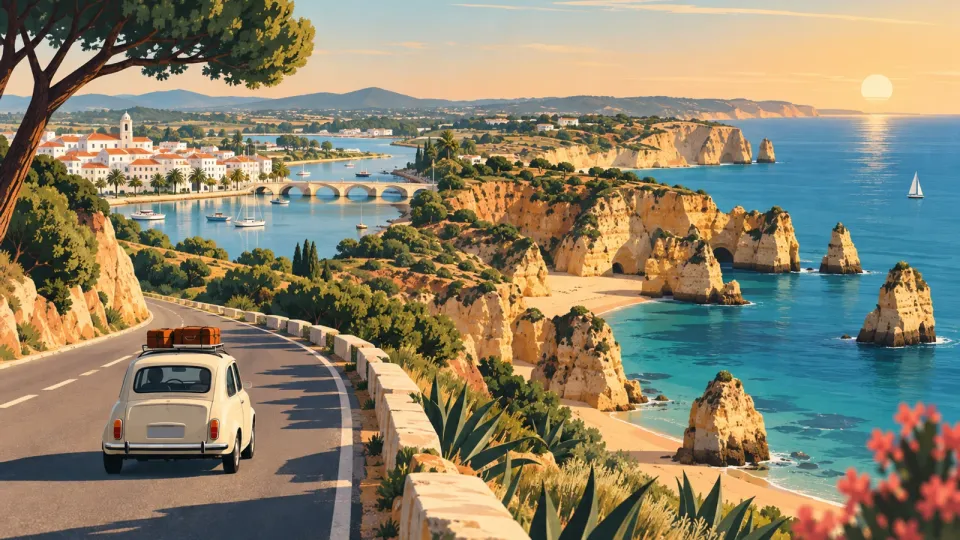
The two-base trick that makes an Algarve road trip feel calm
If you try to sleep in one place while driving the whole coast every day, you end up spending time moving, not exploring. A smart workaround is to use two bases that match the Algarve’s geography: Tavira for the eastern barrier-island side, and Lagos for the dramatic Atlantic coastline.
This matters because several of your “musts” sit on different coasts. On the east, beaches are often accessed by boat or via the Ria Formosa wetlands system, and that changes your daily rhythm. On the west, the cliffs and sea caves near Lagos pair well with walkable town time and short drives.
A quick misconception to avoid: thinking you can replace island access with mainland beaches. Ilha de Tavira is not just “another shoreline,” it is a barrier-island experience, and your practical planning tool is boat availability, not wishful timing. Official VisitPortugal materials describe the region as a mix of cities, beaches, and viewpoints, with Tavira and Faro highlighted as part of that wider Algarve picture. (visitportugal.com)
Road-planning reality, updated: Algarve A22 tolls were set to be valued at zero cost for users from 00:00 on 1 January 2025 for the concession lanes and sublanes specified by Infraestruturas de Portugal. (infraestruturasdeportugal.pt) However, other roads outside your exact route can still have tolls, and rental charges and notices are separate items.
So the rule for success is simple: keep your driving confined within each base’s “side” of the itinerary, then use backups for the sea-dependent days. That is what makes the following Algarve road trip: a seven-day route with two bases feel like a series of relaxed outings, not a constant checklist.
Day 1 in Tavira: historic centre walks plus Gilão viewpoints
Start your Tavira base with the kind of sightseeing that does not require a car. The historic centre gives you warm, walkable streets, old churches, and river views, which is perfect on day one when you are still settling in.
Named stop: Tavira historic centre. Aim for a slow loop through the core streets, then pause where you can see the River Gilão. This river is a defining feature of Tavira’s layout, with bridges and viewpoints that help you orient yourself before you head toward the coast later in the week.
Named stop: Gilão area. Your practical goal is not a single photo spot, it is understanding the river crossings and the “direction of travel” toward the waterfront. Once you understand where the river bends and where the main pedestrian corridors sit, your later logistics (parking, short drives, ferry access) become easier.
How to pace it
- Morning: history-focused walking, take breaks in shaded lanes.
- Late morning or early afternoon: choose one viewpoint stop and one café stop, then stop adding new stops.
- Evening: dinner that is close to where you will actually return to your accommodation.
Optional choices (keep them lightweight)
- If you prefer architecture: focus on churches and facades rather than museums.
- If you prefer views: spend extra time on riverside angles and less time on interior visits.
Common mistake: trying to “complete Tavira” in one go. Tavira rewards a calmer approach because you will likely return to the coast later. Treat day one as a warm-up so day two can be genuinely flexible.
Finally, keep your car habits simple. If you park near your walking loop and commit to short radius trips, you reduce stress and reduce the risk of missing narrow streets at peak hours. Your two-base strategy already does the heavy lifting, so day one should feel easy, not busy.
Day 2: Ilha de Tavira only if boat conditions allow, with a realistic beach plan
Your day-two priority is Ilha de Tavira, but the key detail is the same for everyone: there are no guarantees. Boat operation and access can be affected by weather and conditions, so your plan needs an “if it works, do it” structure.
Named stop: Ilha de Tavira (barrier-island beaches). Ilha de Tavira sits within the wider protected coastal lagoon setting of Ria Formosa, which is why the experience changes by beach zone and by how you reach the island. A dedicated Tavira island planning guide explains that Ilha de Tavira is not a single beach, and it stresses that boat access and timing are the practical gatekeepers. (Tavira Island Day Trip: Boats, Beaches, and a Plan)
Decision rule for the morning
- Check the day’s boat schedule and service notes before you commit to a full island beach day. If service is limited, switch to a mainland coastal plan.
- Treat the island plan as a block, not as scattered half-activities.
A concrete time-block template (adjust to confirmed times)
- Arrive at the departure pier with buffer time.
- Take the boat to your landing zone.
- Choose one “anchor beach zone” first, then add a second zone only if time allows.
- Build your return around the boat return window, not around when you “feel done.”
That framework is directly aligned with the practical approach described in the Tavira island guide, which emphasizes confirming boat departures and planning around the realities of access. (Tavira Island Day Trip: Boats, Beaches, and a Plan)
Optional choices that match different comfort levels
- If you want maximum beach time: pick one zone and commit to shade, water, and a long lunch.
- If you want variety: add a second zone only if it fits your verified departure and return.
- If boats are not running: use Tavira’s waterfront for a relaxed coastal walk and viewpoint time.
Common mistake: planning a second island segment like it is a straight inland hike. On barrier islands, access is segmented, and the wrong timing can turn your day into logistics.
If your day includes the island, you will feel why Tavira pairs so well with your two-base plan: it is not just a beach stop, it is an entire coastline rhythm.
Day 3 along the east: Cacela Velha plus an easy coastal stop
Use day three to connect your Tavira base to the eastern Algarve coastline without turning the day into a long drive day. The best way to do that is to make Cacela Velha your anchor and keep the rest of the route intentionally simple.
Named stop: Cacela Velha. This cliff-top village viewpoint is known for overlooking the sea and the islands of the Ria Formosa Natural Park. VisitPortugal describes Cacela Velha as a worthwhile visit for its viewpoint character over the protected-area seascape. (cdn.visitportugal.com)
How to make Cacela Velha work in real time
- Go with a mindset of “viewpoint first, village second.” That prevents you from sprinting between spots.
- Wear shoes for uneven paths, and keep time for a slow photo loop.
- Plan a short lunch nearby so you are not dependent on long detours.
Easy eastern coast stop (choose one based on conditions) Here are practical options that fit the “keep it easy” requirement. Pick the one that matches your energy.
- Option A: a second Ria Formosa viewpoint stop (short walk, minimal driving).
- Option B: a relaxed beach time at a nearby coastal access point.
- Option C: a coffee and riverside walk back closer to Tavira for an end-of-day recharge.
Because your day includes Cacela Velha and then an extra stop, the best strategy is to limit yourself to one “extra” location. That gives you time to enjoy the main anchor and still return with energy.
Common mistake: turning day three into a “grand tour” by trying to tick multiple villages. Eastern Algarve is beautiful, but the distances add up when you keep changing towns.
Also, keep expectations realistic. Cliff viewpoints and coastal areas can have temporary access restrictions after weather. Plan to stay flexible and treat any closed steps or restricted areas as a cue to shift to viewpoints from nearby safer angles.
This day is built to be the bridge between your day-two island experience and your day-four move toward Faro and onward to the west. It should feel like calm sightseeing, not a relocation scramble.
Day 4: transfer day with a Faro old town stop, then settle in Lagos
Day four is where you move your base west. The goal is to make the transfer feel like part of the journey, not a disruption.
Named stop (on the way): Faro old town. Before you fully switch into Lagos mode, include a short Faro historic-centre stop. VisitPortugal’s Algarve overview positions Faro as the gateway to the region and highlights its historic centre for discovery time. (visitportugal.com)
How to structure a transfer day without losing daylight
- Morning transfer: drive early enough that you still have time for a walk, but not so early that everything is closed.
- Faro old town: keep it focused, one walk loop and one meal.
- Lagos arrival: check in, then do a light evening stroll near your accommodation.
Optional choices in Faro (pick one, not three)
- If you like architecture: choose a single plaza and church facade viewing loop.
- If you like food: prioritize a meal and a short scenic river or waterfront walk.
- If you prefer photos: focus on viewpoints and streets rather than timed museum slots.
Why this works for the two-base plan Faro sits logically between the eastern and western halves of the Algarve. If you skip Faro entirely, day four becomes mostly driving, and then Lagos day five has too much pressure.
Toll reality, kept accurate If you plan to use the motorway segments on the A22, remember the specific update: Infraestruturas de Portugal states that the relevant concession lanes and sublanes for Algarve (A22) pass to zero cost for users from 00:00 on 1 January 2025, meaning A22 user tolls should not apply for that scope. (infraestruturasdeportugal.pt) Still, other roads can have tolls, and you should check current road notices and your rental company’s toll policy separately.
Common mistake: blanket assumptions that every Algarve road is toll-free. Your plan should be based on your chosen route and current notices.
By the end of day four, you want Lagos to feel like the next chapter, not a confusing new base. Day five will be your old-town walk plus your Ponta da Piedade time, so tonight is about settling in.
Day 5 in Lagos: old town walking plus Ponta da Piedade on marked paths
Your Lagos day should combine town atmosphere and coastline drama, and you can do that with a very simple rule: walk the old town, then save your effort for the marked paths around Ponta da Piedade.
Named stop: Lagos old town. Start with a walk you can repeat later: a loop through the centre, a slow look at façades, and a coffee stop that gives you a break before the coastal viewpoints.
Named stop: Ponta da Piedade. VisitPortugal describes Ponta da Piedade as a striking rock formation near Lagos with grottos cut by the sea, and notes that it is best viewed in detail from looking inland and that boat excursions tour in and out of caves and grottos. (visitportugal.com)
Marked paths approach (safer and more relaxing)
- Plan your time so you are on the paths when light is best.
- Keep to marked routes and viewpoint areas.
- If you want close-up exploration, treat boating or guided tours as your method, not improvised cliff access.
A practical guide to Ponta da Piedade emphasizes that the area’s beauty is often best enjoyed via viewpoints and that boat trips offer the most effortless close-up grotto experience. (visitpontadapiedade.com)
Concrete day flow
- Morning: Lagos old town walk and coffee.
- Midday: drive or short transit to the Ponta da Piedade viewpoint area, then do the marked-path loop.
- Late afternoon: return to Lagos centre for dinner.
Optional choices (choose one, not all)
- Option A: add a boat-based grotto tour if conditions allow.
- Option B: skip the boat and focus on viewpoint viewpoints from the top and sea-facing angles.
- Option C: choose a relaxed beach time only if you still have energy for sunset.
Common mistake: treating Ponta da Piedade like a single spot you can “finish” quickly. It is a coastline with multiple rock angles, so give yourself time on the path loop.
Also, respect condition variability. Cliffside and coastal access can be impacted by weather, so do not rely on any “down to the water” expectation unless you confirm land access is open.
If you set this day up correctly, Lagos becomes the active counterpart to Tavira’s calm, and the road trip feels balanced across the whole week.
Day 6: Sagres and Cabo de São Vicente when conditions suit, or a Lagos alternative
Day six is your choice day. The coastline at Sagres and the promontory of Cabo de São Vicente are at the western edge of Portugal’s Algarve story, but weather can make that area feel either perfect or exhausting. Your plan should let you swap smoothly.
Named stop: Sagres and Cabo de São Vicente. VisitPortugal describes Sagres as a picturesque fishing port with historical connections to Henry the Navigator and mentions the nearby cape of São Vicente and its vast horizon of sea and sky. (visitportugal.com) VisitPortugal also describes the extreme southwest promontory character and the sense of “world’s end” associated with Cabo de São Vicente. (visitportugal.com)
Conditions rule (no guarantees)
- If wind, rain, or safety restrictions limit viewpoint comfort, shift your day to a Lagos alternative.
- If visibility is good, prioritize cliff and lighthouse area viewpoints and keep walking distance reasonable.
Lagos alternative (if Sagres feels unkind) Choose one of these so you still get value from your Lagos base:
- Option A: return to the coastline for a second viewpoint walk closer to town.
- Option B: add a relaxed beach and sunset dinner evening.
- Option C: do a longer old town dinner loop and skip extra driving.
This keeps your two-base logic intact. You are not “giving up,” you are adapting.
A route mindset that prevents backtracking If Sagres works, aim to do the far-west part earlier, then come back for an evening that feels warm and sheltered.
If Sagres does not work, keep the car use minimal and treat day six as a slower Lagos day that still gives you coastline satisfaction.
Common mistake: thinking you must “see everything at the tip.” Your trip is a seven-day route designed around comfort and access, not a rigid checklist.
Whatever you choose, remember the coastal lesson from day two and day five: sea-dependent plans can change. Your job is to build in flexibility, not to gamble.
By tonight, you are down to one remaining day. Plan for a departure day rhythm on day seven, and keep the evening restful so your last morning is smooth.
Day 7: departure day that adapts to airport timing, not the clock on the wall
Your last day should be a clean, low-stress finish. The best departure-day plan is the one that matches your airport timing, because travel delays can happen even when everything goes right.
Departure day approach
- Confirm your airport pickup or drop-off time.
- Schedule one last “close to the accommodation” activity.
- Give extra buffer for the final car steps (fuel, parking, paperwork, return desk time).
Because you are using two bases, you also need to decide where to start day seven from:
- If your flight timing favors it, start from your current base (Lagos).
- If your timing forces a morning relocation, start early and keep the morning activity minimal.
Optional last-day stops (near your base) Pick just one:
- A short old town walk for photos.
- A coffee and riverside or sea-view pause.
- A final scenic pull-off that does not require timed access.
What to avoid on day seven
- Do not plan boat trips, cave tours, or cliff route adventures that depend on conditions.
- Do not plan “one more village” that requires extra driving.
This is consistent with the approach that already guided your earlier days: no guarantees on boats, no guarantees on access, and no guarantees on swimming or weather.
Road fact, kept practical If you are driving on the Algarve A22 motorway during your route, remember the official A22 user-toll update from 1 January 2025 as published by Infraestruturas de Portugal. (infraestruturasdeportugal.pt) For everything else, treat tolls and rental toll policies as separate, check current notices, and do not assume blanket toll-free travel.
End the trip with one usable habit: write down your parking and return procedure for tomorrow morning, even if it feels obvious right now. Small friction on departure day is the easiest way to waste a great week.
When you finish day seven, the two-base structure will have done its job: you saw both the eastern barrier-island mood and the western cliff mood, without spending the week in the car.
One comparison table plus a short checklist for a smooth two-base Algarve week
To keep your Algarve road trip: a seven-day route with two bases feeling effortless, use this comparison table to decide which days are “flexible” and which days are “locked to access.”
| Day | Main anchor | Access type | Your flexibility lever |
|---|---|---|---|
| 1 | Tavira historic centre, Gilão | Walkable | Reallocate extra time between streets and viewpoints |
| 2 | Ilha de Tavira | Boat access | If boats are limited or weather is poor, swap to mainland coastal time (Tavira Island Day Trip: Boats, Beaches, and a Plan) |
| 3 | Cacela Velha plus east coast stop | Viewpoints, short drives | Choose an easier nearby stop if paths or sea feel rough (cdn.visitportugal.com) |
| 4 | Transfer, Faro old town | Drive plus short walk | Keep Faro stop tight, then settle in Lagos (visitportugal.com) |
| 5 | Lagos old town plus Ponta da Piedade | Marked paths, optional boat | Skip boat if conditions are poor, stay on viewpoints (visitportugal.com) |
| 6 | Sagres and Cabo de São Vicente or Lagos swap | Wind and visibility sensitive | If weather makes the west tip uncomfortable, keep the day in Lagos (visitportugal.com) |
| 7 | Departure day | Timing sensitive | One close-to-home activity, no sea-dependent plans |
Short checklist you can use right now
-
Confirm boat service for your Ilha de Tavira day before you treat it as guaranteed. The practical guidance emphasizes confirming routes and planning around boat availability. (Tavira Island Day Trip: Boats, Beaches, and a Plan)
-
Plan your Ponta da Piedade time around marked paths, and treat boats or guided cave access as the method for close-up grotto experiences. (visitportugal.com)
-
Use the A22 update correctly: Algarve A22 user tolls were set to zero cost from 00:00 on 1 January 2025 for the specified A22 concession scope, but other roads can still be toll roads and rental policies are separate. (infraestruturasdeportugal.pt)
-
Keep day three and day six “one extra stop only” to avoid end-of-day scramble.
-
On departure day, anchor everything to airport timing and car-return steps, not to a packed sightseeing list.
Finally, one misconception to correct: you do not need to be “maximizing attractions” to have a strong Algarve week. Your two-base plan is built around access realities, so your job is to protect the easy moments and only add options when conditions and timing agree.
Conclusion: your next step for turning this plan into a trip you can actually enjoy
Your Algarve road trip: a seven-day route with two bases works because it matches the region’s real rhythm. East of the Algarve, you lean into Tavira and the island-access mood of the Ria Formosa. West of the Algarve, you lean into Lagos and the cliff-and-grotto mood near Ponta da Piedade, then you decide whether Sagres fits your conditions.
If you only remember three actionable takeaways, make them these:
-
Protect the access-dependent days. Ilha de Tavira and west-coast cliff time are condition sensitive, so build backups and do not treat them as guaranteed.
-
Keep the transfer day tight. Faro old town is your “bridge stop,” not a full day project. That makes your Lagos day five feel relaxed rather than rushed.
-
Treat tolls as route-specific, not blanket. A22 user tolls were set to zero cost from 1 January 2025 for the specified scope, but other roads can still have tolls, and rental policies are separate. (infraestruturasdeportugal.pt)
Do this today (one specific action): write down your exact Ilha de Tavira departure and return window for your planned day, then choose the backup mainland activity you will do if boat service is limited. The moment you do that, day two stops being a gamble and becomes a planned, calm part of your seven-day itinerary.
If you want extra reading for beach selection and coastal logic, start with these resources (they complement the two-base approach):
Related guides

Algarve Without a Car: Faro, Tavira or Lagos
Algarve without a car. Compare Faro, Tavira and Lagos for 3 to 5 nights, then follow a simple checklist for rail, buses, and island access.
Restaurantes em Tavira Quiet Algarve: Where to Eat
Discover Tavira’s Ria Formosa seafood and authentic Algarve flavours. Know where to go, where to avoid, and when to visit to beat August crowds.

Lagos or Albufeira: choose your Algarve base
Lagos or Albufeira: choose your Algarve base. Compare Old Town vs Oura, nightlife, family comfort, and practical travel logistics for car-free trips.
Restaurants in Lagos: West Algarve dining guide
Restaurants in Lagos for great food, from beach lunch to dinner. Clear tips on seafood vs grilled dishes, plus a Lagos day plan.