
Alentejo Beaches: Pick a Base and Plan Beach Days
Alentejo beaches, choose the right coastal base for your pace. Compare Odemira to Tróia and plan beach days with protected-area access rules.
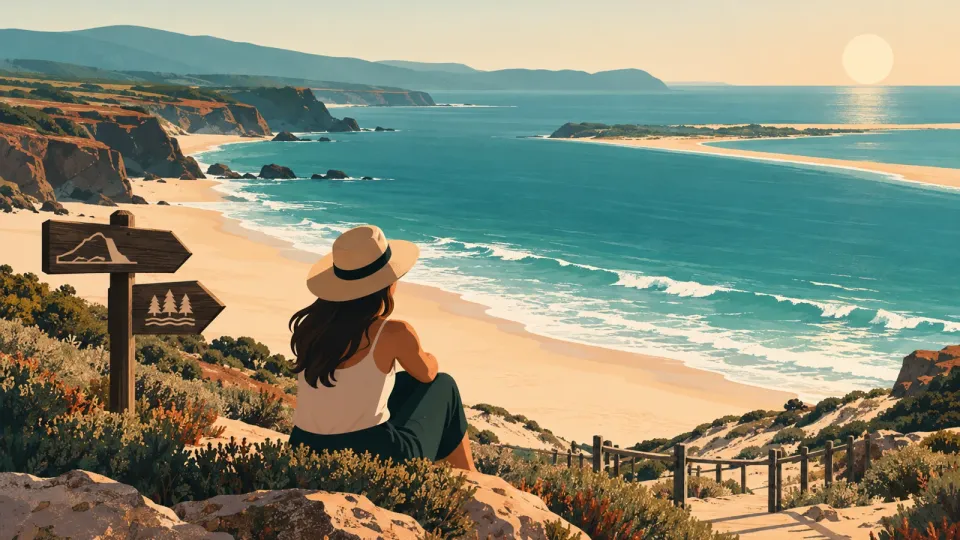
Start with this truth: Alentejo beach “crowds” change more by base than by beach
If you want fewer hassles on Alentejo beaches, pick your base town before you fall in love with a specific beach. In this region, the coastal “day experience” often depends on where your car and your first beach access point are, not just the beach itself.
Most of the Alentejo coast you will visit sits inside protected frameworks that shape where people can walk, park, and enter dunes or cliff tops. The Costa Vicentina stretch is inside the Parque Natural do Sudoeste Alentejano e Costa Vicentina (PNSACV), which covers a long coastal band from São Torpes to near Burgau. (icnf.pt) This matters because beach access can mean marked paths, stairs, and conservation limits, especially around dunes and sensitive habitats.
So here is a practical way to choose a base.
-
Choose a base with multiple beach options within a short drive: you can “rotate” beaches across your week.
-
Choose a base that matches your beach day style:
- Car-focused days: look for towns with easy road access and public parking near approaches.
- Walk-first days: look for towns where you can get to the coast without long, car-dependent transfers.
- Quiet-evening days: prioritize bases with a real town center for dinner and a calmer night scene.
- Treat protected access as part of the plan, not a nuisance. The ICNF encourages visitor activities in the park to happen on existing trails and in infrastructure designed for use, and it explicitly advises checking for temporary bans or restrictions via the park services before doing nature tourism activities. (icnf.pt)
One common mistake: assuming that “nearby” beaches will all have the same access rules. In reality, a beach can be walkable from the road but require stairs for the descent, while the dune system can require you to stay on marked routes. Your base choice determines how often you face those access moments.
If you plan for rotating access points, you get the best mix: easier mornings, more variation, and fewer time-wasting detours when the coast is busy.
Compare two coastal bases: Odemira (PNSACV) vs Tróia and Sado (Reserva do Estuário)
Your “best base” depends on which coastline mood you want. For many itineraries, the two strongest alternatives are Odemira for the wild, Atlantic-facing Parque Natural do Sudoeste Alentejano e Costa Vicentina, and Tróia for an estuary-and-ocean coastline shaped by the Reserva Natural do Estuário do Sado.
Odemira base for PNSACV beach variety
Odemira is a practical hub for beaches across the southwest Alentejo coast. It is also closely tied to PNSACV, the natural park that includes beaches, dunes, and coastal habitats along a wide stretch of coastline. (icnf.pt)
One useful detail for planning: PNSACV is not a single viewpoint. It is an area with different coastal sections, so rotating beaches from one base can keep your trip varied without long travel days.
Tróia base for estuary calm plus Atlantic beaches
If you want calmer water vibes and a different landscape, Tróia is a different proposition. The Sado Estuary Nature Reserve covers around 23,000 hectares and is often described as a major wetland system, with important birdlife and habitats. (natural.pt)
Tourism materials for the area highlight viewpoints and the idea of observing protected nature from within the reserve context. (visitpalmela.pt) This does not mean every beach works the same way. It means you should expect more “move along the right ways” guidance in dune and habitat zones.
How to choose with a simple decision test
Ask yourself these three questions.
-
Do you want cliff-and-dune drama, plus short but sometimes stair-based descents? Choose Odemira.
-
Do you want a coastal ecosystem that blends water types, with a reserve-centered experience? Choose Tróia.
-
How many beach days do you want, with minimal driving stress? If you want 4 to 6 beach days with short hops, pick the base that gives you the most beach options within one day.
A misconception to avoid: treating Tróia and Comporta as “one area.” They connect, but access and landscape differ. The Sado reserve context is its own planning reality, while PNSACV is another. Separate them in your mind and your day planning will feel easier.
A film-and-photo reality check
You are making a photography and film plan, so light matters. Atlanticside beaches and estuary-side areas produce different color and contrast at similar hours. Use your base choice to control your travel time to “golden hour” locations, rather than trying to sprint across the entire coast from the same lodging.
Odemira beach days: a rotation plan using Zambujeira and Almograve
The fastest way to improve your week on Alentejo beaches is to rotate between beaches from your Odemira base. Do not plan one “perfect beach day” and then repeat the same logistics. Instead, build a rotation that changes your shoreline experience while keeping access manageable.
Why Zambujeira do Mar works as a base-day anchor
Zambujeira do Mar is part of the Odemira municipality, and it is often described as having multiple nearby beaches, including Zambujeira itself and more options to the south. (en.wikipedia.org)
A concrete planning win: there is a known alternative beach, Praia dos Alteirinhos, that is described as accessible from Zambujeira via a staircase and located in the heart of the natural park context. (visitportugal.com) That means you can build a “two-beach day” idea:
- Morning at Zambujeira do Mar
- Late morning or afternoon at Alteirinhos for a different descent feel and shoreline framing
You should still treat the exact access method and any temporary conditions as variable. ICNF materials advise contacting park services for temporary restrictions that could affect activities, and they emphasize doing activities on existing paths and infrastructure. (icnf.pt)
Add Almograve for a different kind of sand-and-dune approach
Praia do Almograve is another Odemira option that can change the feel of your week. It is described as being within the Sudoeste Alentejano e Costa Vicentina Natural Park. (flagra.pt) One map-based resource from a Blue Flag program includes an access map that separates access types by route, including roads, trails, stairways, and even a wooden walkway type. (bandeiraazul.abaae.pt)
That map detail matters for planning because it tells you the access route is not one-size-fits-all.
A practical 4-day rotation template from Odemira
Use this template if you want 4 beach days.
-
Day 1 (easy entry): Beach near your first access point from Odemira, then stop early enough to scout dunes and safe viewpoints.
-
Day 2 (stairs and cliffs): Zambujeira do Mar in the morning, Alteirinhos in the afternoon. The staircase access is part of the experience planning, so pack for it (water, sun protection, and footwear with grip). (visitportugal.com)
-
Day 3 (trail-to-sand): Almograve, and choose your approach route based on the access map style, since dunes and pathways are sensitive. (bandeiraazul.abaae.pt)
-
Day 4 (flex day): Pick the beach that matches your energy level. If you feel like repeating, repeat a beach with the easiest access. If you want variety, use your flexibility to try a different section of the coastline.
Common mistakes on Odemira days
- Parking on cliff edges or closing your eyes to signs. Your route should follow intended access and avoid creating new tracks.
- Assuming all beaches allow the same movement. Protected areas encourage staying on paths and in infrastructure.
- Overplanning with back-to-back locations. Your travel time to the beach and your time on foot are separate. Plan a buffer.
For a film and photo studio like yours, build a “shot list” per beach day: 2 to 3 scene goals, one wide composition, one texture detail, one human-scale frame if you are working with people. Then you leave the beach with a plan, not just a memory.
Tróia and Sado beach days: plan for reserve-shaped coastlines
Tróia gives you a coastline that feels less like “just the open ocean beach” and more like a lived-in ecosystem. If you plan your days around the reserve logic, your beach time becomes smoother, and your footage gets more story.
What makes this coast different
The Reserva Natural do Estuário do Sado is described as a major wetland system with around 23,000 hectares. (natural.pt) That scale matters because it signals ecosystem sensitivity, especially around dunes, water edges, and habitats.
Tourism and reserve materials also point out specific experience framing. For example, the reserve context is used for sightseeing ideas like viewpoints that allow you to see the landscape and light across protected areas. (visitpalmela.pt)
A beach day method that fits reserve access
Use this method when you base in Tróia.
-
Pick one “primary beach” for swimming and sand time. Treat it as your main session so you do not lose time moving between shore types.
-
Add one “reserve-mindful” walk. Instead of chasing every beach in the area, choose a walk that uses established approaches.
-
Time your day around coastal transitions. Morning often gives you calmer movement and cleaner background separation, while late afternoon can help with color, especially near water edges.
What not to assume
A common mistake is assuming that all beach movement is allowed across dunes and to every water edge. Reserve systems often encourage visitors to follow designated routes and avoid disturbing habitats. While this article focuses on beach days, not wildlife behavior rules, the general conservation message shows up clearly in guidance for protected areas, including the need to stay on paths and avoid restricted zones. (natural.pt)
How to translate this into a film and photo plan
Reserve-shaped coastlines help your edit. You can build sequences that show the transition between land and water.
- Wide establishing shot: show the coastal system, horizon, and sky.
- Texture cutaways: sand patterns, dune vegetation, and waterline textures.
- Human-scale frames: people near the water, kept away from sensitive zones.
Finally, plan your “day after” logistics. Tróia is not the same as Odemira for internal travel distance. That means your base affects how quickly you can return for a second take if the light shifts.
If you want the calmest beach-day experience, start with Tróia and add one road trip out to the PNSACV coast only once or twice. That keeps your week balanced and reduces the number of days you are dealing with two different access realities in the same itinerary.
Protected access rules: the checklist that prevents wasted beach hours
You can lose an entire beach morning by ignoring protected access rules. Use a simple checklist before you descend, park, or step onto dunes.
Start with the park authority guidance for the Costa Vicentina zone
For the Parque Natural do Sudoeste Alentejano e Costa Vicentina, ICNF guidance advises contacting park services before nature tourism activities to check for temporary restrictions that could make activities impossible. (icnf.pt) It also notes that activities should be carried out on existing trails and in infrastructure designed for that purpose. (icnf.pt)
Even if you are not booking an organized nature activity, this approach is still useful. It tells you what the park considers “good practice.”
Use “movement on purpose” at the beach
Your goal is to reduce random wandering in sensitive areas.
- Look for access markers: stairs, boardwalks, and defined corridors are there to guide movement.
- Stay on approved routes: if a route splits into multiple paths, use the one that leads to the beach without shortcutting dunes.
- Do not cross barriers or restricted zones. General protected-area visitor advice emphasizes not crossing barriers and not accessing restricted areas. (parquesnaturais.azores.gov.pt)
Time buffer: why it matters more than you think
If you arrive at a beach where descent is via stairs, your time cost is different. You should plan for:
- Time to find parking and walk to the access point.
- Time for the descent back and forth.
- A photo buffer for changing light.
If you do not budget for it, you arrive late to the best light and you rush your shots.
What to do when you see “possible restriction” conditions
Don’t improvise. Use the authoritative approach:
- Check for advisories on temporary issues.
- Contact the protected area services if you are unsure, especially for activities in the park. ICNF explicitly suggests doing this via park contact emails. (icnf.pt)
A quick “no drama” template for beach days
Before you commit to a beach:
- Confirm the access type on the ground (stairs, boardwalk, trail).
- Choose your main scene goals so you do not roam excessively.
- Carry essentials in a way that does not slow you down during access.
One misconception to avoid: believing that following rules means you cannot shoot great footage. In practice, defined access helps you plan consistent angles and safer routes, which improves output.
If your studio plans shoots, the checklist also helps you keep your team organized, so you spend time on composition instead of searching for safe paths.
Coast-by-coast comparisons: pick the right beach for sand, cliffs, and camera angles
To choose Alentejo beaches intelligently, compare them by visual geometry. Sand width, cliff height, dune presence, and water edge shape determine both your comfort and your shot list.
Zambujeira and Alteirinhos, Atlantic drama with defined access
Praia dos Alteirinhos is described as a beach with fine sands in the PNSACV context, accessible via a dirt track and staircase approach from just south of Zambujeira do Mar. (visitportugal.com) Another description highlights that Alteirinhos is “between the rocks” and accessible with a staircase. (zambujeira.nl)
What this means for your camera:
- Cliff and rock framing: easier to get foreground depth.
- Texture emphasis: sand against stone creates strong contrast.
- Planning for descent: your gear strategy matters because stairs control how much you carry.
Almograve, sand and dunes with route-specific access
Almograve sits inside Odemira’s protected coastal context. (flagra.pt) Access is not just “drive and walk.” A Blue Flag map-style access resource shows multiple route types for Almograve North, including routes by road, dotted trails, stairways, and a wooden walkway type. (bandeiraazul.abaae.pt)
What this means for your camera:
- Wider “sand-to-dune” gradients: good for wide establishing shots.
- Controlled movement: defined routes help you keep continuity in footage.
- Better logistics: you can pick the easiest route for your team and still keep variety.
Tróia and Sado, water story over pure coastline story
In the Sado reserve context, the “story” becomes the water system and the land-water interface. The reserve’s scale and nature focus are described in reserve materials. (natural.pt) That sets a different visual expectation than cliff beaches.
What this means for your camera:
- More reflective surfaces: useful for cinematic color gradients.
- Layered compositions: land edges, estuary lines, and horizon separation.
- Scene sequences: you can build a narrative montage without changing location every hour.
A common mistake: chasing “quiet” without planning access
People sometimes assume that “less known” means “unrestricted.” In protected landscapes, the opposite can be true: access may be limited, or it may require a specific route like stairs or boardwalks. Follow the designed access to avoid time loss and to stay within conservation expectations.
A simple selection framework you can use immediately
Before you commit to a beach day, ask three questions:
-
Do you want foreground texture? Choose places with rocks or cliff framing (for example, Alteirinhos style descriptions). (visitportugal.com)
-
Do you want dunes and layered sand? Choose Almograve and then match your route to the access map types. (bandeiraazul.abaae.pt)
-
Do you want ecosystem water storytelling? Base in Tróia and plan your day around reserve-shaped coastlines. (natural.pt)
This framework prevents “wrong beach, wrong day” choices, which is one of the most frustrating trip problems.
Transport and timing: build beach days around how you actually get there
Your beach plan will only work if it fits transport reality. In Alentejo, that means planning your route and timing with the assumption that beach access involves both road travel and short walks, sometimes including stairs.
Use Odemira as a timing advantage for multiple beach days
Odemira works well because it is positioned as a coastal hub for the municipality’s main beach areas. (en.wikipedia.org) If you base there, you can schedule several beach days with minimal “move base” complexity.
If you are using public transport for a beach day, you need to treat schedules as part of your itinerary design.
Check bus routes for your specific beach access day
For example, Rodalentejo publishes route information for the Linha 37 (Beja to Odemira to Praia da Zambujeira). (rodalentejo.pt) That does not guarantee the schedule fits your exact plan, but it gives you a credible starting point so you are not guessing.
Third-party schedule aggregators can also list time options for specific routes, but for best accuracy you should confirm with the operator when you are ready to travel. (rododemira.com)
Plan your day as two halves: “get there” and “work the light”
If you want strong film and photography output, you should schedule like this.
- Half 1, travel and access: road travel plus descent to the beach.
- Half 2, production time: your shoot window plus buffer.
If you compress these halves, you get less production time, even if your beach time looks long on paper.
Timing strategy for sand and dunes
Dune and coastal access routes often slow you down. You can reduce that cost by:
- choosing a single main beach per day when access is stair-based,
- bringing essentials in one small kit,
- and planning a “come back later” approach for your second location within the day.
This is why the earlier rotation idea, Zambujeira morning and Alteirinhos later, is practical. (visitportugal.com)
Timing strategy for reserve-based days
For Tróia and Sado, your day rhythm often benefits from calmer transitions. Reserve-shaped coastlines encourage walk segments that align with established approaches rather than rapid point-to-point hopping. (natural.pt)
One more misconception to avoid
Do not plan your beach day around the assumption that “any time equals the same.” Access routes, light contrast, and the practical ability to move gear change throughout the day.
Instead, use your base to create repeatable logistics. When you return to the same base, you improve your timing automatically because you stop re-learning routes.
If you want a concrete action step right now, pick one base, then list two beaches you can reach with the least access friction. Build your first day around the easier one so you start your trip with momentum.
A ready-to-use 6-day sample itinerary (two bases, beach days focused)
This itinerary is designed around a simple principle: you do not try to “cover the whole coast.” You choose a base, then you rotate beach days with different access friction.
Days 1 to 3, base in Odemira (Atlantic and PNSACV beach variety)
Day 1, arrival and first beach session
- Keep it simple. Choose your easiest access beach from Odemira so you can recover from travel and scout backgrounds.
- Plan a short production block, 60 to 90 minutes, then leave before you feel rushed.
Day 2, Zambujeira do Mar + Alteirinhos
- Start at Zambujeira.
- Add Praia dos Alteirinhos later, since it is described as accessible via a staircase and a route from just south of Zambujeira. (visitportugal.com)
- Keep your gear minimal for the stair descent. Your photos will be sharper because you will move with less friction.
Day 3, Almograve dunes and sand
- Use Almograve for sand-and-dune gradients.
- Match your movement to the route types shown in access mapping style resources (roads, trail segments, stairways, and wooden walkway options). (bandeiraazul.abaae.pt)
- Photograph textures first (sand patterns, dune edges), then wider scenes.
Days 4 to 6, switch base to Tróia (reserve-shaped coastline storytelling)
Day 4, Tróia orientation and main beach
- Pick one primary beach session for swimming and your establishing shots.
- Plan one short reserve-mindful walk segment instead of hopping between many shore types.
Day 5, water story day
- Build sequences that show reflections and land-water layers.
- Remember, the Sado reserve context is large and nature-focused. (natural.pt)
- Keep distance from dune and habitat edges, and stay on established approaches.
Day 6, flexible closing day
- Repeat your favorite beach or swap one segment based on light.
- If you are doing any nature tourism activity with specific rules, contact protected area services in advance for temporary restrictions, using ICNF guidance as your reference for the Costa Vicentina park system. (icnf.pt)
The “protected access” rule embedded in this itinerary
Every day has at least one planned movement that uses established access patterns. That reduces the risk of wasting time and helps you avoid stepping into sensitive areas.
Where this itinerary intentionally avoids a common mistake
It avoids the trap of trying to “optimize for perfect solitude.” Protected areas often change where access is comfortable. You optimize by choosing a workable base, rotating beach days, and respecting access routes.
If you want to adapt this to your pace, use this adjustment rule: for every extra beach day you add, remove one travel change, either by keeping the same base longer or by limiting to one beach per day.
FAQ: Alentejo beaches, base choice and protected access (fast answers)
1) What is the main protected area that shapes Alentejo beach access near Odemira?
The Parque Natural do Sudoeste Alentejano e Costa Vicentina (PNSACV) covers a long stretch of the coast and includes beaches, dunes, and other habitats. ICNF materials emphasize that activities should be done on existing trails and in infrastructure designed for use, and they advise checking for temporary restrictions through park services when needed. (icnf.pt)
2) Should I plan my beach days around a base town or around individual beaches?
Base town planning usually reduces friction. If you choose Odemira you can rotate between multiple beach options within the PNSACV context, and you can use that rotation to avoid repeating the same access problem every day. For example, Praia dos Alteirinhos is described as accessible via a staircase from the Zambujeira do Mar area. (visitportugal.com)
3) What is a good Tróia beach-day focus if I want a different landscape than PNSACV cliffs?
Focus on the estuary-and-ocean story. The Reserva Natural do Estuário do Sado is described as around 23,000 hectares and is a major wetland reserve, which supports a different kind of visual narrative than purely Atlantic cliff framing. (natural.pt)
4) How can I avoid wasting time if a beach access route is more difficult than expected?
Build in a two-half day plan: (1) travel and access, (2) production time. Also, assume that route type matters. For Almograve North, access can involve different route types such as roads, trails, stairways, and wooden walkways, so choose the route that fits your team and gear. (bandeiraazul.abaae.pt)
5) Is it ever necessary to check for temporary restrictions in protected areas?
Yes, especially if you are planning nature tourism activities in the park context. ICNF guidance advises contacting park services to ensure there are no interdições temporárias or restrictions that could prevent activities. (icnf.pt)
6) Can I use public transport for Alentejo beach days?
You can, but you must plan around actual route options. For instance, Rodalentejo publishes a Linha 37 that includes Beja to Odemira to Praia da Zambujeira do Mar, which is a concrete starting point when you plan a beach day without driving. (rodalentejo.pt)
7) What is the biggest misconception people have about Alentejo beaches?
People often assume that “nearby” beaches have the same access rules and movement difficulty. In protected coastal systems, access can vary by beach and by habitat sensitivity, so you should plan movement using stairs, boardwalks, or marked routes as appropriate. (icnf.pt)
Conclusion: Lock your base, then schedule beach days with access friction in mind
If you remember one planning rule for Alentejo beaches, make it this: your base town choice controls how smoothly your beach days run. PNSACV coastal access and the Sado reserve coastline are different planning realities, and both are shaped by conservation expectations around paths, dunes, and protected zones. (icnf.pt)
Turn that rule into action with next steps that take less than 30 minutes.
- Choose one base for your main run
- Pick Odemira if you want PNSACV cliff-and-dune variety and a rotation plan like Zambujeira plus Alteirinhos plus Almograve. (visitportugal.com)
- Pick Tróia if you want the reserve water system and estuary-centered storytelling. (natural.pt)
-
Schedule beach days as rotations, not as one-offs Your goal is to change the shoreline, but reuse the same base logistics. That keeps your mornings calm and improves your ability to shoot at the best light.
-
Use the access checklist
- Plan your descent method (stairs or boardwalk style routes).
- Stay on marked or approved movement routes.
- If you are doing a nature tourism activity in protected areas, check for temporary restrictions via park services as ICNF guidance recommends. (icnf.pt)
One specific thing you can do today: open a map of your chosen base and mark two beaches that use different access styles, for example, one with stairs (Alteirinhos style) and one with mapped route options (Almograve style). (zambujeira.nl) Then write a one-line plan for each day: “primary scene, texture scene, and one reserve-mindful walk.” This turns your trip from guesswork into production.
Related guides
Best Beach Towns in Portugal: Pick the Right Base
Compare Portugal beach towns as overnight bases. Learn transport links, town facilities, and beach setting, so you choose the right stay for your style.
Baleal Beach in Peniche, Pick a Side and Plan Your Break
Baleal beach guide for Peniche, learn which side fits surf lessons or calm bathing, plus where to base yourself and how to plan a coastal day.
Algarve Beaches: Pick the Right Coast Stretch
Algarve beaches by region, western coves, central resort sands, eastern barrier islands. Learn what each stretch is best for, how to reach it.
Azores Beaches by Island: Pick Your Coastal Style
Azores beaches are volcanic, changeable, and island-specific. Compare São Miguel, Terceira, Faial, Pico, and Santa Maria, then plan safer swim windows.