
Porto airport to the city centre: arrival routes
Porto airport to the city centre: choose your arrival route by metro, bus, or licensed taxi, with destination tips for Trindade, Boavista, and Ribeira.

Why your hotel area changes the best route from Porto Airport
The biggest mistake people make is choosing a transport mode first, then discovering their accommodation is inconvenient for that mode. Porto’s airport is well connected, but your final few minutes can matter as much as the main journey, especially with heavy bags, late arrivals, or rain.
Start with one practical question: Where are you staying? Porto’s popular “central” areas behave differently when you arrive:
- Trindade: a practical interchange, so you can keep your transfer plan simple.
- Boavista (near Casa da Música): useful if you want a clearer route to the north side.
- Ribeira (riverfront): classic and scenic, but you often need a careful last step, either a planned transfer or a short walk from a drop-off point.
A common misconception is that the metro line is always the fastest. Even when a metro route looks direct, you can lose time if you have to transfer again, walk uphill, or carry luggage the last stretch.
Porto Airport’s official public-transport page highlights Metro Line E, bus connections, and taxis as core options. Use that menu as your starting point, then match it to your hotel area rather than your personal preference. https://www.portoairport.pt/en/opo/access-parking/getting-to-and-from-the-airport/public-transportation
If you want an outcome-focused plan, treat it like logistics:
- Identify the nearest key area to your hotel (Trindade, Casa da Música, Ribeira).
- Choose the arrival method that minimizes transfers and carrying.
- Confirm where you will exit and how you will reach your entrance.
Still choosing a base? Compare Where to Stay in Porto: Neighbourhoods, Hills and Transport.
Metro Line E: best when you can start your walk at the right station
Metro is often the most straightforward option when your accommodation is close to a Metro station. On Porto Airport’s official page, Line E (Purple) runs to and from the airport and lists key points along the way, including Estádio do Dragão. The page also notes that Line E runs every 20 or 30 minutes, depending on time and day. https://www.portoairport.pt/en/opo/access-parking/getting-to-and-from-the-airport/public-transportation
What makes metro smarter than it sounds is consistency. A direct vehicle can be easier with bags or at late hours, but metro can still win when:
- You can board and exit without extra transfers.
- Your hotel is within a short walk from the station.
- You prefer predictable schedule rhythm over street-level navigation.
Your destination fit matters:
- Trindade area: good for travellers who want a central interchange approach, because you can plan onward movement from a hub rather than from the airport side.
- Boavista area (Casa da Música): can be suitable when you want a clear metro-to-area pattern and your hotel is not far from the relevant station exits.
- Ribeira: metro may still work, but assume you may need a planned last step. Treat “arriving at the city” and “arriving at your door” as two different moments.
Don’t get trapped by the idea of a single perfect line ending. Instead, focus on your real path from station to hotel:
- Estimate walking time with luggage.
- Note steps or steep streets in old neighbourhoods.
- Decide if you will prefer a transfer to reduce dragging distance.
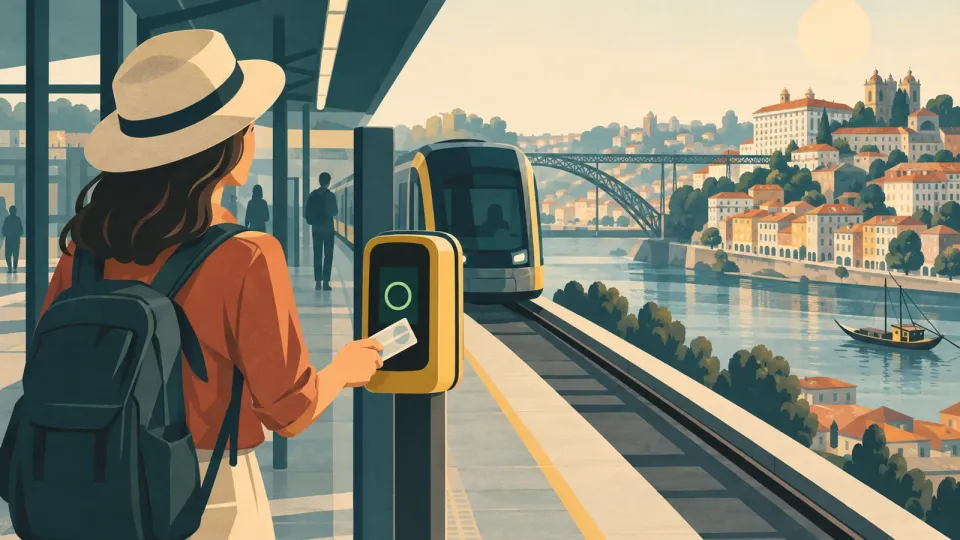
Tickets and validation can also affect your experience. Andante explains that the ticket must be validated when you start, and you can validate up to 10 minutes before starting your journey. https://andante.pt/en/purchase/blue-andante/
If you plan to use metro, build your route around your station exit, not only the airport-to-city connection.
Before buying your Metro ticket, check Porto Metro and Andante Zones: Tickets and Validation.
Bus options: when a direct vehicle reduces luggage stress
Buses are a strong choice when you want a direct ride to a specific area or you need flexibility around where you can get off. Porto Airport’s official transport page lists bus connections from the airport provided by STCP and Resende, plus additional shuttle services. It also notes that taxis are available 24/7 at taxi ranks. https://www.portoairport.pt/en/opo/access-parking/getting-to-and-from-the-airport/public-transportation
Two practical benefits stand out:
- Less walking with bags: you can often get closer to your entrance than metro-only routes.
- Late arrival comfort: direct vehicles can reduce the number of steps you need after you are already tired.
A realistic way to use bus information is to translate it into a simple destination test:
- If your hotel is near a known drop-off zone or main road, bus can be efficient.
- If your hotel is in a hillier or older street network, bus might help you get nearer, but the final segment still needs a plan.
Destination fit reminders:
- Trindade: buses can be a convenient way to reach a central interchange without depending on only one rail movement.
- Boavista (Casa da Música): bus can work when you want to reduce transfers and keep the route compact.
- Ribeira: bus can reduce the “walk uphill” problem if you choose a stop that aligns with your actual accommodation entrance, but you still need a last-step plan because the riverfront street layout can be tight.
Avoid a common mistake: assuming “bus” means “one bus to everywhere.” Porto Airport’s page lists multiple services and operators, so you need to confirm the specific route that matches your area. https://www.portoairport.pt/en/opo/access-parking/getting-to-and-from-the-airport/public-transportation
If you are travelling as a group, bus can also be a smoother compromise: you can share logistics and coordinate where everyone will meet after exiting.
When rain or night lighting makes walking unpleasant, bus becomes less about cost and more about reducing friction in the last kilometres.
Licensed taxi and app-style arrivals: fastest when bags and timing collide
If you have heavy luggage, arrive late, or want the simplest path to your door, a licensed taxi is often the lowest-stress option. Porto Airport’s official page states that taxis circulate 24/7 and are available at taxi ranks, and you can also order by phone. It also notes that fares are distance-based, tolls may add to the total, and there can be a supplementary baggage fee for items larger than a size threshold. https://www.portoairport.pt/en/opo/access-parking/getting-to-and-from-the-airport/public-transportation
How taxis compare in real arrival situations:
- With 2 to 4 passengers, a taxi can be efficient because you avoid multiple transfers.
- When you are carrying one large case plus smaller bags, a direct door-to-hotel ride can remove the biggest pain point.
- When your hotel is deep in Ribeira streets, the ability to set your drop-off point can matter more than the main ride.
A common mistake is treating “taxi” as “always cheaper than everything.” In Porto, a taxi is often the right tool for time and convenience, not budget optimisation.
Practical destination advice by area:
- Trindade: taxi can be a straightforward way to reach your interchange point and walk less after you arrive.
- Boavista (Casa da Música area): helpful when you want a direct line to that side without stitching together multiple segments.
- Ribeira: taxis can help you get as close as possible, but you still need to communicate your hotel entrance clearly because old streets can be awkward.
Checklist for taxi readiness:
- Have your accommodation name and address visible on your phone.
- Confirm the best drop-off spot, especially for Ribeira where access can be limited.
- If you have extra-large luggage, mention it early so the baggage fee is not surprising.
If you prefer app-style logistics, still prioritize the same decision criteria: directness to your door, clarity of drop-off, and avoiding unnecessary walking with luggage.
For many travellers, taxi is the “no-regrets” option when the trip from the airport to your hotel is the last step of a tiring day.
Route comparison table: pick the right tool for your arrival day
Choose the arrival route that reduces the biggest friction for your exact situation. Use this comparison to decide quickly, then refine it for your hotel area.
| Arrival option | Best match for your situation | Watch-outs to plan for |
|---|---|---|
| Metro Line E | You are near a station, you want a consistent commute rhythm, and you can handle a short station-to-hotel walk | Metro is not universally best, especially if your hotel requires a longer walk or extra transfer |
| Bus | You want a more direct ride to an area, you have bags, or you prefer reducing walking | Bus routes vary by operator and stop, so confirm the specific service that matches your destination area |
| Licensed taxi (rank or phone) | You arrive late, have heavy luggage, travel in a small group, or need door-to-door convenience | Distance-based fares apply, tolls and baggage fees can affect the final total |
Tie the choice to your hotel area:
- Trindade: metro and bus can both work well because it is a central interchange mindset.
- Boavista (Casa da Música): metro or bus are often cleaner if your hotel is near a station or a practical stop.
- Ribeira: taxi or a carefully planned public route can reduce stressful last steps.
Important detail for any public transport plan: Andante is the ticket system for public transport in Porto Metropolitan Area, and it works across bus and metro. Andante’s “Blue Andante” page explains that you validate when you start and you can validate up to 10 minutes before starting your journey, using validators in stations or on buses. https://andante.pt/en/purchase/blue-andante/
If you plan around timing, don’t over-focus on one “universal best” option. Instead, pick the one that minimizes the longest part of your journey, usually the last part between a transport stop and your hotel door.
Use the comparison table as a decision filter, then apply the destination-specific arrival tips in the next section with a concrete example route.
A concrete example: airport to Trindade, then onward to Ribeira
Use this as a model route for travellers whose hotel is near Ribeira, but who want a stable first hub approach. This example starts by reaching a central interchange mindset, then planning your final movement.
Concrete route idea (public transport first, final transfer planned)
- Arrive at Porto Airport and board Metro Line E (Purple). Porto Airport’s official page confirms the existence of Line E and the airport connection. https://www.portoairport.pt/en/opo/access-parking/getting-to-and-from-the-airport/public-transportation
- Ride to the central interchange area you can use as a staging point, aiming for a hub mindset such as Trindade (this is where many travellers choose to connect onward).
- Plan your Ribeira last step: either walk if your accommodation is close to the drop-off path you choose, or take a short additional transfer if your hotel is tucked into streets where walking becomes long or steep.
Why this approach works: it separates the trip into two jobs. The metro job is moving you from the airport area into a central area. The Ribeira job is the careful last step, where walking time and street layout matter.
If you choose a public transport ticket, validate correctly. Andante’s guidance says you must validate when you start, including when you change lines or transport, and you can validate up to 10 minutes before starting your journey. https://andante.pt/en/purchase/blue-andante/
How to adapt this example for your hotel area
- If your hotel is near Casa da Música (Boavista): consider using the metro or bus as the primary leg, then keep the last step short.
- If your hotel is truly in Ribeira: if you expect tired legs or a steep walk, a taxi can be the easier second job (or the entire solution).
Common mistake to avoid: planning “metro to Ribeira” as one continuous experience. Instead, treat Ribeira as a neighbourhood where your final step needs its own mini-plan.
Arrival success comes from controlling the last 10 to 30 minutes. The earlier part is usually reliable. The last part is where you feel the difference.
Arrival checklist that prevents the usual Porto airport mistakes
Turn your route choice into a simple pre-arrival checklist. This is designed to prevent the most common errors, like arriving at the wrong stop, forgetting validation rules, or assuming your luggage will be easy to manage.
Short arrival checklist (use it before you leave the airport)
- Confirm your destination zone: Trindade, Boavista (Casa da Música), or Ribeira.
- Decide how you want to manage luggage:
- If bags are heavy, prioritize directness (bus or taxi).
- If bags are light, prioritize station convenience (metro).
- Public transport only, validate correctly:
- Validate when you start and when you change lines or transport.
- You can validate up to 10 minutes before starting your journey. https://andante.pt/en/purchase/blue-andante/
- Avoid “one-step expectations” for Ribeira: plan the last step, walk or transfer, based on your hotel entrance.
- If using taxi, prepare your drop-off:
- Have your hotel name and address ready.
- Mention large luggage early in case of baggage fees. https://www.portoairport.pt/en/opo/access-parking/getting-to-and-from-the-airport/public-transportation
Ticket and pricing awareness (what to check once, not repeatedly)
If you use Andante products, check the specific ticket type you plan to load. Andante’s “Blue Andante” page explains it is a paper card for occasional use and includes validation and duration guidance. https://andante.pt/en/purchase/blue-andante/
For pass and fare stability in 2026, Andante’s news page states that its tarifário keeps pass values and mentions stability for the fare for the occasional Z2 type, with updated occasional simple ticket values listed for later in the page. Because pricing details can change, confirm your intended ticket at purchase time rather than assuming it based on memory. https://andante.pt/noticias/tarifario-andante-mantem-o-valor-dos-passes-em-2026/
One more habit that saves time: screenshot the walking directions from your station or stop to your hotel entrance, then follow them when the signs are easy to miss under rain or at night.
Pick the right route for Trindade, Boavista, or Ribeira
Your hotel area should decide the route. The transport network is capable, but your final walk and transfer complexity are what you will actually feel.
Trindade: choose routes that keep transfers small
Trindade is a practical staging point. If your hotel is near Trindade, metro and bus both tend to work well because you can use the area as a connector without a complicated second plan.
Best approach:
- Use metro if you want a steady, low-navigation journey.
- Use bus if you want a shorter walk from the stop to your lodging.
Boavista and Casa da Música: aim for station-to-hotel convenience
Boavista travellers often choose the north-side feel of the city, with a convenient anchor around Casa da Música. If your accommodation is close to a station or a main access road, metro or bus can keep the last step reasonable.
Best approach:
- Use metro when your walking distance is low and you want predictable timing.
- Use bus when you want fewer rail or station exits to manage.
Ribeira: plan your last step or go direct
Ribeira is where arriving “in the neighbourhood” can still feel unfinished. Narrow streets, hills, and scenic detours can turn a short walk into a slow carry.
Best approach:
- If you want a controlled arrival, use taxi to reduce the last step.
- If you prefer public transport, build a transfer plan that ends with a realistic walking segment from a stop that matches your hotel entrance.
Why this matters: Porto Airport’s official transport page lists metro, buses, and taxis as options, including Line E, bus providers, and 24/7 taxi availability. The missing piece is not availability, it is matching your route to your exact lodging access. https://www.portoairport.pt/en/opo/access-parking/getting-to-and-from-the-airport/public-transportation
Quick misconception to correct: “Ribeira is central so any stop is fine.” In practice, central can still mean steep and narrow. Choose your final arrival method accordingly.
If you want a broader Porto planning angle that includes routing through neighbourhoods, you can also review this related itinerary: 48 hours in Porto: a Lisbon resident’s working itinerary.
Final decision: the simplest next step for your Porto arrival
A good arrival route is the one that makes your next 20 minutes easy. Metro, bus, and licensed taxis all have legitimate strengths, but the right choice depends on your hotel area, luggage, and arrival time.
Use this decision rule:
- If you are near a station and you want consistency, start with Metro Line E as your main leg. Porto Airport’s official page confirms the Line E airport connection and its frequency range. https://www.portoairport.pt/en/opo/access-parking/getting-to-and-from-the-airport/public-transportation
- If you need a more direct ride to reduce carrying, pick bus for your specific destination area.
- If your priority is minimal hassle, especially with heavy bags or Ribeira access, choose a licensed taxi, available 24/7 at taxi ranks. https://www.portoairport.pt/en/opo/access-parking/getting-to-and-from-the-airport/public-transportation
Then apply the public transport safety net:
- If you use Andante, validate when you start, and up to 10 minutes before you start your journey. https://andante.pt/en/purchase/blue-andante/
One thing you can do today:
- Open your booking, check your hotel entrance location, and write down your target zone label: Trindade, Boavista (Casa da Música), or Ribeira. Then decide which arrival method best reduces your last step.
Do that before you board anything, and you will avoid the most common Porto airport trap, which is planning the main journey well while leaving the last part to chance.
Related guides

Day trips from Porto: compare trains, coast and the Douro
Day trips from Porto: compare trains, coast and the Douro. Choose Braga, Guimarães, Aveiro, Matosinhos, or a real Douro day with clear trade-offs.
Porto Metro and Andante Zones: Tickets and Validation
Porto Metro and Andante: zones, tickets and validation explained for tourists, including Tour 1 vs Tour 3, ticket choice, and how to validate correctly.

Porto to the Algarve: trains, buses, flights, driving
Compare Porto to the Algarve travel options. Direct vs connections, rail vs coach vs flights, and driving tips for Faro, Lagos, and nearby towns.

Where to Stay in Porto: Neighbourhoods, Hills and Transport
Where to stay in Porto: neighbourhoods, hills and transport, choose the best base for Ribeira views, Baixa access, Boavista ease, Foz sea air, or Gaia crossings.