
Porto to the Algarve: trains, buses, flights, driving
Compare Porto to the Algarve travel options. Direct vs connections, rail vs coach vs flights, and driving tips for Faro, Lagos, and nearby towns.
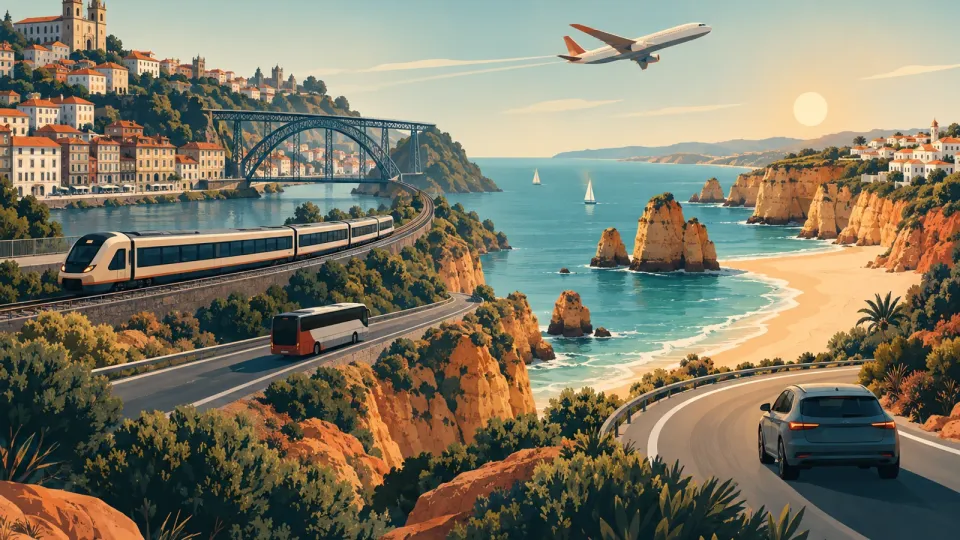
Why Porto to the Algarve feels longer than it is (and how to beat it)
Most travelers guess that the trip from Porto to the Algarve is “one long slog,” then they pick a transport mode based on mood. The surprise is that Portugal has a fast rail backbone south, plus short local legs for the coast. If you plan around the right stations, you can cut real travel time and stress.
Start by anchoring your journey to the Algarve town you truly want. Faro is the main rail and coach hub, Lagos sits on the Algarve Line toward the west, and towns like Albufeira, Loulé, Olhão, and Tavira usually require a short transfer once you arrive in the region.
Here is the planning misconception to avoid: confusing “direct from Porto” with “direct to your town.” On paper, the long-distance service may be direct to Faro, but your destination could be Lagos or Albufeira. In those cases, the best option often includes a rail connection after you reach Faro, or it depends on the new direct Algarve Line pattern.
A second misconception is that the “best” option is always the fastest headline time. In reality, your total door to door time depends on:
- Departure point (Campanhã vs airport terminals vs city center hotels)
- Arrival point (Faro station vs bus terminal access vs transfer waiting times)
- Connection type (train to train is usually easier than coach to coach)
- Baggage handling (especially if you fly)
You can reduce the problem using a simple time model. Count (1) travel in motion plus (2) transfer friction plus (3) last-mile access. Then compare modes on the same day and similar departure windows.
To keep this guide practical, we will focus on the most common Algarve targets travelers use: Faro, Lagos, and nearby coastal towns that are reached from the Algarve Line. We will also compare direct services versus connecting journeys, and flying versus rail, coach, and driving.
The rail backbone: when Alfa Pendular gives you a near-direct route
If you want the simplest long-distance journey, start with Alfa Pendular. It is Portugal’s flagship tilting train service, and it runs along the north to south axis that includes Porto and the Algarve region. CP’s network documentation and service pages show the Alfa Pendular line diagram and that the service connects Porto Campanhã with Lisbon and continues toward Faro, and onward toward Lagos and Vila Real de Santo António on parts of the network. (cp.pt)
What matters for you is whether the timetable gives you a direct train to your Algarve town. There are two common patterns.
-
You arrive in Faro by long-distance train, then use the Algarve Line for west coast towns.
-
You continue farther toward Lagos or Vila Real de Santo António, sometimes without changing trains, depending on the corridor operations.
The Algarve corridor has been improving. CP and Infraestruturas de Portugal announced electrification progress for the Linha do Algarve, including an operational shift from 19 July 2026 that allows direct journeys between Vila Real de Santo António and Lagos without changing trains in Faro. (cp.pt)
That change is important because it directly affects the “direct vs connecting” decision you are trying to make. If your destination is Lagos, a journey that reaches the Algarve corridor during this improved service pattern can reduce transfer stress.
For a realistic travel duration reference, local tourism and transit summaries cite a Porto to Faro rail trip around 5h51m on Alfa Pendular and longer times on Intercidades. (faroportugaltourism.com)
Even if you do not copy a specific departure, you should use the same idea: assume rail will be a consistent multi-hour segment that gets you into a major station with easier onward connections.
Practical rail tips you can apply immediately
- Travel to Porto Campanhã, not just “Porto” in general. The long-distance service is tied to the main rail station in the city system. (cp.pt)
- Pick your Algarve station, then work backward. For example, if you want the beach towns near Faro, prioritize arriving at Faro station. If you want Lagos, check whether the route stays direct under the current service pattern.
- Plan for station access time. Use station service listings from Infraestruturas de Portugal for Faro and the Algarve line station network to understand what is near the station. (servicos.infraestruturasdeportugal.pt)
Finally, set expectations about comfort and convenience. CP notes that Wi‑Fi is available free of charge on Alfa Pendular and Intercidades trains. That matters for photographers who need downtime between segments. (cp.pt)
Coach and bus: the value play, and the hidden transfer traps
Coach can be the most budget-friendly way to get from Porto to the Algarve, but it often pays a “time tax” in route structure. Many travelers assume that a cheap bus means “simple.” In practice, you need to check whether the service is truly direct and which terminals you use.
A useful reality check comes from Faro tourism and transport summaries. They state that travel between Porto and Faro by train takes around 5h51m on Alfa Pendular and up to around 7h24m on Intercidades, while coaches often require more travel time and can involve connections. (faroportugaltourism.com)
Where coach can shine is when you want:
- Lower cost per person compared with rail
- More departure options across the day
- A seat and luggage arrangement that fits your travel style
But here are the traps. First, “direct bus” depends on the operator and the specific departure. Second, some services start at different Porto terminals, and the final drop-off point can be outside the city center.
To ground this, travelers often reference Rede Expressos as the major long-distance coach network in Portugal. One coach scheduling aggregator shows Rede Expressos examples for Porto to Faro that are labeled as a Rede Expressos service departing Porto (Campanhã) and arriving at Faro with an example schedule around 8h15m in that listing. (checkmybus.pt)
That does not mean every departure matches that exact time, so treat it as a template. The takeaway is that coach duration is typically in the “one long day segment” range. It might be shorter than some rail options, but it can also be longer.
How to compare coach options fairly
-
Compare from the same Porto origin (city center vs Campo 24 de Agosto area vs Campanhã area).
-
Compare arrival terminal in Faro (terminal location affects how long it takes to reach your hotel).
-
Use the connection rule: if the itinerary includes a transfer, add the transfer waiting time, not just the driving time.
-
Count baggage friction: if you have bulky camera gear, check how much access you get to your compartment.
A “direct vs connecting” approach for your itinerary
- If your destination is Faro, coach is often straightforward because Faro is a main coach hub.
- If your destination is Lagos, check whether you need a second leg. Sometimes the coach may not bring you all the way to a specific beach town, and you will rely on local bus or train after arriving.
One practical method for photographers and film crews
- If you plan to travel with critical gear, choose a coach that minimizes transfers and lets you keep your most important items in your personal bag. Then plan an easy check-in buffer at your first night stop so you can test equipment without racing to the next town.
If you want a quick check on possible routes, you can also validate your final plan against a route comparison service like Rome2rio, which summarizes multiple modes and typical durations. Use it to spot whether “direct bus” is really direct on your dates. (rome2rio.com)
Flying from Porto to Faro: when it beats rail and when it does not
Flying feels like the fastest way to get to the Algarve, but it often beats rail only if you factor in airport time realistically. Your total travel time includes getting to the airport, security, airport-to-city transfer, and sometimes bag collection.
What we can say confidently about the route structure is that there are direct flights from Porto Airport (OPO) to Faro Airport (FAO). One schedule tracker notes the presence of direct flights and gives an example count of weekly departures at the time it was updated. (directflights.com)
Flight duration comparisons also show that direct flights can be around 1 hour and 10 minutes for the in-air segment. (flightconnections.com)
Now the key question: does that in-air time beat your door-to-door rail time? Rail to Faro is often referenced around 5h51m for Alfa Pendular. (faroportugaltourism.com)
So the flight win depends on your schedule.
A simple decision framework
- Choose flying if you have a tight itinerary and your preferred flight times align with your day.
- Choose train if you want predictable timing, city center station access, and less friction with camera bags.
- Choose coach if you want lower cost and accept longer travel time.
Airport reality checks you should do before booking
-
Check baggage rules for camera gear. Budget airlines can differ on cabin baggage limits. Use the airline page or booking flow to confirm limits.
-
Add airport access time. Porto and Faro airports require transfers from city centers.
-
Confirm the transfer needed for your Algarve town. Flying into Faro can be great if your destination is Faro or nearby. For Lagos, you will likely need an onward connection once you land.
A source you can use for flight options
- Airline and booking pages for Porto to Faro exist across major carriers. For example, TAP’s destination page lists fares and routes in its booking widget context, which can help you see whether TAP serves the direct route on your travel dates. (flytap.com)
Avoid a common mistake
A lot of travelers compare “flight duration” with “train duration,” forgetting that the airport day is longer. If you do that, flying looks unrealistically good. Instead, compare total travel time from where you will actually start and end your day.
If you are filming or photographing
- Flying can work well if you need to preserve days on location, but plan an equipment buffer on arrival day. If you land in the afternoon, choose an arrival plan that still gives you time to test batteries, storage, and lenses before night shooting.
If you want an evergreen strategy
- If your Algarve base is Faro, flying is a strong candidate because you are hitting the main entry point. If your base is Lagos, rail often becomes more attractive when there is a direct corridor or when rail-to-rail connections are easy.
Driving Porto to the Algarve: total control, but plan the last-mile carefully
Driving from Porto to the Algarve gives you control over departure times, stops for coffee and gear, and the flexibility to reach smaller coastal towns without waiting for local transport. But control comes with responsibility: you must budget time for long highway stretches and fatigue management.
A key planning point is geography. The Algarve covers many different beach environments. Faro is the entry with the easiest transport network. Lagos is further west and can mean more road time from Porto compared with reaching Faro first by train.
The driving question for you is simple: are you willing to trade time on the road for door-to-door flexibility?
Use this checklist to drive well, not just “drive somehow”
-
Choose a base town first, then decide whether to drive to it directly.
-
Plan two stop windows, not one. For film and photography schedules, you need predictable breaks to manage hydration, equipment handling, and storage card management.
-
Decide on parking strategy in advance. City parking and airport parking can be expensive and slow.
-
Use road conditions awareness. Do not plan to arrive in the Algarve at the end of a day with heavy fatigue and no buffer.
A misconception to avoid
Some people assume driving is always faster than rail or coach. That might be true on one specific departure day, but it is not guaranteed. If you want to compare fairly, use the same time model: motion time plus stop time plus last-mile parking and check-in time.
When driving is the best fit
- You have a lot of gear and want to keep it with you at all times.
- You plan multiple Algarve locations over consecutive days, and you want to reposition without relying on buses.
- You want to go beyond Faro and Lagos, for example toward inland viewpoints near Loulé or toward coastal spots between towns.
When driving is less attractive
- If you only need a single town base and then you plan to explore using local transport.
- If you dislike parking stress.
If you want to reduce risk with a hybrid plan
A common approach is to take rail or coach to Faro, then rent a car for day trips. That hybrid keeps the long-distance stress low, and preserves your flexibility for smaller coastal stops.
To confirm timing and entry station strategy for rail alternatives, you can use CP’s long-distance service route documentation and the Algarve line electrification update details from CP and Infraestruturas de Portugal. That helps you see whether switching to rail is now more direct for some Algarve corridor pairs. (cp.pt)
Direct vs connecting: a practical way to pick your Porto to Algarve itinerary
The fastest transport mode is not the one with the shortest segment time. It is the one with the fewest friction points. Your goal is to minimize stress while still reaching your actual beach town.
Here is a decision method you can apply to any travel date. Use it like a filter.
Step 1, write your Algarve target as a station-first plan
- If your target is Faro: look for the most direct Porto to Faro service you can find.
- If your target is Lagos: you need to plan either a direct corridor or a two-leg plan (arrive closer to the west, then connect).
Step 2, apply the “no-transfer comfort rule”
If you value simplicity, treat rail as the default. CP’s corridor updates matter here. Electrification progress on the Linha do Algarve enables direct journeys between Vila Real de Santo António and Lagos without changing in Faro from 19 July 2026. (www1.cp.pt)
Even if your starting point is Porto, that corridor update influences whether you will face an extra transfer once you hit the Algarve line network.
Step 3, compare modes using the same arrival logic
- Flying: often direct to Faro, but not always direct to Lagos. You still need a local leg from Faro.
- Rail: often offers a smoother rail-to-rail continuation if you land in Faro.
- Coach: can be direct to Faro depending on departure, but it can also add time through routing and terminal logistics.
A concrete example of how to think about this
If you want to sleep near Faro, you can focus on a Porto to Faro long-distance arrival, then use the Algarve Line or local transport for beach days.
If you want to sleep near Lagos, you should check whether your route stays direct within the Algarve corridor. The 19 July 2026 electrification change is specifically about removing some transfers in Faro for the Lagos direction under the new service pattern. (cp.pt)
Practical booking tips that prevent real mistakes
- Do not book “Porto” and “Algarve” vaguely. In Portugal, station names matter: Porto Campanhã for long-distance rail and specific Algarve stations for transfers. CP’s published diagrams show the station order for the corridor. (cp.pt)
- Use the station network data to sanity-check access. Infraestruturas de Portugal’s station service pages can help you understand what station serves which rail corridor, including Faro station listings. (servicos.infraestruturasdeportugal.pt)
- For coach, confirm the departure terminal and arrival terminal names. Terminals can be different even when the city name looks the same.
A final “common mistake” reminder
Many travelers see that a flight is short, or that a train segment is short, and they ignore the time to reach the final town and the waiting time for connections. Build your plan around the town you will actually sleep in, not just the destination region name.
Budget, comfort, and gear-friendliness: the decision matrix for photographers and filmmakers
If you carry a camera bag, a drone case, and a few memory cards, “best value” changes meaning. A cheaper ticket can cost more when you add transfers, delays, and the stress of managing gear.
Use this decision matrix to choose the best transport mode for your specific needs.
- Comfort and workflow on board
- Rail (Alfa Pendular and Intercidades): CP notes free Wi‑Fi on Alfa Pendular and Intercidades trains. That helps you offload footage or manage workflow between segments. (cp.pt)
- Coach: service varies by operator, and you may have less reliable connectivity.
- Flights: connectivity is inconsistent, and you will have security and boarding time constraints.
- Predictability of door-to-door timing
Rail often wins when you want fewer moving parts. Flight schedules depend on airline operations and airport processing. Coaches depend on highway conditions and traffic.
- Gear handling and baggage strategy
- Rail supports a simpler carry strategy when you keep critical gear in a single bag. You also have a station arrival, which can reduce last-mile uncertainty.
- Flying can be great for speed, but you need to verify cabin bag rules and plan battery storage access.
- Your Algarve base determines what matters most
- If you are based in Faro, flying and rail both make sense because the entry point aligns with major transport networks.
- If you are based in Lagos, rail can be more attractive when corridor services reduce transfers, especially with the 19 July 2026 direct Algarve corridor improvement for Lagos and Vila Real de Santo António. (www1.cp.pt)
A practical “minimum friction” rule
Choose the itinerary that lets you arrive with a buffer. For example:
- Arrive in the Algarve town by late afternoon if you want time for equipment checks.
- Avoid building a connection chain that can force you into a late-night first day.
What about prices?
Prices change daily, and fares depend on class and booking timing. Instead of guessing numbers, use authoritative fare lists when they exist. CP publishes documents and fare references for Alfa Pendular products such as routes involving Porto and Faro. For example, CP provides Alfa Pendular price documents for Lisbon to Porto to Faro style corridors. (cp.pt)
For planning, the more useful budget question is not “lowest fare today,” it is:
- How much time do you save by paying more?
- How much cost do you add by needing a rental car later?
Then pick the option that matches your schedule and production needs, not just your ticket price.
Where to arrive: choosing Faro vs Lagos for beaches and logistics
Choosing your Algarve base is where the trip either clicks or becomes complicated. Your transportation mode should serve your base, not fight it.
Start with Faro as your default logistics choice
Faro is the main rail and coach entry point in the Algarve region. Faro’s transport descriptions note that from Faro station you can reach Lisbon via Intercidades and Porto via Alfa Pendular, and you can access regional rail services toward Lagos and Vila Real de Santo António. (pt.wikipedia.org)
That means Faro works well when you want:
- Fast arrival from Porto by rail
- Many onward options by local rail
- Easy access to multiple Algarve day trips
Now consider Lagos if you want a west-coast base
Lagos is the classic west-coast option for beach days and sunset scenes. The rail planning advantage improves because the Algarve Line electrification allows direct journeys between Vila Real de Santo António and Lagos without needing a transfer in Faro from 19 July 2026. (cp.pt)
That helps the “direct vs connecting” comparison when your Algarve base is Lagos.
A common mistake to avoid: treating the Algarve as one place
The Algarve is a region with different coastlines and transport patterns. If you pick a beach town without checking transport entry points, you may lose time on local transfers.
How to make your base choice quickly
Use this 3-question test.
- Do you plan to shoot or photograph mostly in a single area for 3 to 5 days?
- If yes, pick the base closest to that area.
- Do you want minimal transfers on day 1?
- If yes, pick the arrival hub that best matches your final base.
- Are you traveling with bulky gear?
- If yes, minimize transfers between modes.
A booking strategy that keeps your plan flexible
- Book long-distance transport to the nearest major hub (often Faro or a route that serves Lagos direct under the updated corridor pattern).
- Then lock in your Algarve local transport plan once you are physically in the region.
A final logistics check you can do today
Use station network listings to confirm what is available where you will arrive. For example, Infraestruturas de Portugal’s station pages provide station service and departure information for Faro on the Algarve line. (servicos.infraestruturasdeportugal.pt)
FAQs: Porto to the Algarve direct routes, best mode, and common pitfalls
What is the fastest direct option from Porto to the Algarve?
There are direct flights from Porto Airport (OPO) to Faro Airport (FAO), with the in-air segment reported around 1h 10m by flight schedule summaries. (flightconnections.com) However, the full door-to-door outcome depends on airport time and your onward travel if your destination is Lagos rather than Faro.
Is rail usually more convenient than flying for reaching beach towns?
Rail is often more convenient when it drops you at Faro and you can continue via the Algarve rail network. Faro station transport descriptions note rail links from Faro to major directions including Porto and Lagos. (pt.wikipedia.org) For Lagos specifically, the Algarve Line electrification enables direct journeys between Vila Real de Santo António and Lagos from 19 July 2026, which can reduce transfers for west-coast bases. (www1.cp.pt)
How long does it take to travel from Porto to Faro by train?
A Portugal-focused transport summary for Faro cites about 5h51m on Alfa Pendular and up to about 7h24m on Intercidades for Porto to Faro. (faroportugaltourism.com) Timings can vary by departure and routing, so confirm your exact date in CP’s timetable tools.
Are there direct trains to Lagos from the north without changing in Faro?
The Algarve corridor update matters here. CP and Infraestruturas de Portugal report that from 19 July 2026, electrification enables direct journeys between Vila Real de Santo António and Lagos without the need to change trains in Faro. (www1.cp.pt) Whether your full Porto-to-Lagos itinerary is direct depends on which Porto service you start with and how it connects into that corridor pattern.
Should I book a coach or a train if I have expensive camera gear?
For many travelers with complex gear, the advantage is minimizing transfers and handling. Rail can help because CP notes free Wi‑Fi on Alfa Pendular and Intercidades and the station-to-station experience can reduce mode switching. (cp.pt) If you choose flying or coach, plan baggage and equipment workflow buffers at your Algarve arrival town.
What is the biggest mistake people make when comparing Porto to the Algarve options?
They compare only the in-motion time (for example, flight duration vs train duration) and ignore airport or terminal access time plus connection friction. Build your plan from the town you will sleep in, then match it to Porto’s departure station or airport and the Algarve’s arrival hub (often Faro for easier onward travel). (pt.wikipedia.org)
Where can I verify station access and services for Faro?
Infraestruturas de Portugal’s station pages provide station service details and departure information for Faro and related corridors. (servicos.infraestruturasdeportugal.pt) Use this to understand which rail line and services stop at the station you plan to arrive at.
Your next step: pick the mode that matches your Algarve base and day plan
You now have enough to make a clean decision instead of guessing. The strongest way to plan Porto to the Algarve is to start with your Algarve base town, then choose the transport mode that reaches the right hub with the least friction.
Use this action checklist today
-
Write down your base town: Faro, Lagos, or another town.
-
Select the arrival station logic:
- For Faro, prioritize a Porto to Faro route (rail or flight, depending on your day).
- For Lagos, check whether your itinerary can benefit from the Algarve corridor electrification pattern that enables direct journeys between Vila Real de Santo António and Lagos without changing in Faro from 19 July 2026. (www1.cp.pt)
- Compare door-to-door time, not just the in-motion segment:
- Rail typically lands you at a station you can reach from the city.
- Flights require airport processing and onward travel if your base is not Faro.
- Coach often works, but confirm terminal names and whether the departure is truly direct.
- Pick a buffer for equipment and check-in If you bring film or photo gear, plan a calmer first evening. Avoid building a complex connection chain that can steal that buffer.
Two quick validation links you can use immediately
- CP’s Algarve Line electrification update confirms the 19 July 2026 direct corridor change affecting Lagos. (cp.pt)
- Infraestruturas de Portugal station pages help you verify Faro station services and which rail corridor connections exist when you arrive. (servicos.infraestruturasdeportugal.pt)
If you want one recommendation to start with
- If your base is Faro, start by comparing Alfa Pendular rail vs flying for your departure window.
- If your base is Lagos, start by comparing rail itineraries that align with the improved Algarve corridor services and only switch to flying if your schedule makes it worth the airport friction.
Do this one thing today: open your preferred booking source for your travel date range, enter Porto Campanhã to Faro for rail and Porto Airport to Faro Airport for flights, then check your onward plan from Faro to your exact final town (especially if it is Lagos).
Related guides

Day trips from Porto: compare trains, coast and the Douro
Day trips from Porto: compare trains, coast and the Douro. Choose Braga, Guimarães, Aveiro, Matosinhos, or a real Douro day with clear trade-offs.

Lisbon to the Algarve by train, coach or car
Lisbon to the Algarve by train, coach, or car: compare journey patterns, where you arrive (Faro vs Lagos), luggage rules, and last mile options.

Porto airport to the city centre: arrival routes
Porto airport to the city centre: choose your arrival route by metro, bus, or licensed taxi, with destination tips for Trindade, Boavista, and Ribeira.
Porto Metro and Andante Zones: Tickets and Validation
Porto Metro and Andante: zones, tickets and validation explained for tourists, including Tour 1 vs Tour 3, ticket choice, and how to validate correctly.