
Portugal in 10 Days: Realistic Mainland Route
Portugal in 10 days itinerary on the mainland only: a realistic Lisbon to Porto route with beaches, Arrábida, and smart day-trips. Plan fast.
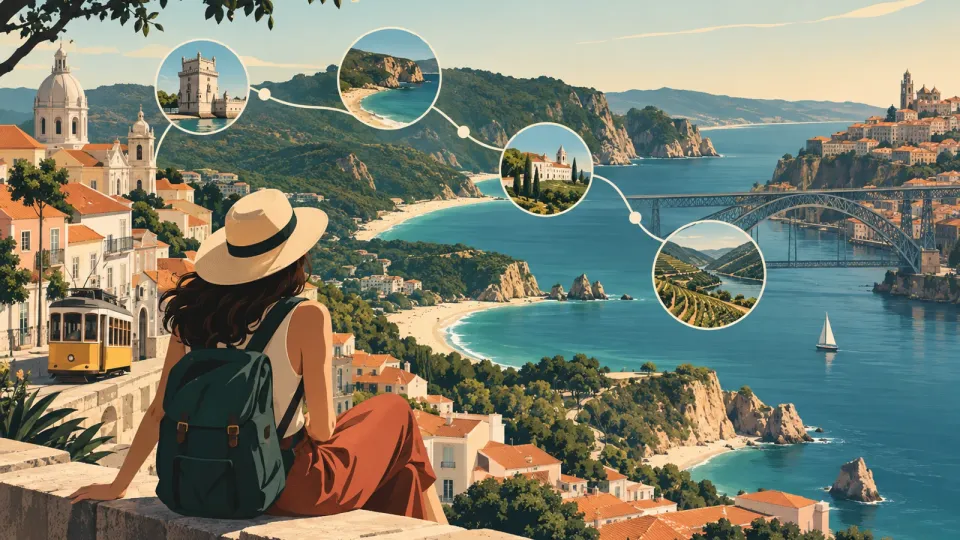
Stop trying to “do everything” in Portugal: here is the mainland plan that fits 10 days
A common first-trip mistake is building your plan around where a travel blog says you “should” go, then discovering your map is mostly travel time. Portugal punishes that approach with long drives, slow bus links, and tight days when you add day-trips.
For a first trip, the most time-efficient strategy is a single geographically workable mainland corridor. In practice, that means you base in two main hubs (Lisbon area, then Porto area) and connect them with one medium-length transit day. You add one beachy day near Lisbon, one protected-area nature day, and two to three classic cultural day-trips.
Why this works:
- You avoid island hopping and region hopping. You will not try to “fit in” Madeira, the Azores, or every coastline town from North to South.
- You keep your best scenery inside short transport windows. Lisbon to Porto is the big cross-country move, so you schedule it as one clean handoff.
- You make your trip photography-friendly. You can start early for light and end late for golden-hour shots without running across the country daily.
Your core logistics anchor is the train network. CP, Comboios de Portugal, sells long-distance services and lets you check times digitally. CP also describes its Alfa Pendular as a flagship service for work and leisure travel between Lisbon and Porto. (www1.cp.pt)
For the local transport inside Lisbon, you can use day tickets on Carris and Metro. Carris lists a 24h daily ticket price of EUR 7.25 that is valid for unlimited trips on the Carris and Metro network (subject to ticket rules). (carris.pt)
The misconception to avoid: “One day per town” often creates an itinerary that looks impressive but feels rushed. Instead, plan around areas (Old Town, viewpoints, coastline belt, historic neighborhoods) and give each area one focused day.
In the next sections, you will get a realistic 10-day mainland route with tradeoffs, what to cut, and a simple daily template you can reuse.
Days 1 to 4 in Lisbon: where to stay, what to shoot, how to move
Your best first four days in Portugal start with Lisbon as a base. If you pick a neighborhood that minimizes uphill walking, you buy yourself time for photography, museums, and spontaneous viewpoints.
A practical base choice: Lisbon neighborhoods that reduce friction
You want to be close to two things:
- Historic core access (Baixa, Alfama, Graça) for walking loops and lookout points.
- Efficient transit so you can escape the hills when you need a rest day.
A simple rule for first trips: prioritize a stay within a short taxi or bus ride of a metro or tram connection, then plan one big walking loop per day.
Daily template for Lisbon (use this each day)
- Morning light: pick one area you can photograph without sprinting.
- Midday anchor: a museum, viewpoint, or market where you can sit down.
- Late afternoon payoff: a river walk, a miradouro, or a hill neighborhood.
- Night snack route: one short “food circuit” so you avoid hunting.
Concrete photo and walking targets (low-risk picks)
- Alfama and Graça corridor for old stone lanes, tiled facades, and viewpoint angles. Lisbon’s Tram 28 is iconic and passes through this area, but it can also be crowded. A slower walking approach is often more flexible because you control pace and stops.
- Baixa to river edge for wide river compositions and architecture details.
Even if you do not ride Tram 28, it is useful as a mental map. Tram 28 is a loop that runs through east-side neighborhoods like Baixa, Graça, and Alfama, then heads west. (eaquals.org)
Transport that keeps your days smooth
For multiple short rides in central Lisbon, Carris and Metro day tickets simplify planning. Carris lists a 24h daily ticket at EUR 7.25 for unlimited trips on the Carris and Metro networks during the validity window. (carris.pt)
Common Lisbon day-trip mistake
People often spend Day 3 “shopping for a ticket” rather than touring. Fix it by deciding in advance:
- Which day you will do a major museum.
- Which day you will do an early excursion.
- Which day you will stay local.
That structure is the difference between a trip that feels relaxed and one that feels like a checklist.
At the end of Day 4, you will be ready for one dedicated coastline day near Lisbon, then a protected-area nature day before you start moving north to Porto.
Day 5 beach near Lisbon: Arrábida (no cramming, just real coastline time)
On Day 5, pick one beach and one viewpoint belt. Arrábida is designed for that style of visit, because it combines a protected landscape with scenic access.
Why Arrábida fits a 10-day mainland plan
Arrábida sits in a protected area. The national nature conservation authority describes the Parque Natural da Arrábida and its conservation framework. (icnf.pt)
That matters for travel planning because protected areas often use access rules (especially in peak season and on restricted sections). You can still enjoy the beaches, but you should plan around the rules.
The “two-part” beach strategy (works for first-timers)
Spend time in two nearby zones:
- A main beach area for swimming and relaxed photography.
- A viewpoint trail or coastal lookout for golden-hour images and wide compositions.
This prevents the classic beach mistake: spending the entire day in transit because you try to cover five beaches.
Access and restricted sections: what to watch for
Some Arrábida access models include Restricted Car Access Areas. A Visit Setúbal informational PDF explains that access to certain beach access zones can be divided into restricted car access areas. (visitsetubal.com)
Setúbal’s “Arrábida sem Carros” program has also published guidance about restricted vehicle circulation and access controls for specific beach access stretches. (mun-setubal.pt)
Practical tip: treat your beach day as a transit-aware shoot day.
- Plan to arrive earlier, especially if you have a car-based plan.
- If you rely on public transport or day-access controls, build in a flexible backup viewpoint.
What to photograph (so you are not wandering)
- Cliff and coastline lines for leading lines into the bay.
- Shadows on rocks in late afternoon.
- Water texture with a slower shutter if conditions allow.
If you only take one decision from this section
Choose one beach zone, then build your entire day around it. That keeps your Day 5 peaceful instead of frantic.
By the end of Day 5, you will have coastal scenery without paying the “time tax” of too many regions.
Day 6 Sintra from Lisbon: the day trip that people overstuff
Sintra is the day trip that can either be magical or exhausting, depending on how you schedule it. For a realistic 10-day plan, you need a tight framework, not a long list.
The best mindset for Sintra in one day
Treat Sintra as a single base with multiple “stops”, not as five separate attractions that each deserve their own commute. If you try to do palace, gardens, historic town, coastal viewpoints, and multiple castles, you will feel rushed by early afternoon.
Get to Sintra with Lisbon’s urban rail link
CP provides a Lisbon urban trains timetable for the Sintra and Azambuja lines, including Rossio station service patterns. (cp.pt)
That timetable source is useful because it reminds you Sintra trips are not just “one train whenever you want.” They follow a schedule, so you should plan your departure window around your arrival priorities.
How to choose what to see (a simple selection rule)
Pick one palace-style highlight plus one viewpoint or garden. Then add the town walk only if time remains.
A common mistake is prioritizing “more tickets.” That causes long queues, which then pushes your afternoon light out of the window.
A schedule that keeps you moving at a human pace
- Early arrival: start with the major highlight.
- Midday: eat in the historic center area.
- Afternoon: viewpoint or garden where you can slow down.
- Return before you feel tired: do not stay until late just because you are there.
Photo tips for Sintra without getting overwhelmed
- Shoot details in the morning when foot traffic is lower.
- Switch to wide landscape compositions after lunch when the light softens.
- If you bring a camera, plan one composition you want, then move on.
Tradeoff you should accept
You will not “finish Sintra.” You will finish a curated slice. That is the correct choice when your total trip length is only 10 days.
After Day 6, you will shift from “day-trip energy” toward “base-to-base travel,” because you need time to enjoy Porto later.
Days 7 to 8 travel to Porto: one move, no detours
Your biggest time win in a 10-day mainland itinerary is treating Lisbon to Porto as a single clean transition. Do not add detours that force you to re-pack and re-route again.
How to move between Lisbon and Porto by rail
CP describes its Alfa Pendular as a premium service for travel between major cities, including Lisbon and Porto. (www1.cp.pt)
CP also provides guidance on train timetables and checking times digitally, which matters because departure and arrival stations vary by service type. (cp.pt)
Practical planning step:
- Pick your departure based on the day’s energy. If you arrive late, shorten your Day 8 sightseeing.
- Decide in advance which Porto area you want to base in, then plan your walking routes around hills and river viewpoints.
Common mistake: choosing the wrong arrival station in Porto
Porto has central stations and connections. While exact station placement can change depending on the service, your safest approach is to check your booked service details in CP’s timetable tools and plan your accommodation around the station you actually arrive at. (cp.pt)
Day 7 template: travel and settle
Keep Day 7 simple:
- Morning to midday: travel window.
- Late afternoon: one neighborhood walk plus dinner.
- Early night: you are preparing for a full Day 8.
Day 8 template: Porto neighborhoods, not more country
For first-time Porto, you want a compact day:
- One historic core walk.
- One riverside viewpoint or bridge angle.
- One food stop you can repeat the next day if you love it.
You are not trying to cover every museum. You are building a Porto “visual story” like you do in film and photography workflows: establishing shots, then a few detail scenes.
Where this itinerary stays realistic
The plan avoids turning Day 7 into a second day-trip. That preserves your energy and makes Porto feel like a destination, not a stop.
By the end of Day 8, you will have the Lisbon-to-Porto arc done, then you can focus on coastal nature and a final day-trip choice near Porto.
Day 9 near Porto: one coastal nature option and one city finish
Day 9 should balance two goals: coastline variety and a calm end to your trip. The temptation is to pick a second big day-trip near Porto. Resist that.
Choose one nature-and-coast option, not three
For mainland travel, coastal time near Porto can be rewarding, but you only have one free day before your final morning. A realistic approach is:
- Pick one coastal area for a long walk and photography.
- Pick one city finish in the afternoon.
The key is staying in your chosen region rather than moving again.
Make your itinerary “lightweight” for your last day
Your last sightseeing window matters because you will need time for:
- packing and laundry basics.
- a relaxed meal.
- a final viewpoint.
If you do too much on Day 9, Day 10 becomes stressful and you lose the photo light you wanted.
Transport planning that keeps you flexible
Use the rail and urban transport you already planned around. CP provides a digital approach to timetable checking and real-time departure status, which reduces the risk of missing the connection that returns you to the city. (cp.pt)
Within cities, day tickets can simplify multiple rides. For Lisbon, Carris publishes a 24h daily ticket price. Even if you are in Porto today, this principle is the same: buy the simplest ticket that matches your day’s ride count and validity window. (carris.pt)
A simple Day 9 shooting plan
- Morning: coastline walk (wide shots, texture, horizon lines).
- Lunch: coastal area or return to the city for a familiar rhythm.
- Afternoon: historic neighborhood details.
- Sunset: one viewpoint only.
Common mistake: “We will buy tickets later”
On a tight itinerary, late-day ticket purchases can create delays. If you want a specific palace, viewpoint, or guided entry, plan your Day 9 priorities early.
This is also where protected-area rules can matter. Even though this section does not lock you into one specific protected site near Porto, you should still check local access rules the way you did for Arrábida, because some natural zones restrict vehicles and access during certain periods.
Day 9 stays realistic by keeping the choices count low, so you end your trip with calm, not chaos.
Day 10 in Portugal: the morning checklist that prevents last-day stress
Your Day 10 plan should protect two things: time for a final neighborhood loop and enough buffer to reach your departure without rushing.
A 60-minute “last morning” checklist
Do this before you leave your hotel:
- Charge camera and phone backups.
- Quick pack of anything that might be missing (passport, charger, external card reader).
- Confirm your transport option (station, airport, or bus stop).
This checklist matters because travel days are the ones where minor delays hurt the most.
A last loop that fits most schedules
Choose one:
- A riverside walk for skyline and bridge lines.
- A historic street circuit with cafes for a final coffee.
- A viewpoint that you already know you like.
Keep it short. You are not collecting attractions. You are collecting images and a sense of place.
One final transport insight: plan using published timetable tools
If you are taking train connections, CP provides ways to check train times and timetables digitally. CP also points you to its timetable documents and real-time departure tools. (cp.pt)
Even if you think “we will figure it out,” the best use of your last morning is confirming times and station details.
If you used public transport cards in Lisbon
Carris Metro day tickets can be used to reduce fare complexity. Carris lists the 24h CARRIS/Metro daily ticket at EUR 7.25 and explains it is valid for unlimited travel across the network during the 24-hour validity window. (carris.pt)
In Porto, you will have a different ticketing setup, but the same planning logic applies: pick a ticket aligned to your final ride pattern.
The misconception to fix on Day 10
People worry they will “miss something” and keep adding stops. With only 10 days, that fear is usually a signal you planned too many locations earlier. The cure is a short loop plus a relaxed meal.
Your end goal is not to see every monument. It is to return home with a coherent Portugal story: Lisbon’s old lanes, Arrábida’s coastline atmosphere, Sintra’s day-trip magic, then Porto’s riverside grit.
Take a final batch of photos early, when the light is calm, then leave enough time for your departure so you do not spend your last hours running.
10-day Portugal FAQ: trains, transport tickets, and how to avoid the biggest itinerary traps
1) What is the most realistic mainland route for Portugal in 10 days?
The most realistic approach is a Lisbon to Porto corridor with one coastline day near Lisbon and one nature or coast-style day near Porto. You base in Lisbon for several days, then make one main transit to Porto, then finish locally. This avoids the time tax of cramming islands and multiple regions.
Train-wise, CP describes its Alfa Pendular as a premium service for travel up and down Portugal, including Lisbon and Porto, and CP provides official tools to check timetables digitally. (www1.cp.pt)
2) How do I handle transport in Lisbon without making my days complicated?
Use the simplest ticket that matches your day. Carris publishes a 24h CARRIS/Metro daily ticket at EUR 7.25 for unlimited trips on the network during its validity window. (carris.pt)
Then plan one major walking loop per day, use transit to connect between areas, and avoid hopping neighborhoods all day long.
3) Is Sintra doable as a day trip from Lisbon?
Yes, it is doable if you avoid overstuffing. CP provides Lisbon urban train timetables for the Sintra and Azambuja line, including departures from Rossio. That means you can plan a return time and avoid waiting around. (cp.pt)
A practical rule: pick one major palace-style highlight plus one viewpoint or garden, then stop.
4) What is special about Arrábida for first-timers?
Arrábida is a protected natural area, and some beach access models include restricted car access sections. The national authority describes the protected area framework, and Visit Setúbal materials explain restricted access areas for beach access. (icnf.pt)
Plan your beach day around one or two zones, arrive early, and keep a backup viewpoint.
5) Do I need to worry about train schedules on long-distance travel days?
Yes. CP provides official timetable and timetable-checking tools for train times and departures. Use those tools for your booked service and plan your accommodation so you can reach the station without stress. (cp.pt)
6) What is the biggest itinerary trap in a 10-day Portugal plan?
The biggest trap is stacking too many separate regions and day trips. It turns your trip into transit time plus fatigue. The fix is to choose a corridor route (Lisbon to Porto), then add only a few focused day trips.
7) Can I make this itinerary photography-friendly?
Yes. Use this structure:
- Early morning for light.
- Midday anchor for rest and indoor details.
- Late afternoon for viewpoints.
Then reduce your number of “must-see” stops per day.
If you want your plan to stay realistic, you should keep your attraction count low and your arrival times confirmed.
Plan your 10-day Portugal route in 30 minutes: a simple next-step checklist
You do not need a complicated spreadsheet to make this trip work. You need a decision order that prevents last-minute chaos.
Step 1: lock your two bases
- Base 1: Lisbon for Days 1 to 4.
- Base 2: Porto for Days 8 to 10.
This matches the single, geographically workable mainland approach and avoids region cramming.
Step 2: schedule only three “day trip” commitments
Use these as your three anchors:
- Day 5: Arrábida beach and viewpoint belt.
- Day 6: Sintra day trip from Lisbon.
- Day 9: one coastal or nature-style day near Porto plus one city finish.
Step 3: pick your transport method for the two big moves
-
For the main corridor move, use CP’s long-distance planning approach and check official timetables and service details digitally. (cp.pt)
-
For Lisbon local movement, consider a Carris and Metro day ticket to simplify your ride planning. Carris lists a EUR 7.25 24h daily ticket. (carris.pt)
Step 4: write a one-sentence rule for each day
Use this template:
- Day X is for one area plus one payoff.
This prevents the “one more stop” spiral.
Step 5: confirm one operational detail today
Choose one:
- Look up your CP timetable times for your Lisbon to Porto travel day using CP’s official timetable tools. (cp.pt)
- If you plan a Sintra day, confirm your Lisbon starting station and return time based on CP’s published urban timetable. (cp.pt)
One thing you can do today
Open CP’s timetable checking page and select your Lisbon to Porto departure day time window. Then write down the arrival station and your accommodation target neighborhood, so your Day 8 plan starts from reality, not hope.
Related guides
Barcelona to Lisbon by train: a realistic overland plan
Barcelona to Lisbon options, from a practical Renfe to CP route with possible overnight stops, plus a smarter flight comparison.

48 hours in Porto: a Lisbon resident’s working itinerary
48 hours in Porto itinerary that skips tourist theatre. Plan Ribeira, wine cellars, Foz, Matosinhos, and one best day trip. Use this today.

Albufeira Beaches: Old Town, Resorts, and Quieter Picks
Albufeira beaches compared for day trips and stays: Old Town coves, resort strips like Oura, plus calmer options such as São Rafael and Falésia.
Alentejo Beaches: Pick a Base and Plan Beach Days
Alentejo beaches, choose the right coastal base for your pace. Compare Odemira to Tróia and plan beach days with protected-area access rules.