
Praia de Odeceixe River-Mouth Guide (Sea and River)
Praia de Odeceixe is sea and river at once, at the Algarve and Alentejo border. Learn tides, access, and safer planning for families.
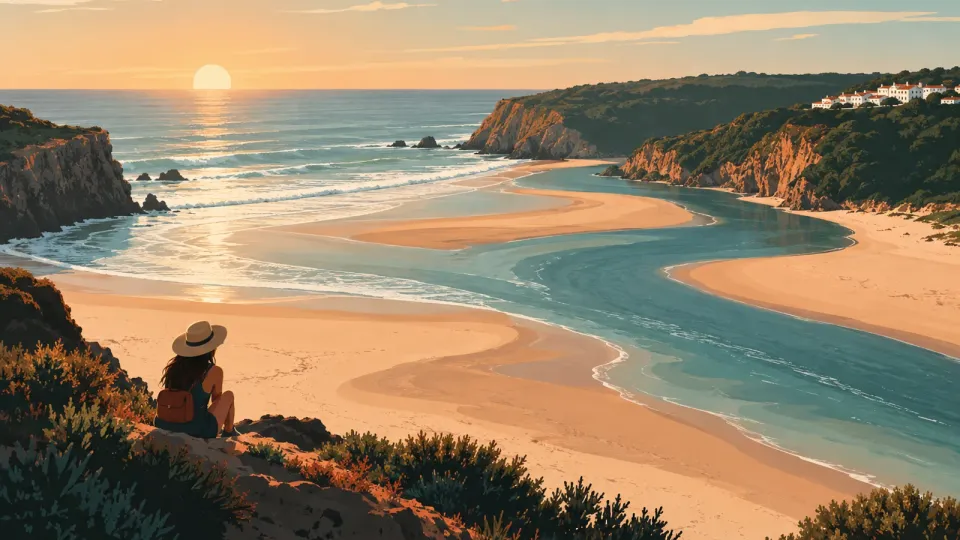
Praia de Odeceixe is the Algarve and Alentejo meeting point at sea level
The first surprise is geographic, not cosmetic. Praia de Odeceixe sits at the mouth of the Ribeira de Seixe, where the river valley opens onto the Atlantic shoreline, and it marks the border between the Algarve and Alentejo regions. The effect on the beach is instant: you can experience protected, calmer water by the river side and fully open ocean conditions with surf and currents close by. (freguesiadeodeceixe.pt)
If you are planning for kids, use this simple rule. Do not treat “river water” as universally safe. Even when waves are weaker near the river mouth, the area can still have fast-moving flow, changing salinity, and mixed conditions. Local guidance describing the beach as “sea and river at the same time” is useful because it implies mixed hazards, not a guaranteed calm zone. (dirportugal.com)
This beach is also inside a protected landscape. Odeceixe lies within the Southwest Alentejo and Vicentine Coast Natural Park (Parque Natural do Sudoeste Alentejano e Costa Vicentina). That helps explain why you will not find the same level of built amenities you see on more urban Algarve beaches. Plan to be self-sufficient. (icnf.pt)
Quick self-check before you go
- Are you planning beach time or river-mouth exploration? You can do both, but the “right” waterline differs.
- Will you swim? If yes, you need to understand which side is ocean-facing and which side is river-facing at your exact tide.
- Are you bringing children? Keep them under close supervision at all times, and choose the calmer side based on what you see in the water right now.
Place names you will see on signs
- Praia de Odeceixe (beach)
- Odeceixe (the village, in the municipality of Aljezur)
- Ribeira de Seixe (river, sometimes called Rio Seixe)
This matters because many directions mix “Odeceixe village” and “Praia de Odeceixe” as if they were the same spot. They are close, but not identical.
Village vs beach: two different landscapes, two different pacing
Odeceixe village and Praia de Odeceixe are linked by a short geography story, but they feel different underfoot. Odeceixe sits along a hill near the Ribeira de Seixe. The beach is further down the valley, by the river mouth and Atlantic shoreline. (pt.wikipedia.org)
What the village gives you
The village side is where you slow down. Freguesia de Odeceixe’s tourism page highlights that Odeceixe’s valley and river setting define the Algarve-to-Alentejo separation, and it points to village landmarks like the church and the windmill viewpoint. (freguesiadeodeceixe.pt)
Practical takeaway: if you want calmer moments for kids, or you need shade and a place to reset, the village is often the easier option before you descend to the beach.
What the beach demands
At the beach, you are in a protected coastal system with strong natural forces. The official village tourism page describes Praia de Odeceixe as an extensive strip of sand protected by high cliffs, and it explicitly notes that small lagoons form during low tide. Lagoons help some families feel reassured, but lagoons do not equal “still water all day.” You still need to watch the tide and the waterline as conditions shift. (freguesiadeodeceixe.pt)
The same page also states that the beach is the most northern beach of the Algarve, at the mouth of the Seixe River, and it has a Blue Flag and seasonal lifeguard supervision with support services during the bathing season. Treat that as a baseline, not a substitute for situational awareness. (freguesiadeodeceixe.pt)
A simple visit plan that keeps everyone comfortable
- Morning village stop (30 to 60 minutes): quick viewpoint, snack, toilets if available.
- Late-morning beach descent (the low-tide window if you can plan it): focus on the river-mouth side where lagoons may appear.
- Early afternoon break: return to village shade or plan a long pause off the hottest sand.
- Ocean-only time for adults: if you do surf-facing zones, keep kids away from the ocean edge.
Common mistake to avoid
Many travelers treat “Praia de Odeceixe” like one uniform swimming spot. It is not. Your experience changes as the river side turns from lagoon to channel and as the ocean swell arrives. Plan for two zones, not one.
Source-based anchors for your decisions
- Odeceixe village is defined by its setting near the Ribeira de Seixe and access via EN120. (pt.wikipedia.org)
- Praia de Odeceixe is described as protected by cliffs and forming small lagoons at low tide. (freguesiadeodeceixe.pt)
That is enough to build a realistic day plan without guessing.
Tides decide the water you will actually see (low tide lagoons vs open-ocean surf)
If you remember only one thing, remember this: Praia de Odeceixe changes with tide. The local tourism description notes that “during low tide small lagoons form on the sand.” Those lagoons are the reason many people fall in love with the river-mouth setting. (freguesiadeodeceixe.pt)
But the tide also changes the relationship between river flow and Atlantic waves. At certain stages, the river-side can look calm, yet the ocean-facing edge can still bring waves and currents. Other sources describing the beach as sea and river at the same time explain why you should not assume one side predicts the other. (dirportugal.com)
Use a two-zone strategy instead of a single swimming plan
- River-mouth zone: look for shallow, lagoon-like pools when low tide exposes more sand.
- Ocean-facing zone: assume surf and stronger currents are possible because the Atlantic is open water nearby.
Even if the river side looks inviting, keep children within reach. Mixed water conditions at a river mouth can still move. And if there is swell, water can arrive across sand bars faster than you expect.
What “river-mouth” means in practice for families
The beach is where Ribeira de Seixe meets the sea. The river’s lower course is part of the coastal system, and it runs into the Atlantic right here. (pt.wikipedia.org)
So your child’s “swim” area may switch from:
- gentle lagoon edges (often at low tide), to
- a more active channel that follows the river’s outflow (as tide changes), and then to
- a wider ocean-influenced shoreline.
A tide-based checklist you can do on arrival
- Find the tide line visually: where does the water stop, and where does dry sand begin?
- Observe wave behavior: do small waves reach the river-side pools, or do you see mostly sheltered water?
- Watch flow direction: does the river side show clear current, even if it is shallow?
- Pick your boundary: set one spot as “kids only” and keep the ocean edge for non-swimmers.
One misconception to correct
A common mistake is saying, “The river side is calm, so it is safe for kids.” You cannot safely generalize that. The beach description itself is about conditions changing with tide, and the geographic reality is mixed sea and river water. Use the visual and situational checks above. (freguesiadeodeceixe.pt)
How to think about timing without guessing numbers
You may not want to compute tides yourself. Instead, plan your day around two arrival windows:
- Arrive toward low tide if your priority is lagoon-like sand and gentle exploration.
- Arrive earlier or later if you want more wave action for photos, but keep swimmers separated by zone.
This approach avoids the trap of making one tide assumption for an entire beach day.
How to reach Praia de Odeceixe and avoid the access surprises
The access plan is simpler than it feels once you separate two steps: get to Odeceixe, then descend to the beach. Odeceixe village is served by road access along EN120, which passes close to the locality. (pt.wikipedia.org)
From there, you need to follow beach signage for Praia de Odeceixe. Practical walking and route descriptions for the area consistently reference reaching the beach via the main EN120 corridor and then using signposting for “Praia.” (walkalgarve.com)
What to expect at the final approach
In a natural park setting, the last stretch can feel “less urban.” Route notes for the beach trail mention a dedicated parking area close to the beach, and they also describe the possibility of roadside parking along the access road if parking fills. (walkalgarve.com)
That leads to a helpful planning rule: arrive with a buffer if you are going on a busy beach day.
A navigation mindset that works for road trips
- Treat EN120 as your backbone. Use it to position yourself near Odeceixe.
- Then follow “Praia” signs rather than relying on “Odeceixe” as the final destination.
- Decide your return route early. It is easy to get focused on photos and forget where you parked.
Walking down from village to beach, if you prefer it
Some visitor descriptions and trail content describe the beach walk as following the river valley and taking about 45 minutes from the village. One site frames this as a scenic route through the vale, emphasizing natural beauty rather than speed. (sandsguide.com)
For families, the key insight is not the exact minutes. It is the fact that you are walking a valley approach, which can mean hills at the beginning and end, and sand travel near the beach.
Stay aware of protected-area conditions
Because Odeceixe sits within the Southwest Alentejo and Vicentine Coast Natural Park, you should expect rules around habitat protection, and you should avoid stepping off-limits in dune or sensitive cliff areas. An official protected-area planning document for the natural park includes the Odeceixe area among the zones considered for protection. (diariodarepublica.pt)
Common access mistake
People often try to “optimize” by arriving at the beach at the last possible minute. At river-mouth beaches with seasonal lifeguarding and variable parking, that plan backfires. Build in time to park, walk, and then reassess water conditions before you let kids go near the edge.
Evidence-based anchors
- EN120 road access near Odeceixe. (pt.wikipedia.org)
- Signposted approach for “Praia,” plus notes on parking availability. (walkalgarve.com)
- Protected-area planning references covering the Odeceixe vicinity. (diariodarepublica.pt)
Use these three facts as your access baseline, not vague promises.
Sea and river safety: a practical ruleset for families at a mixed shoreline
Praia de Odeceixe is “mar e rio ao mesmo tempo” (sea and river at the same time). That phrase is not marketing, it is risk management. When sea and river meet, conditions can look calm in one spot and change quickly in the next. (dirportugal.com)
Because your scope includes tides and the ocean/river distinction, here is a ruleset you can apply without assuming any category of water is automatically safe.
Rule 1: Choose the zone by what you see, not by the label
- River side: you might see lagoons at low tide. The local tourism page notes small lagoons form during low tide. (freguesiadeodeceixe.pt)
- Ocean side: you should assume open Atlantic surf and currents can occur near the ocean-facing edge because the beach is on an open Atlantic setting. (pt.wikipedia.org)
Your “kids zone” should be the calmest visible area at your exact tide stage.
Rule 2: Treat “river-mouth calm” as temporary
River flow and wave arrival change through the day. Even if water is shallow, movement can increase if tide rises, and incoming swell can reshape sand edges.
This is where many families get it wrong. They treat the river side as stable, then forget it is controlled by tide and the meeting of two water systems.
Rule 3: Never let children drift toward the ocean edge
One easy method is to set a physical boundary.
- Pick a landmark: a sandbar, a rock line, or the edge of a lagoon-like pool.
- Agree on a “no-go line” for kids.
- Keep an adult assigned to “watch duty” rather than everyone trying to supervise while also relaxing.
Rule 4: Watch for changes in wave reach, not just wave size
At river mouths, waves may break farther up the beach at one moment and then reach nearer waterline at another. Your check should be simple: do waves reach your children’s feet, or do they break farther away?
Rule 5: Use lifeguarding cues, but do not outsource judgment
The Odeceixe parish tourism page states that Praia de Odeceixe has Blue Flag and is vigilated in the bathing season, with support services. Use that as a confidence booster, not as a blanket guarantee. (freguesiadeodeceixe.pt)
What to do if someone is unsure about swimming
- Stop moving closer to the ocean edge.
- Sit or stand in shallow, sheltered water.
- Reassess after 10 minutes. If conditions change, you change too.
Ocean vs river distinction, in one sentence
The river side can offer lagoon-like calm at low tide, but the ocean side can still bring surf and currents, and both zones can shift as the tide changes. (freguesiadeodeceixe.pt)
One direct misconception to avoid
Never call river water universally safe for children. Even when it looks gentle, it is part of a mixed coastal system at a river mouth. Your safety planning should always be observational and time-dependent.
Photograph the river-mouth look without getting stuck in the wrong tide window
Praia de Odeceixe rewards photos because the shoreline splits into visual narratives: sheltered water and lagoons at one stage, and Atlantic energy at another. The local parish tourism page explicitly notes lagoon-like pools forming at low tide, which is a strong clue for when the “river-mouth calm” images are possible. (freguesiadeodeceixe.pt)
At the same time, other descriptions emphasize that you are at a point where sea and river conditions coexist. If you plan your shots without checking tide influence, you can end up with great sand and flat compositions, or with dramatic surf that hides the river-side detail. (dirportugal.com)
A tide-driven shooting checklist
- Arrive with flexibility. If lagoons are visible, spend time there first.
- Separate “composure shots” and “action shots.”
- Lagoons and sheltered pools favor calmer compositions.
- The ocean-facing edge favors longer focal lengths and higher shutter speeds if waves are breaking.
- Watch waterline movement for 5 minutes. Then choose where to set up.
Composition ideas that match this specific beach
Because the Ribeira de Seixe shapes the shoreline, you can capture:
- Curves of the river channel where sand bars guide the eye.
- Borders between wet sand and exposed sand when low tide expands the beach.
- High cliffs as a framing element since the parish description highlights protection by high cliffs on both sides. (freguesiadeodeceixe.pt)
The “wrong expectation” that costs time
A common mistake is treating the beach as if the “river mouth effect” stays constant all day. The evidence says the effect includes low-tide lagoons. If you arrive too late, the lagoons may shrink and your river-side details can disappear under rising water. (freguesiadeodeceixe.pt)
Quick lighting notes based on geography (no weather promises)
This is an Atlantic-facing shoreline with cliffs and sheltered pockets. That usually means:
- Overcast or broken light can still deliver texture.
- Directional sunlight makes wet sand and lagoon edges pop.
Do not rely on guaranteed sunshine. Instead, plan to shoot details, not just wide scenes.
What to watch for on the ground
- Stay away from fragile dune and cliff edges in a protected natural park setting.
- If you see wildlife or sensitive habitats, change your angle rather than stepping closer.
Protected-area planning materials show that the Odeceixe area includes zones considered for protection, which is a practical reminder to keep distance from sensitive areas. (diariodarepublica.pt)
A minimalist gear setup that suits river-mouth conditions
You do not need bulky equipment. For this shoreline style:
- A lens for close details (river-lagoon edges, ripples, footprints patterning).
- A lens for landscape framing (cliffs and the arc of sand).
- Bring something to protect gear from sand spray near ocean-facing zones.
Evidence-based timing cue
If your priority is lagoon-like pool detail, target low tide because small lagoons form at low tide on the sand at Praia de Odeceixe. (freguesiadeodeceixe.pt)
That is the most reliable planning hint available from local descriptions, and it directly supports shot selection.
Plan a half-day route: beach, village viewpoint, and a realistic return
The most efficient way to enjoy Praia de Odeceixe is to treat it as a half-day loop. You will get the river-mouth perspective, then reset in the village area, and return without rushing.
This pacing matches what the parish tourism page describes about the village and the beach, including a direct tie between the village valley setting and the river that reaches the beach. (freguesiadeodeceixe.pt)
A 4-step half-day plan that fits most families
- Village viewpoint and river understanding (45 to 60 minutes).
- Use the village setting to visualize how the Ribeira de Seixe runs down to the beach.
- Look for a viewpoint area to frame cliff and valley context.
The parish tourism page describes the village viewpoint experience and connects the river valley to the beach setting. (freguesiadeodeceixe.pt)
- Descend to Praia de Odeceixe (when lagoons are likely).
- Low tide is the key clue because small lagoons form on the sand during low tide.
- Spend time exploring the river-mouth edges rather than sprinting to the ocean edge.
- Switch zones for photos and calm time (30 to 90 minutes).
- Zone A: river-mouth lagoon-like pools.
- Zone B: ocean-facing edge for photos only, keep kids away.
This follows the sea and river at once reality described by sources that emphasize the mixed shoreline character. (dirportugal.com)
- Return to the village for a rest or a meal (45 to 90 minutes).
- The village setting is a natural place to recover from sand heat and wind.
Transport reality for the area
Even if you drive, keep in mind that travel within the Rota Vicentina region often uses the N120 corridor and local connections. The Rota Vicentina regional page describes N120 passing through Odeceixe and gives a broader picture of regional bus connections to Odeceixe (and references services). (rotavicentina.com)
If you are coming from Faro, that same page mentions bus services via VAMUS Algarve toward Lagos and then links to local connections that include Odeceixe. Exact timetables change, so treat those as a route map rather than a promise. (rotavicentina.com)
A “no stress” family packing checklist
- Water in sealed bottles and a small snack.
- Sun protection and a light layer for wind.
- A spare set of clothes, lagoon sand gets everywhere.
- Small towel or mat for a stable sitting spot away from ocean reach.
A common scheduling mistake to avoid
People sometimes schedule Odeceixe beach as a late afternoon stop, then arrive to find lagoons less visible. Since the lagoon effect is tied to low tide, a late arrival often shifts the day toward ocean energy and away from the river-mouth calm that drew you there in the first place. (freguesiadeodeceixe.pt)
Evidence-based anchors for your loop
- Low tide lagoons form on the sand. (freguesiadeodeceixe.pt)
- Odeceixe village is connected to the Ribeira de Seixe valley, and the river delimits Algarve and Alentejo in this area. (freguesiadeodeceixe.pt)
Use those anchors, then adapt your timing to your tide window on the day you travel.
Getting there by public transport: what to plan, what to confirm
Public transport to Odeceixe works best when you think in connections, not one direct line. The Rota Vicentina regional information page describes how the region is accessed by road along N120, and it also describes bus options linking major hubs toward Odeceixe. It specifically mentions that VAMUS Algarve serves connections from Faro toward Lagos, and that from Lagos there are national and local links including Odeceixe. (rotavicentina.com)
For rail, CP provides nationwide train services to major Algarve stations, but Odeceixe is not a train stop in the way Faro or Lagos can be. So you should plan for a final bus or transfer from a larger town.
A practical planning framework for public transport travelers
- Pick your anchor city. Likely Faro, Lagos, or another major Algarve node.
- Plan the rail segment first (if needed). Use CP timetables pages to check which services run on your travel date. CP publishes train timetable information online. (www2.cp.pt)
- Add the bus segment to the regional area. Use Rota Vicentina’s regional transport description as the route logic, then confirm the exact bus service for your day of week. (rotavicentina.com)
- Confirm the last mile to the village and beach. Some travelers still rely on local taxis or short transfers for the final approach to the village and beach.
Why you must confirm details
Timetables and operating days can change. Even the CP pages stress that train connections are under normal operating conditions, which signals that disruptions can occur. (www2.cp.pt)
So treat any “how to get there” summary as a starting point, then check live schedules when you book or before you leave.
A family-friendly public transport tip
River-mouth beaches benefit from flexible timing. If you cannot predict tide precisely with transport timing, prioritize arriving with daylight and enough buffer to reassess water conditions. The key planning variable is the tide-driven lagoon effect, since small lagoons form at low tide. (freguesiadeodeceixe.pt)
One misconception to avoid
People assume public transport options are “the same every day.” In rural-to-coastal connections, that is often false. The Rota Vicentina page notes that some connections can be available only certain days of the week. (rotavicentina.com)
Evidence-based starting points you can cite while planning
- N120 runs through the Southwest region and passes through Odeceixe. (rotavicentina.com)
- Bus connections toward Odeceixe are described via VAMUS Algarve and links from Lagos. (rotavicentina.com)
- CP publishes timetable resources and train service information to anchor your rail segment. (www2.cp.pt)
If you share your departure city and travel month, you can outline a connection strategy that matches your priorities, but for the exact times you should confirm on the day you plan to travel.
FAQ: Praia de Odeceixe, river mouth tides, and what to do with kids
Is Praia de Odeceixe really both a river beach and an ocean beach?
Yes. Praia de Odeceixe is located at the mouth of the Ribeira de Seixe, where it meets the Atlantic. Descriptions of the beach emphasize that it is sea and river at the same time, and local material notes that the beach is bathed on one side by the river and on the other by the sea. (freguesiadeodeceixe.pt)
What changes at low tide at Praia de Odeceixe?
At low tide, small lagoons can form on the sand. The parish tourism page for Odeceixe explicitly notes that “during low tide small lagoons form on the sand.” That is one reason people plan the visit around tide timing. (freguesiadeodeceixe.pt)
Does the “river side” mean it is always safe for children?
No. Even if the river side looks calmer, you should not treat river water as universally safe for children. Praia de Odeceixe is a mixed sea and river environment with conditions that depend on tide and wave reach, so use observational safety rules and keep children close. (dirportugal.com)
Where is Odeceixe village compared to the beach?
Odeceixe village sits along the valley near the Ribeira de Seixe, while Praia de Odeceixe is at the river mouth down by the Atlantic shoreline. The parish tourism page connects the valley, the river, and the beach, and the village geography notes the proximity of Odeceixe to the Ribeira de Seixe. (freguesiadeodeceixe.pt)
What is the main road access people use?
Road access to Odeceixe is described as being along Estrada Nacional 120 (EN120), which passes near the locality. From there, you follow signposting for the beach. (pt.wikipedia.org)
Is Praia de Odeceixe a fully urban beach with lots of facilities?
No. It is within the Southwest Alentejo and Vicentine Coast Natural Park, and local material emphasizes cliffs, dunes, and protected coastal habitat context. You should expect fewer urban-style amenities than at more developed Algarve beaches and plan accordingly. (icnf.pt)
Do I need to plan for parking availability?
Yes. Route notes for the Odeceixe beach trail describe a dedicated parking lot close to the beach, but they also mention roadside parking if areas fill. Add buffer time so you are not stressed if you arrive when parking is busy. (walkalgarve.com)
Can I rely on one rule about swimming here?
Use a two-zone approach. The safest plan is to treat the river-mouth lagoon edges as one zone and the ocean-facing edge as another, then choose where children stay based on what you see at your tide. Low tide lagoons are documented, but ocean conditions can still exist nearby. (freguesiadeodeceixe.pt)
What should I do today if I am planning a trip?
Check your tide window for the day you plan to arrive, then plan an arrival that gives you time to reassess conditions before kids go near the waterline.
Conclusion: make Praia de Odeceixe work for your family with tide-first planning
Praia de Odeceixe can feel like a single beach, but it behaves like two environments. The evidence is clear: it is sea and river at once, it is at the mouth of the Ribeira de Seixe, and low tide can create small lagoons on the sand. (dirportugal.com)
That leads to actionable planning. Do not plan “one swimming spot.” Plan two zones, river-mouth calm versus ocean-facing energy. Then decide where kids stay based on what you observe at your arrival time.
Your next steps you can do today
- Pick your tide-first arrival window. If lagoons are your goal, plan to arrive near low tide because small lagoons form on the sand during low tide. (freguesiadeodeceixe.pt)
- Plan a village reset. Build time for Odeceixe village before and after the beach. Village setting is linked to the river valley and gives you an easier place to rest between changes in conditions. (freguesiadeodeceixe.pt)
- Write your “kids boundary” rule. Choose the calmest visible waterline, then keep children within reach and away from the ocean edge.
One specific action you can take now
Open your calendar and choose a beach arrival time for the day you plan to visit Praia de Odeceixe, then schedule a 30 to 60 minute buffer on both sides of that time so you can park, descend, and re-check water conditions before swimming.
Related guides
Praia da Nazaré surf, the North and the sea like cinema
Praia da Nazaré: Praia do Norte for giant waves and Praia da Vila for swimming. Safety guide, best time, and seafood.

Lagos Beaches: Meia Praia, Porto de Mós, Dona Ana, Camilo
Compare Lagos beaches by access and trip needs: flat Meia Praia, easy Porto de Mós, scenic Dona Ana, and the 200-step Camilo. Pick your base.
Praia da Arrifana guide: surf, grilled fish, zero crowds
Praia da Arrifana guide to avoid Albufeira vibes, waves by month, cliff descent, where to eat grilled fish, parking, and whether to stay in Aljezur.

Praia da Bordeira: Costa Vicentina without crowds
Praia da Bordeira guide: how to get there, what to pair in one day, and how to choose windy surf conditions. 3-day plan.