
Things to Do in Braga: City Steps to Bom Jesus
Things to do in Braga with a practical plan for the city center and Bom Jesus do Monte. Steps, transport tips, and realistic timing.
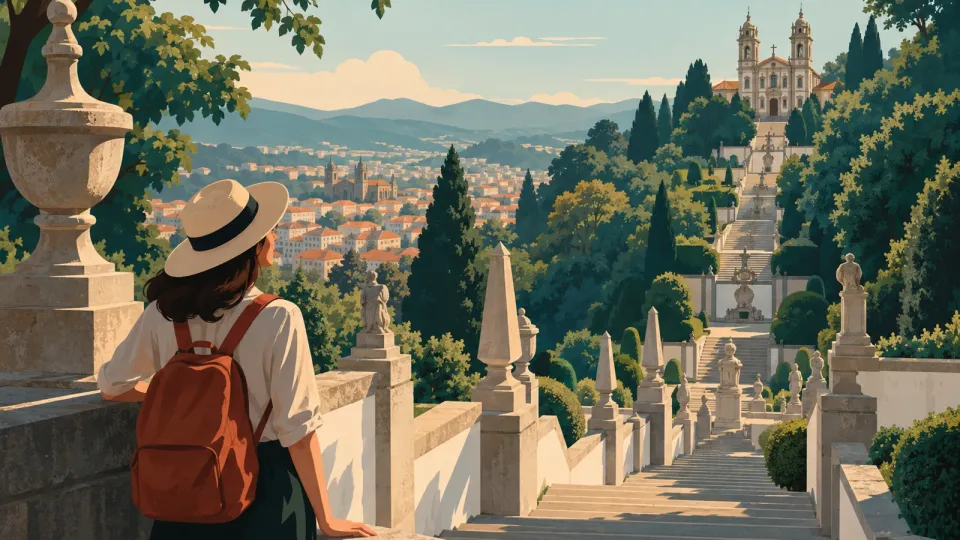
1) Start with the “two-level” Braga plan: old city first, Bom Jesus second
Braga rewards you when you split the day into two real zones: the historic core (walkable, compact, photo-friendly) and Bom Jesus do Monte (uphill, timed visit). A common mistake is trying to do everything as if it were flat, which usually leads to wasted walking and missed light.
In practice, you can treat Braga like a filming setup. You shoot the “base layer” first, then you move to the “elevated layer.” That means:
- Base layer (Braga city center): Sé de Braga area, the New Gate (Arco da Porta Nova), and the main viewpoints near the gardens.
- Elevated layer (Bom Jesus do Monte): the sanctuary complex on Mount Espinho, reached via the funicular (elevador/funicular) or the staircase.
Bom Jesus is not just a viewpoint. It is a whole cultural landscape, and it is protected for its significance as a steep-slope sanctuary overlooking Braga. The UNESCO nomination describes the Sanctuary of Bom Jesus do Monte as a 26 ha cultural landscape on the slopes of Mount Espinho above the city. (whc.unesco.org)
Why this matters for your planning: Braga’s center works well in one continuous walk. Bom Jesus works better when you budget for ascent, then slow down for the baroque details and terraces.
A smart “transfer distinction” rule: plan a city day movement that keeps you near Sé and the old streets in the morning, then schedule your transition to Bom Jesus as a dedicated segment. You can do it by public transport, or by taxi, but you should not try to treat it as an afterthought.
If you want one immediate win today, save this sequence: Sé area, then gardens and arches, then Bom Jesus do Monte.
2) Do the Braga historic core walk that actually fits a few hours
Your best first stop is the Sé de Braga (Cathedral of Braga) area, because it anchors the rest of the walk. The city itself highlights a “Mapa da Cidade de Braga” route that explicitly points visitors to Sé Cathedral and nearby heritage sites, including the Municipal Council, Paço Arcebispal, and Arco da Porta Nova. (cm-braga.pt)
Also, Sé is not a quick-looking church only. Braga Cathedral is one of the city’s major visited monuments, and the Portuguese Wikipedia entry cites 149,462 entries in 2022 for the Sé (based on reported visitation data). (pt.wikipedia.org)
A practical core-walk framework (you can adapt to your pace):
- Sé de Braga: arrive early enough to see the façade with softer light.
- Cathedral area streets: look for smaller ecclesiastical details and historic facades before you chase views.
- Arco da Porta Nova (New Gate): treat this as your “urban photography marker.” It is a strong end-point for a city-center loop.
- Garden segment: include Jardins de Santa Bárbara (Garden of Santa Bárbara) if you want a calmer change of pace. VisitPortugal’s accessible Braga route names this garden as part of an itinerary axis around Porta Nova and the Municipal Square. (cdn.visitportugal.com)
- Return to the city axis: aim to end near the main squares for lunch.
Common misconception to avoid: “Braga is all churches, so I will skip museums.” That logic fails because Braga’s heritage sites are often more than a single interior. The Municipality of Braga maintains information and maps for heritage routes, and those routes are designed for visitors who want more than one kind of stop. (cm-braga.pt)
If you are planning with a photography mindset, build time for pauses. The historic core is dense, which is good for shots, but it also means you will want small breaks to avoid overshooting your day.
Quick planning tip: if you arrive midday, still do Sé first. It is easier to adapt the rest of your loop than it is to “recover” energy after Bom Jesus.
3) The Bom Jesus do Monte basics: steps, terraces, and the water-powered lift
Bom Jesus do Monte is Braga’s signature “uphill” experience, and it is built around both ascension and spectacle. The Visit Braga official tourism page describes Bom Jesus de Braga as a monument where nature and the work of man blend, and it highlights two defining features: a water-powered funicular and a flight of steps leading upward, framed by Baroque elements. (visitbraga.travel)
If you only remember one detail, make it this: Bom Jesus is reachable by three routes according to the Confraria’s information, including the staircase (Escadaria/Way of the Cross) and the elevator (funicular option). (bomjesus.pt)
What the staircase and lift let you do (practical angle)
- Staircase route: best if you want a slow narrative climb and you can pace your effort.
- Lift/funicular route: best if you want to conserve energy and focus on terraces and viewpoints.
- Road access: best if you are traveling by car or taxi.
The Confraria’s page also gives concrete engineering context. It states the lift rises 116 feet over an inclined 267 meters, and it notes the lift was created to replace earlier access challenges associated with steep ascents. (bomjesus.pt)
Why this matters for planning your day: your time allocation depends on what you want your “main story” to be.
- If your story is architecture and religious landscape, use the lift to arrive and then do the internal terraces slowly.
- If your story is exercise and visual rhythm, add the staircase at least one way.
A key common mistake is assuming Bom Jesus is only one climb and one church. The UNESCO nomination frames it as a broader cultural landscape on steep slopes, not just an isolated viewpoint. (whc.unesco.org)
Also, do not blur your “Braga city plan” and your “Bom Jesus plan.” The lift and the terrace complex are part of the same place, but they change your pacing dramatically.
Bottom line: treat Bom Jesus as a dedicated half-day block unless you move very fast. If you want a realistic day, pair morning city core with late morning or afternoon Bom Jesus.
4) Transit from the city to Bom Jesus: pick one mode and commit
To plan realistically, decide your transfer mode before you leave the city center. Otherwise you will keep second-guessing it during peak hours, and that is when your day loses time.
Two strong, defensible options
-
Use the funicular at Bom Jesus (for ascent and comfort). The Bom Jesus funicular is described as connecting the upper town of Braga with the sanctuary, and it parallels the Bom Jesus staircase to the highest points near the statue of Saint Longinus. (pt.wikipedia.org)
-
Use public transit to reach Braga then transfer to Bom Jesus. Many visitors plan a bus-based approach. The Rome2Rio route page collects travel options from central points, and while it is not an official operator page, it can help you compare modes before you verify with official timetables. (rome2rio.com)
How to avoid the most common planning failure: “I will figure out the transfer on arrival.” Braga is walkable, but Bom Jesus is not a “walk it in 20 minutes” place. The steps and slopes are part of the experience. For that reason, you want your transfer plan to be simple.
What the lift history tells you about how visitors should think about time
The Câmara Municipal de Braga notes the elevator’s initiative in the 19th century and describes the shift in responsibility for operations after an expropriation in 1914, when the municipality became responsible for exploitation of transport services. (cm-braga.pt)
That municipal context is not just trivia. It supports the idea that the lift is a well-established visitor access tool, not a novelty you should gamble on.
A concrete, planning-friendly method
- Step 1: Choose the “anchor point” in Braga: Sé Cathedral area is the easiest starting neighborhood for most people.
- Step 2: Choose your Bom Jesus entry approach: lift plus terraces, or staircase plus lift.
- Step 3: Decide a fallback: if you cannot take the lift at the exact time you planned, you still have the staircase and road options listed by the Confraria. (bomjesus.pt)
If you are also doing evening plans in Braga, do not schedule a late Bom Jesus entry. You need the daylight to read the terraces and fountains as you move through the complex.
5) A 1-day Braga plus Bom Jesus itinerary that keeps your energy consistent
Here is a realistic, self-planned structure that keeps you moving without exhaustion. It assumes you want the highlights, but you are not trying to do everything in one rushed day.
Morning, in Braga city (walkable core)
- Sé de Braga and cathedral area (start here)
- Use Sé as your anchor because the Municipality of Braga’s heritage map route highlights Sé and related historic points in the city center. (cm-braga.pt)
- Arco da Porta Nova
- Use it as your loop boundary, then decide whether you want extra time for nearby streets.
- Jardins de Santa Bárbara
- If you want a visual reset, VisitPortugal’s accessible Braga route includes Jardim de Santa Bárbara near the Municipal Square axis. (cdn.visitportugal.com)
Lunch strategy
- Aim to eat near the city axis after your first walking loop.
- If you are doing photography, eat before you go uphill. Your camera and shoes will thank you.
Late morning or early afternoon, transfer to Bom Jesus do Monte
- Arrive with a plan: lift first, staircase later (or the reverse)
- Visit Braga highlights Bom Jesus as having both a water-powered funicular and a stairway complex. (visitbraga.travel)
- The Confraria confirms you can use routes including the staircase and the elevator (funicular). (bomjesus.pt)
- Spend time on terraces, fountains, and baroque details
- Treat this as the “scene time.” The sanctuary is not only a climb. It is a terraced narrative landscape. (whc.unesco.org)
Optional evening, back in Braga
If you still have energy, consider one culture stop rather than more walking. One solid option is Theatro Circo, which Visit Braga lists as a highlight for culture and art and provides a location on Avenida da Liberdade. (visitbraga.travel)
To keep things realistic, check the theater’s program before you commit. Theatro Circo’s guided tours are subject to the programme schedule, and that is a useful constraint when you plan your day. (theatrocirco.com)
A misconception to fix now
- Misconception: “Bom Jesus is just a viewpoint, so I can compress it into 45 minutes.”
- Reality: The UNESCO description frames it as a cultural landscape, and the Visit Braga description emphasizes both the funicular and the staircase and Baroque elements, which implies more than a single stop. (whc.unesco.org)
If you want one immediate action today, decide your Bom Jesus approach now: lift plus terraces or staircase plus lift.
6) Where to shoot and what to notice in Braga (photo and filming friendly)
Braga feels cinematic because you can move between tight historic streets and dramatic uphill landscapes in the same day. If you plan like a creator, you reduce wasted walking and you get cleaner compositions.
Start with the “lines and gates” shots
- Arco da Porta Nova: Use it as a framing device for your city series. It works as a transition between historic density and open garden spaces.
- Sé de Braga exterior: Treat the cathedral area as your establishing shot. The city’s official heritage map names Sé as a central point for visits. (cm-braga.pt)
Then shift to “terraces and water mechanics” at Bom Jesus
Visit Braga’s official description is a gift for your shot planning. It explicitly calls out the water-powered funicular and the flight of steps with fountains and Baroque statues. That combination is ideal for both wide establishing images and medium detail close-ups. (visitbraga.travel)
The Confraria’s elevator information provides concrete scale details that help you visualize angles, like the lift rising 116 feet over an inclined 267 meters. Use that when you choose where to stand for perspective. (bomjesus.pt)
A practical “creator checklist” for Bom Jesus
- 1 wide, 2 mid, 3 detail:
- Wide: capture the sanctuary terraces as layered geometry.
- Mid: capture the main axis between fountains and statuary.
- Detail: shoot inscriptions, Baroque surfaces, and water elements.
- Stay consistent with one lens style: If you like documentary framing, avoid switching between ultra-wide and portrait too often. Your series will feel more coherent.
- Use the lift strategically: The lift is not only transport. It changes your vantage point. Decide early whether you want to arrive by lift then move by foot.
Avoid the most common photography mistake in hilly sites
- Mistake: rushing from arrival point to the “top photo” and ignoring the terraces in between.
- Fix: pick one main terrace loop. The UNESCO listing calls Bom Jesus a cultural landscape on steep slopes, which means the middle sections are part of the experience. (whc.unesco.org)
If you are also documenting culture after dark, Theatro Circo can be a clean end to the day. Visit Braga lists Theatro Circo as a culture and art highlight with a known address on Avenida da Liberdade. (visitbraga.travel)
Before you plan night shots, do check performance or tour scheduling because guided visits depend on the programme. (theatrocirco.com)
One immediate thing you can do today: map your “shot order” on your phone using two markers, Sé area and Bom Jesus, then add three photo targets inside each marker.
7) Fit museums and culture into Braga without breaking your Bom Jesus timing
Braga’s best cultural stops are easy to overbook. You do not need a long list, you need a timing filter.
The timing filter
- If you plan to do Bom Jesus on the same day, keep museum stops to one or two city-center options.
- Choose stops that are close to your walking axis near Sé and the garden area.
A strong example is Theatro Circo. Visit Braga presents it as a culture and art highlight for those who want something more than churches and viewpoints. (visitbraga.travel)
If you want a guided visit, the theater notes that visits are subject to the programme schedule. That is the key constraint you need to manage your day. (theatrocirco.com)
For ticket planning and performance context, the Theatro Circo site also states that on Sundays and bank holidays the box office opens 1 hour before a show and closes 30 minutes after show start. (tcircommxv.theatrocirco.com)
Common misconception to avoid
- Misconception: “I can show up and a guided thing will always be available.”
- Reality: guided tours and performances depend on schedules, so you should treat them as optional bonuses, not the backbone of your day.
How this supports your Bom Jesus timing
Bom Jesus is the “big vertical block.” The Visit Braga page frames it around both the funicular and a staircase complex, which implies you need time on-site, not only a quick stop. (visitbraga.travel)
So you can use Theatro Circo as your post-Bom Jesus or late-afternoon culture anchor, not as a mid-day replacement for the sanctuary.
Where municipality info helps you make smarter choices
The Municipality of Braga publishes heritage maps and city route suggestions that include major points like Sé Cathedral and other monuments. (cm-braga.pt)
That is useful because it tells you which stops belong to the same city-center geography. When you cluster your culture stops by geography, your day feels easier even if the total number of sites is the same.
A practical rule you can use on the day
- Set your Bom Jesus arrival target time.
- Work backward and place one culture stop in the window after you are done with your city-center walk.
- Keep one “flex buffer,” 30 to 45 minutes, for walking delays and photography stops.
If you want one immediate action today: check whether Theatro Circo has a performance or a guided visit that fits your evening window, then lock that as your only cultural add-on besides the core walk.
8) Accessibility and realistic pacing: plan for slopes and choose your route option
Braga’s main challenge for planning is not distance, it is elevation. Your best tool is to choose routes intentionally: lift versus staircase, and “city loop” versus “uphill block.”
Bom Jesus route options are explicit
The Confraria lists three routes to reach the sanctuary: the road, the staircase, and the elevator. (bomjesus.pt)
If you need a realistic pacing plan, that list is your decision tree.
A practical accessibility mindset (without assuming you have accessibility needs)
- If stairs are hard for you or for your group, prioritize the elevator/funicular and spend your effort on walking inside the terraces.
- If you want exercise and you can pace, choose the staircase in smaller segments, then use the elevator for the return.
- If you are uncertain, choose the lift for your first entry so you can evaluate fatigue.
Support your plan with official context
The UNESCO description frames Bom Jesus as a steep-slope cultural landscape. That framing helps you understand why the experience is physically structured the way it is. (whc.unesco.org)
City walking also has elevation, but it is more manageable as a loop. VisitPortugal’s accessible Braga route mentions an itinerary axis that includes Sé Cathedral Treasure Museum access and the return toward Porta Nova and Jardins de Santa Bárbara. (cdn.visitportugal.com)
Common mistake to avoid
- Mistake: assuming the “top view” is the only valuable part.
- Fix: on steep sites, the in-between terraces and fountains are where you can slow down safely. Treat those as your “accessible highlights.”
For transport planning, commit to your mode
Your earlier decision matters. The Bom Jesus funicular connects the upper town area with the sanctuary and parallels the staircase. (pt.wikipedia.org)
That means you can keep your energy predictable by choosing a single entry method and using the other only as a fallback.
A quick pacing template you can apply immediately
- City segment: 2 to 3 main stops near Sé and the garden axis.
- Buffer time: 15 to 25 minutes for transit uncertainty.
- Bom Jesus segment: lift entry, terrace loop, then one optional staircase section if you still feel good.
If you want one specific action today: write down, on a note app, your Bom Jesus entry choice (lift or staircase) and your return choice. Then build your city loop around that.
9) Your next steps for a smooth Braga day, from planning to walking
Make your Braga visit feel easy by doing three actions in order: lock your anchor points, choose one transfer plan, then keep your day flexible.
Action 1: lock your anchors
- Anchor A (city): Sé de Braga area. It is a natural starting point and appears in official city route mapping by the Municipality of Braga. (cm-braga.pt)
- Anchor B (uphill): Bom Jesus do Monte. It is defined by its water-powered funicular and its staircase complex. (visitbraga.travel)
Action 2: pick your Bom Jesus route combo
Use the Confraria’s explicit options to decide without guesswork. You can choose the road, the staircase, or the elevator, and you can combine them based on energy. (bomjesus.pt)
A simple default that works for many travelers: elevator first, terraces loop, optional staircase later.
Action 3: keep one cultural add-on optional
If you want a culture stop, Theatro Circo is a strong candidate because it is clearly listed as a highlight and has a practical location on Avenida da Liberdade. (visitbraga.travel)
But treat guided tours and performances as schedule-dependent. The theater notes visits are subject to the programme schedule, and ticket counter timing varies for Sundays and bank holidays. (theatrocirco.com)
One common misconception to avoid on your final day
- Misconception: “I will decide everything hour by hour.”
- Better approach: decide the big transfer and the city loop first. That reduces stress and makes your walking feel intentional.
Today, do this one thing
Open your map app and drop two pins: Sé de Braga and Bom Jesus do Monte. Then add a third pin at Arco da Porta Nova so your city walk has a clear endpoint. This turns “things to do in Braga” into a path you can follow without overthinking the day.
Related guides
Praia da Marinha Guide: Steps, Access, Viewpoints
Praia da Marinha in Lagoa, Algarve, explained: how to reach the beach, what the cliff descent is like, and how viewpoint walks differ from sand access.
Things to do in Albufeira beyond the beach
Things to do in Albufeira beyond the beach: explore the Old Town, panoramic viewpoints, local routes, and rainy day plans.
Things to Do in Faro: Old Town, Culture, Ria Formosa
Things to do in Faro for a city break: walk the Old Town landmarks, plan culture indoors, and add a flexible Ria Formosa park excursion when it suits you.
Things to do in Funchal: old town, gardens and a plan
Things to do in Funchal: old town, gardens and a two-day plan, with a no-car route, Monte cable car options, and smart timing tips.