
Praia da Marinha Guide: Steps, Access, Viewpoints
Praia da Marinha in Lagoa, Algarve, explained: how to reach the beach, what the cliff descent is like, and how viewpoint walks differ from sand access.
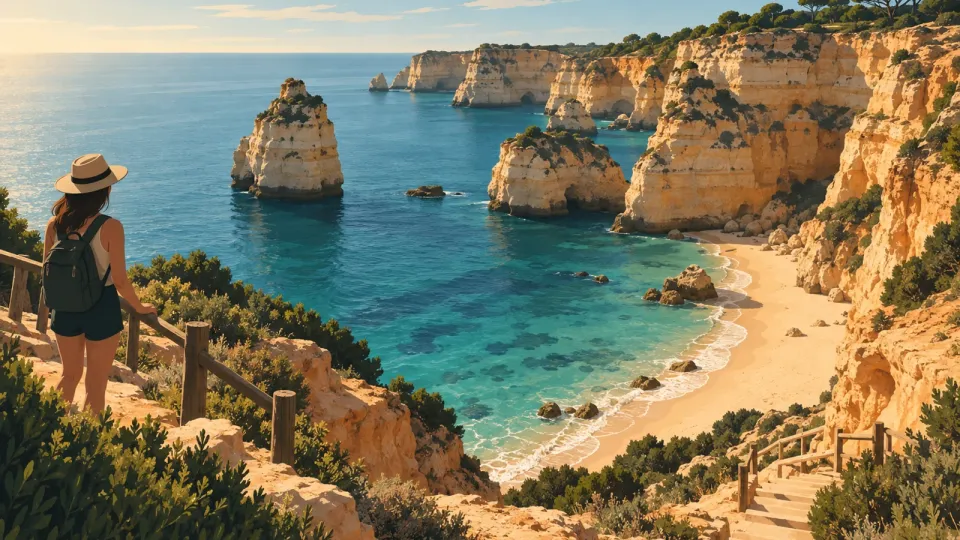
Why Praia da Marinha looks easier than it feels (and what changes the moment you go down)
Praia da Marinha is famous for its postcard cliffs and the “double arch” look from above, but the experience changes completely once you leave the viewpoint and start the descent.
The beach sits inside the Algarve’s central limestone coast near Caramujeira, within the municipality of Lagoa. It is approached from higher ground along a cliff edge, then you reach the sand via a staircase with many steps. Different guides cite different step counts, but the consistent point is the same: it is not a flat, wheelchair-friendly beach access.
A common mistake is treating it like a casual stroll to a shoreline. The viewpoint feels close to the water, because your eye sees a single frame of cliffs and sea. The reality is vertical, with steep sections and multiple decision points on the way down and back up.
Another misconception is that “near the viewpoint” means “near the sand.” Some visitors spend most of their time at the top for photos, then leave before they ever get onto the beach. That is fine if your goal is only the panorama, but you should plan differently if you want to swim, snorkel, or explore the rock arches from the waterline.
For planning, anchor your day to two questions:
- Do you want viewpoint time only, or beach time too? The walking effort is not the same.
- Are you relying on tides? Many rock features around the area are easier to approach at low tide.
As you plan, treat access as the main “attraction,” not just the scenery. That mindset helps you pack the right shoes, bring water, and pace yourself for the climb back up. (pt.wikipedia.org)
Where Praia da Marinha sits on the Algarve coast (so you can choose the right starting town)
Praia da Marinha sits between well known coastal areas, but it is not a “turn up and see everything from one street” beach. It sits in the Lagoa municipality, in the Caramujeira area, along the central Algarve coastline. (pt.wikipedia.org)
Why this matters for your trip planning is simple: the easiest approach is the one that matches your mobility and time.
- If you are building a coastal day around Lagoa and Carvoeiro
- You can connect Praia da Marinha with the cliff walk known as Percurso dos Sete Vales Suspensos (PR1 LGA), which links Praia da Marinha to Praia de Vale Centeanes.
- The trail length is given as 5.7 km one way in widely published trail descriptions. This makes it a strong “same area” plan, rather than a long transfer plan. (walkingportugal.com)
-
If you are using public transport, expect a “last segment” on foot Many transport and tourism guides acknowledge that reaching the final beach access is not the same as reaching a main town center. Even when buses run toward the general area, the beach access is still down steps and along cliff terrain.
-
If you are planning a photo focused half day You can treat the viewpoint and the cliff line as the main goal, then decide on the descent based on heat and energy.
A practical framework for choosing your starting point is to measure your day in “climb cycles”:
- One descent and one ascent if you go onto the sand.
- Zero climbs if you only photograph from the top.
This keeps your expectations aligned with the geography of the site, and it reduces the odds of turning back halfway because you underestimated the return climb. (praiasdeportugal.com)
The exact access reality: cliffs, steps, and why “nearby” still means effort
The most important planning detail for Praia da Marinha is straightforward: the beach is reached by descending a long staircase on cliff terrain.
Multiple sources describe it as a staircase descent with a high step count. For example, one guide states there are 115 steps to reach the sand. (allaboutportugal.pt) Others emphasize that there are many steps and that the beach is not accessible for people with reduced mobility due to the access stairs. (praiasdeportugal.com)
So what does this mean for you on the ground?
-
Plan footwear for a return climb Wear shoes with grip. The Portuguese limestone coast can be slippery when damp. Even when the weather is bright, you can get algae slick spots or wet steps from spray.
-
Bring water even if you only plan “a short stop” The top can feel breezy, but the descent and the return climb are physical. Tourism focused guides specifically mention heat and the importance of bringing water. (praiasdeportugal.com)
-
Choose your pacing before you start down Ask yourself:
- Do you want time on the sand for snorkeling and rock features?
- Or do you mainly want photos and then return to the viewpoint?
If your plan is beach time, you should budget extra time for the climb back up after you have cooled off in the water.
- Don’t mix up “beach access” and “trail access” The official cliff walk PR1 LGA is built along the top line and connects beaches. It is not the same thing as just “walking down to sand.” You can use the trail for viewpoints and route variety, but sand access still means the steps.
A quick misconception check: if you are used to Algarve beaches that are reachable via flat promenades, Praia da Marinha will feel steeper than you expect. Treat it like a short hike with a payoff view, then decide if you want the full beach experience. (praiasdeportugal.com)
Viewpoint vs beach: what you will see from above, and what you miss if you stay up
From the viewpoint, Praia da Marinha can look like a single clean “sea and beach” scene. On the sand, it becomes a different story.
From above, you get your iconic composition: cliff lines, the curve of the cove, and the famous double arch style formation that people associate with this coast.
On the sand, your main experiences shift to:
- Swimming and snorkeling orientation near the rocky edges
- Low tide opportunities to reach rock features and see more of the nearshore geology
Tourism guides that focus on the area repeatedly highlight that low tide expands access around rock features and the shoreline. One guide notes that at low tide the sand extends and more rock pools and passages become reachable compared with high tide. (marealgarve.com)
So what do you gain by going down?
-
You gain time at the waterline If you want to photograph the arches with scale, you need to be near enough for waves and texture. That is hard to replicate from the cliff edge.
-
You gain practical movement across the cove At low tide, the nearshore options change, so you can plan a “photography window” that is more about tidal timing than about the exact hour.
-
You reduce the chance of a disappointing outcome A common trip mistake is planning for sea level photos but only arriving when the sea is high. If you do not descend to the beach, you also cannot adapt your plan to tide changes in real time.
What you may miss if you stay up:
- The scale of the cliffs relative to people and waves
- The view from inside the cove when you are sitting near the waterline
- The tactile detail of the rocky edges and their wet and dry textures
How to decide in advance:
- If you only have a short stop and you want the classic photo, keep it viewpoint only.
- If you want waterline shots or snorkeling, commit to descent time and treat low tide as part of your schedule.
This viewpoint vs beach distinction is the fastest way to turn Praia da Marinha from “pretty from a distance” into “earned by effort.” (marealgarve.com)
The best way to think about the surrounding cliffs: PR1 LGA and nearby beaches
The cliff coastline around Praia da Marinha is more than a backdrop. It is also a network you can walk.
The trail most connected to the beach access conversation is Percurso dos Sete Vales Suspensos (PR1 LGA). Published trail descriptions state it runs for about 5.7 km one way, connecting Praia de Vale Centeanes and Praia da Marinha along the top of the cliffs. (walkingportugal.com)
What makes PR1 LGA useful for trip planning is that it creates a “choose your loop” day.
- Full trail experience
- Start at one beach, follow the cliff edge, and reach the other beach.
- Your return plan is then the next day or a transfer back.
- Partial trail experience
- Walk out from a starting point, stop when you have the views you came for, then turn back.
- This helps if you want cliff panoramas without committing to the whole distance.
- Photo strategy along the trail The trail is built for sea viewpoints. If your camera setup needs calmer conditions, aim to walk early or late, then use the sand access for a separate “waterline” phase.
Nearby beaches and “nearby walking” are often discussed together in the same Caramujeira and Lagoa coastal region. For example, one local style listing groups beaches reached from Benagil and states Praia da Marinha is part of a trio you can reach by walking or by longer routes along the coast, while noting the distance and time for the walk. (benagil.pt)
Be careful with a common misunderstanding: “nearby” by coastline does not mean easy access by foot. Your body still pays for cliffs, steps, and uneven terrain.
A concrete planning tip you can use today is to label your options as view-first or beach-first:
- View-first: Start on the cliff top trail, take photos, then decide whether to descend.
- Beach-first: Descend first to enjoy the sand and tide changes, then walk on the cliff edge for longer panoramas.
PR1 LGA makes Praia da Marinha part of a bigger, coherent coastal walk day instead of a single isolated beach stop. (walkingportugal.com)
Tides and timing: how low tide changes what you can approach
If there is one timing lever you should not ignore at Praia da Marinha, it is the tide.
Tourism focused sources describe how low tide changes the shoreline around the cliffs and rock features. One guide specifically notes that at low tide the sand expands and exposes more nearshore areas such as natural rock pools, and that some rock features are more reachable then compared with high tide. (marealgarve.com)
Why this matters even if your main goal is photos:
- At high tide, waves reach higher on the rocks and can block views of some passages.
- At low tide, you can see and approach more of the rock structure, which affects composition.
A practical “timing decision tree” you can use:
- If you want to swim and snorkel
- Plan around a safer water window and be mindful of currents near rocky edges.
- Treat low tide as a boost for access to nearshore features, but keep an eye on wave conditions.
- If you want to photograph arches and waterline texture
- Plan to be on the sand when the water is lower enough to show rock shapes and reduce wave wash over key surfaces.
- If you only want a viewpoint photo
- Tide matters less for the main panorama, but it still affects how the sea surface looks and whether rocks show clearer detail.
Avoid a mistake many visitors make: going to a famous beach at a memorable hour but assuming the sea behaves like a static postcard. At tide driven sites, the same spot can be visually different.
Also, do not conflate “accessible” with “safe.” Even if low tide reveals more rock and pools, conditions can still be changing and slippery. The cliff coastline is dynamic.
Today’s actionable approach is simple: choose your visit window based on the tide and then build your walk schedule around that decision. If your tide window does not align, consider staying longer at the viewpoint and saving the beach time for another day. (marealgarve.com)
Getting there without assuming easy car access: buses, transfers, and a realistic final approach
You can reach Praia da Marinha in multiple ways, but planning around access means you should not assume “easy car access” or unrestricted parking.
Some sources provide transport notes and route context, including public transport references linked to the Lagoa area. For example, one guide describes a bus route that reaches the Praia da Marinha area from Lagoa, including times noted for weekdays and a seasonal pattern. (algarveportugaltourism.com)
However, for trip planning you should focus on the part that truly controls your day: the final approach is still on cliff terrain with stairs. Even if public transport gets you close to Lagoa, you still must plan for the physical descent and ascent.
Here is a safer, more reliable way to plan your arrival when you do not want to gamble on parking:
-
Choose Lagoa or Carvoeiro as your “transport hub” The majority of route planning descriptions connect the area to these larger reference points rather than to the beach access itself. One guide places Praia da Marinha about 15 minutes from Carvoeiro and Armação de Pêra and about half an hour from Albufeira depending on routing. (algarveportugaltourism.com)
-
Build a “final segment on foot” expectation Even when you have a bus schedule, the last segment is not a flat promenade.
-
For boat tours and sea views, do not assume beach landing Many operators pass the beach from the water for viewing, but some do not land people on Praia da Marinha itself. If your plan includes going from water to sand, confirm what is included.
-
Pack to handle the return If you descend once, the return climb is unavoidable. Water and grip shoes matter more than whether your arrival was by bus or car.
Common misconception to fix: “If I can get close by road, I can avoid stairs.” At Praia da Marinha, road proximity does not remove the core access challenge.
If you are traveling with limited mobility or traveling with children, treat this as a reason to reconsider your plan or to keep the visit viewpoint only. Sources that describe the beach explicitly note its limitations for reduced mobility due to the stairs. (praiasdeportugal.com)
Nearby coast and what to link in the same day (without mixing up other Algarve beach guides)
Praia da Marinha is best planned as part of a coherent coastal strip in the Lagoa and Caramujeira area, not as an isolated stop.
One strong same day link is the PR1 LGA cliff trail to Praia de Vale Centeanes, because it uses the same coastal geography and keeps you on the cliff line with continuous viewpoints. Published trail material gives the corridor length as 5.7 km one way between the two beaches. (walkingportugal.com)
Another link option is to treat the area as a “from above and from sand” day:
- Morning: cliff top viewpoint time, then decide whether to descend.
- Midday: sand time near tide windows.
- Late afternoon: trail segment for additional angles.
This planning method matters because it prevents you from trying to do everything at once. Many visitors overbook the day, then end up rushed at the exact time their tide window matters.
If you are a photographer or digital creator, you can also use a light discipline:
- Use the cliff edge for wide compositions (sea, cliffs, arches framed by horizon).
- Use beach and waterline for texture and scale.
Also, do not mix up the nearby coastline with different access types that belong to other beach entries. For example, the Algarve includes beaches with very different access methods, including tunneling access or easier promenades. Those belong in their own planning category, not in Praia da Marinha’s access planning.
A final misconception: “Nearby coast means nearby walking.” Along this stretch, cliff breaks and uneven terrain can turn a short distance into a big effort. That is why PR1 LGA is so valuable, it gives you a defined pedestrian route along the cliff top.
Actionable next step: choose one “connector” plan before you depart, either PR1 LGA toward Vale Centeanes or a viewpoint to sand cycle. Then build your photography time around tides and your physical recovery time for the climb. (walkingportugal.com)
Plan a realistic visit: what to pack, what to avoid, and how to reduce stress
You reduce stress at Praia da Marinha by treating it like a structured hike to a beach, not like a simple beach walk.
Pack checklist that matches the access reality:
- Grip shoes for stairs and possible damp rock
- Water (heat plus stairs adds up). One guide explicitly points out that there is limited shade and emphasizes water needs. (praiasdeportugal.com)
- Sun protection: hat or cap, sunscreen, and sunglasses
- A small day bag that you can carry up and down comfortably
- Camera strap management to avoid tangles on crowded stair sections
Avoid these common mistakes:
-
Waiting too long at the top If you photograph first and then descend late, you may run out of time for tide changes or for the return climb before the heat drops.
-
Assuming it is suitable for reduced mobility Multiple sources state the beach lacks accessibility for reduced mobility due to stairs. (praiasdeportugal.com)
-
Treating tide as optional Low tide affects what you can approach around rock features and pools. Guides describing the site note this effect. (marealgarve.com)
-
Overpacking the schedule Because you must ascend after you cool off, build a buffer. A tight plan is how you end up climbing when you are tired.
A simple “time budget” you can copy:
- 20 to 30 minutes viewpoint and wide photos.
- 30 to 60 minutes on the sand (swim, snorkel, nearshore photos).
- 30 to 60 minutes for the return climb and a final scenic exit.
Your exact timing depends on tide and crowd levels, but this budget prevents a common failure mode, descending too late and rushing back.
Finally, respect that coastal conditions change. Even if an area looks passable when the water is lower, rocks can still be slippery and currents can move.
If you want one decision to make right now, it is this: pick whether you are doing viewpoint only or viewpoint plus beach descent, then pack and schedule accordingly. (praiasdeportugal.com)
Praia da Marinha in practice: next steps for your trip today
Praia da Marinha rewards the right kind of planning. The beach is famous, but the access is the real challenge, and tides change what you can approach.
Here are three actionable next steps you can do today, before you book anything:
- Choose your access mode
- Viewpoint only if you do not want to commit to a steep staircase return.
- Viewpoint plus beach descent if you want sand time, waterline photos, and tide related features. (praiasdeportugal.com)
-
Build your day around low tide if your goal is rock features Tourism sources for Praia da Marinha describe how low tide expands sand and exposes nearshore features compared with high tide. (marealgarve.com)
-
Add one nearby connector plan so your route feels intentional If you want variety, consider linking Praia da Marinha with the cliff top trail PR1 LGA toward Praia de Vale Centeanes, published as 5.7 km one way. (walkingportugal.com)
One last misconception to clear: “If it is a famous beach, it should be easy to reach in the same way as the easiest Algarve beaches.” Praia da Marinha is iconic because the cliffs create beauty, and those same cliffs create access effort.
Your one specific action today:
- Write down two times you could arrive, a higher tide time and a lower tide time, then plan your visit around the lower one if you want sand and nearshore exploration.
That single decision improves your outcomes more than almost any other planning detail you can make for this beach. (marealgarve.com)
Related guides
Praia de Galapinhos Access: Plan an Arrábida Beach Day
Plan a Praia de Galapinhos day in Arrábida: where to start, foot access vs seasonal road limits, and how Setúbal transport helps you arrive.

Lagos Beaches: Meia Praia, Porto de Mós, Dona Ana, Camilo
Compare Lagos beaches by access and trip needs: flat Meia Praia, easy Porto de Mós, scenic Dona Ana, and the 200-step Camilo. Pick your base.
Praia da Arrifana guide: surf, grilled fish, zero crowds
Praia da Arrifana guide to avoid Albufeira vibes, waves by month, cliff descent, where to eat grilled fish, parking, and whether to stay in Aljezur.

Praia da Bordeira: Costa Vicentina without crowds
Praia da Bordeira guide: how to get there, what to pair in one day, and how to choose windy surf conditions. 3-day plan.