
Monsanto Portugal Village Guide: Parking and Day Trip
Plan a Monsanto Portugal village visit without the usual stress: steep streets, where to park outside the core, and how to choose a day trip or overnight.
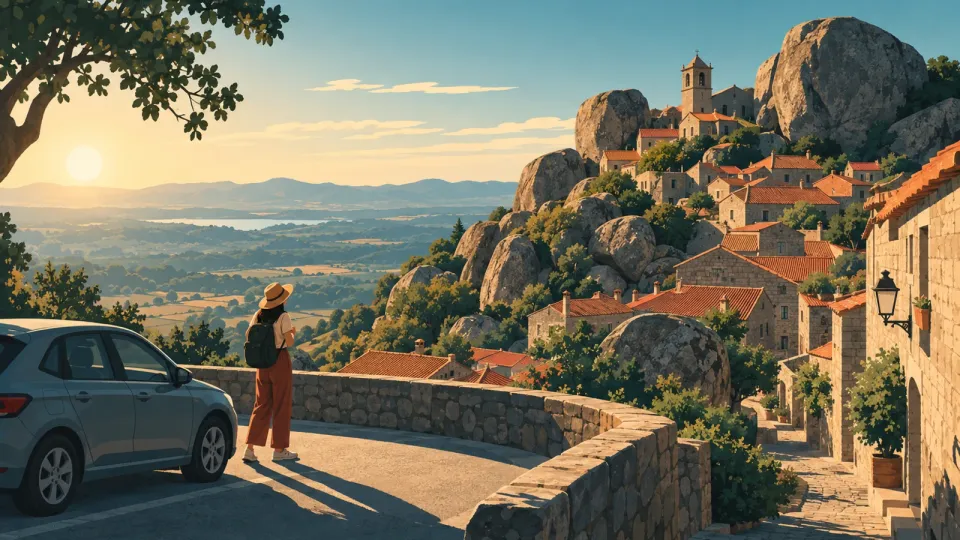
Why the village of Monsanto feels like a staircase, not a destination
Monsanto does not greet you with flat streets. It greets you with gravity, because the historic village sits on a steep, rocky slope, with narrow lanes that make walking the main way to move through the core. The official tourism description highlights how your “stroll” is shaped by “steep and narrow streets,” and how the buildings sit alongside classic features like Manueline doorways and a well-known literary connection (Fernando Namora’s house). (visitportugal.com)
That steep layout leads to a common misconception: people assume the village is “drive-in, park, stroll.” In practice, you should plan for parking outside the historic core and then walking up cobbled, steep segments. Rough Guides also points out that you cannot drive through the historic core, but you can park on the lower edge of the village area, which is the travel planning clue you need for the rest of your route design. (roughguides.com)
Another misconception is confusing the name “Monsanto” in central Portugal with “Monsanto Forest Park” in Lisbon. They are not the same place, not the same landscape, and not the same transport logic. Lisbon has the Parque Florestal de Monsanto (a large forest park within the city). (en.wikipedia.org) The Monsanto you want for “the village among the boulders” is the historic village in the interior, described by Visit Portugal as resting on a high outcrop in the Beira interior, between the Serra da Gardunha and the Rio Ponsul. (visitportugal.com)
A third reality check: your photography plan needs time for the climb. If you arrive late and miss the best light window, you will still be on steep lanes, but without your ideal angle and without a calm crowd level. Start your day with the walk in mind, not after you have “settled in” somewhere else.
Use this quick self-test before you go:
- If “lots of stairs” stresses you, plan an earlier start and wear footwear with real tread.
- If you need a car for mobility, plan for parking at the perimeter and a shorter loop inside.
- If you are filming or shooting video, plan extra buffer time for repositioning on foot.
Where you can park near Monsanto, and why the village blocks car access
Your biggest planning win in Monsanto is understanding the parking rule: the village core is not built for through-traffic, so parking happens at the edges, then you walk in. Multiple sources describe this exact pattern: one practical guide notes that the Miradouro de Monsanto parking area at the top of the Rua Fernando Namora is very small, described as holding about nine cars, and that it fills by mid-morning on weekends. (onmetravel.com) Another reputable travel guide states you cannot drive through the historic core, and you should expect parking on the lower edge. (roughguides.com)
So what does “parking outside the core” look like, in decision terms? You have two common strategies.
- Park at the perimeter viewpoint area first, then walk down and back up.
- This suits you if you want the classic walking route and you are filming handheld or with a small tripod.
- It also suits you if you want to shoot a sunrise or early-morning style look, because the small parking capacity can become a bottleneck later in the day. (onmetravel.com)
- Park slightly lower, then choose a shorter ascent inside the village.
- This suits you if you have equipment that is awkward to carry up uneven cobbles (light packs help, but cameras and batteries add weight quickly).
- It also fits family groups who want to reduce one long climb.
Either way, treat the village like a walking zone, not a car park.
A useful misconception to avoid: “If I can find any road inside Monsanto, I can drive to the best viewpoint.” Narrow access roads can tempt you, but travel guidance consistently emphasizes restrictions that protect the historic lanes. Rough Guides frames it as “you can’t drive through the historic core.” (roughguides.com)
A production-friendly planning checklist (quick and realistic):
- Arrive early enough to choose between parking options, because the Miradouro parking area is small (about nine spaces in some descriptions). (onmetravel.com)
- Keep a “walk back plan,” because your return is also downhill and then uphill.
- Pack for micro-moves: you will be repositioning more often than on a flat promenade.
Finally, keep your destination label precise. If you type “Monsanto” into mapping apps and accidentally select the Lisbon forest park, you will lose hours and you may get stuck with the wrong transport and the wrong schedule logic. Lisbon’s “Monsanto” is managed as a city forest park. (en.wikipedia.org) The village Monsanto is the inland historic village described above. (visitportugal.com)
Day trip vs overnight in Monsanto: choose based on light and crowds
If you only do one thing in your trip planning, decide whether Monsanto is a day trip or an overnight in the right order. The village’s steep lanes and small parking capacity make timing more important than many people expect. When guidance notes that the small Miradouro de Monsanto parking area can fill by mid-morning on weekends, you get a clear signal: the village experience can change quickly as the day progresses. (onmetravel.com)
Here is the simplest way to choose.
Choose a day trip if you want: intense daylight walking and you can leave early.
- You should plan to park at or near the Miradouro area early, because later arrivals can mean more time spent searching for a spot and then walking from farther away. (onmetravel.com)
- Your best photo window is likely in the morning, before the lanes get crowded.
- A day trip also works if you are shooting “details” (doorways, towers, signage, cobbles) and not relying on long golden hour sequences.
Choose an overnight if you want: calm streets and night-to-dusk storytelling. Travel guidance repeatedly frames Monsanto as quiet once day-trippers leave, and this is exactly why overnight planning matters. Rough Guides explicitly mentions that after the day-trippers, you can get near-empty streets and starry skies. (roughguides.com) Earthy travel advice also describes a small parking area and a classic walk loop, which usually becomes more comfortable when you are not racing to beat morning crowds. (onmetravel.com)
Now add a production reality. If you are filming interviews, close-ups, or b-roll that needs slower movement and fewer interruptions, overnight is usually the better technical choice.
A practical overnight framework (easy to follow):
- Plan to arrive early enough to walk your main route while there is still light for repositioning.
- Identify one “anchor location” you will return to (for example, a tower viewpoint or a loop near a miradouro).
- In the evening, shift to slower shots: medium-length lane views, silhouettes, and texture.
Common mistake: trying to “do everything” in one intense afternoon. Because the streets are steep and narrow, you burn energy faster than you expect. You also reduce your time for careful framing, which is the part that actually makes documentary images look intentional.
One more reminder about names. Ensure you are planning for the inland village, not the Lisbon forest park. The Lisbon park is a city-wide protected green space, not a boulder village with steep lanes. (en.wikipedia.org)
Your best nearby base choices: where to sleep depends on transport
In Monsanto, your “base” decision is not just about comfort. It is about whether you can realistically move between the village and your accommodation without wasting time on steep walking or uncertain parking windows.
If you are traveling by public transport, your logical first waypoint is often Castelo Branco in the wider region, because bus connections can feed into the Idanha-a-Nova area. A transport aggregator example (and a travel-planning source) describes routes from Castelo Branco onward to Monsanto and Idanha-a-Velha using bus lines. (rome2rio.com) However, because schedules can change and routes can vary by season, you should confirm the exact line and day-of-week using the latest operator resources.
For locally operated connections in the Beira Baixa region, Transdev publishes schedule pages that include services “(por Monsanto)” on the Idanha-a-Nova to Termas de Monfortinho corridor, and it also references a connection labeled “Castelo Branco - Idanha-a-Nova.” (transdev.pt) If you are planning a tight day trip, this is the kind of official source you want to check, not only a travel blog.
For your planning logic, consider three base patterns.
- Base near Castelo Branco if you want flexibility.
- You have more transport options in many cases.
- You may trade a longer drive for easier logistics and a wider choice of accommodation.
- Base in the Idanha-a-Nova area if you want shorter transfers.
- You can reduce time spent commuting to and from Monsanto.
- You get closer to the village’s inland setting described by Visit Portugal (between Serra da Gardunha and Rio Ponsul). (visitportugal.com)
- Base closer to Monsanto itself if your priority is early entry and evening shooting.
- Overnight is most valuable when you can take advantage of calm streets after day-trippers leave. (roughguides.com)
- Your time cost is the steep nature of the village access and the parking constraint. (onmetravel.com)
A crucial misconception: “The closest base is always best.” For film and photography, the closest place can still create pressure if you need to drive into a small parking area at peak times. If a parking area is described as holding about nine cars and filling by mid-morning, your best base might be the one that lets you arrive at the right time without rushing. (onmetravel.com)
A quick decision tree you can use tonight:
- Do you want early morning golden light? Choose a base that reduces your arrival risk.
- Do you rely on bus connections? Choose a base that aligns with the lines that feed into Idanha-a-Nova and then Monsanto. (transdev.pt)
- Do you want night-to-dusk continuity? Choose a base that lets you return to the village without an exhausting second commute.
Also, confirm you are in the inland Monsanto village region, not “Monsanto” in Lisbon. Lisbon’s forest park is a different travel pattern and has different management and access. (en.wikipedia.org)
A realistic route on foot: how to move through steep lanes and still shoot well
Your walking route in Monsanto should be built around two constraints: steep lanes and car access limits. Once you accept those, you can plan movement that supports filming and photography instead of fighting the terrain.
Start with the best evidence-based mental model. Visit Portugal describes a stroll that runs through steep and narrow streets, with notable architecture such as Manueline doorways and the Torre de Lucano. (visitportugal.com) Rough Guides adds that the walk is steep, but you can expect near-empty streets once day-trippers leave. (roughguides.com) That combination tells you the route is not just scenic, it is a time-dependent experience.
Step-by-step route planning (no guesswork, just sequencing):
- Pick your first “anchor,” then work outward.
- For many visitors, an anchor is a miradouro viewpoint near the perimeter parking logic described in sources like the Miradouro de Monsanto parking area. (onmetravel.com)
- Use that anchor to limit how much you retrace your steps.
- Plan a loop, not a point-to-point sprint.
- Because streets are narrow and steep, backtracking costs energy.
- A loop also helps you keep continuity for video shots.
- Use “micro-stops” for detail shots.
- Instead of staying in one spot too long, capture short clips or frames where the light hits doorways, stone textures, and signs.
- Leave room for the crowd curve.
- If parking fills by mid-morning on weekends in the small Miradouro area, then your “dense movement period” likely happens earlier than you think. (onmetravel.com)
For production: bring a setup that matches the terrain. A lightweight tripod and a small gimbal, or stable handheld with short takes, is usually better than a large rig that slows you down.
Common mistake: assuming you can drive to “the best location” and then walk minimally. The evidence from travel guidance is consistent that car access is restricted through the historic core, and parking is outside it. (roughguides.com)
A Monsato-specific shot list you can plan in advance (based on described sights):
- Torre de Lucano area (as described by Visit Portugal) (visitportugal.com)
- Manueline doorways and historic façades (as described by Visit Portugal) (visitportugal.com)
- Steep lane perspective shots that show depth and scale (guided by the steep street description) (visitportugal.com)
If you are separating “Monsanto village” from “Lisbon forest park,” this matters because the Lisbon park is not a steep boulder village lane network. Lisbon’s Monsanto is mapped as a large urban forest park. (en.wikipedia.org) Your walking planning for the village should focus on cobbled steep lanes and perimeter parking logic, not park trails.
What to see in Monsanto besides the rocks: towers, houses, and the historic core
The rocks are the headline in Monsanto, but your visit will feel complete only when you connect those rocks to specific historic landmarks. Visit Portugal highlights multiple distinct elements inside the village, including Manueline doorways and the Torre de Lucano (Lucan’s Tower). It also notes the house where the doctor and writer Fernando Namora lived and practised. (visitportugal.com)
Rough Guides reinforces that you can build your visit around a classic walking route that typically starts near the Miradouro parking area, then goes down and up past key viewpoints and landmarks. (roughguides.com)
Here are the sights to anchor your itinerary.
- Torre de Lucano (Lucan’s Tower).
- Use it as a compositional goal, because it stands out in the village setting described by Visit Portugal. (visitportugal.com)
- For video, treat it like your “return point” when you are building a loop.
- Manueline doorways and historic façades.
- Visit Portugal specifically calls them out as part of the village experience. (visitportugal.com)
- Shooting tip: take a short clip slowly panning across the doorway stone, then cut back to the lane for context.
- Fernando Namora’s house.
- Visit Portugal identifies the Fernando Namora house as a notable stop. (visitportugal.com)
- For documentary storytelling, pair this with a wider shot that shows the village’s steep context.
- The village’s overall “boulder integration” setting.
- Even if you know the headline, you still need a plan to see how buildings sit in relation to the rock landscape.
- Treat the rocks as your geography map: you can orient yourself by how the lanes wrap around the terrain.
What about staying away from irrelevant “Monsanto” landmarks? If someone tells you to visit “Monsanto” near Lisbon for the boulders, they likely mean a different place. Lisbon’s Monsanto Forest Park is described as a municipal protected forest, a large green patch inside the city, not a historic boulder village. (en.wikipedia.org)
A practical itinerary builder (choose one):
- If you have half a day, focus on one loop and the Torre de Lucano plus Manueline doorways.
- If you have a full day, add a second viewpoint segment and longer evening shooting (overnight helps). (roughguides.com)
For crews, keep your movement short between shots. The village is best consumed as “sequence,” not “checklist,” because the steep lanes make every reposition a decision.
Transport from Lisbon region: avoid the wrong Monsanto and plan a smooth day
If you start from the Lisbon region, the risk is not just distance. The risk is selecting the wrong “Monsanto.” Lisbon has Monsanto Forest Park as a city protected forest, while the inland Monsanto village is a separate historic place. (en.wikipedia.org)
Once you commit to the inland village, your day transport planning typically follows one of these patterns.
Pattern A, drive or rent a car to the interior, then park at the village perimeter.
- This works best if you want control over arrival time, especially because small parking areas tied to viewpoints can fill by mid-morning on weekends in some descriptions. (onmetravel.com)
Pattern B, bus to the Castelo Branco and Idanha-a-Nova area, then connect toward Monsanto.
- A route planning source describes bus options from Castelo Branco toward Monsanto and Idanha-a-Velha, using bus lines, with a reported travel time window and fare range as an example. (rome2rio.com)
- For official schedule checking in the Beira Baixa region, Transdev publishes a schedule page that includes services referencing “(por Monsanto)” and a connection labeled “Castelo Branco - Idanha-a-Nova.” (transdev.pt)
Because bus schedules can shift, treat these as the method to find the right line, not as a guarantee of today’s departures.
A simple booking and routing workflow (built for real trips):
- Confirm the inland Monsanto destination name in your maps and booking tools.
- Plan your arrival time to match your shooting plan, not only your departure time.
- Use official or operator schedule pages to confirm the line and direction, especially for transfers near Idanha-a-Nova. (transdev.pt)
Common mistake to avoid: assuming “Lisbon to Monsanto” means a direct bus to the village boulders. Some travel sources note that there are no direct buses straight from Lisbon in certain contexts, which is why planning through Castelo Branco or Idanha-a-Nova is often necessary. (portugallovers.com)
Practical crew tip: build a buffer into your schedule for parking decisions and walking. Parking is not just “where you put the car,” it affects the length of your climb and how quickly you can start shooting. The Miradouro parking is described as very small (about nine cars) and can fill early. (onmetravel.com)
Finally, if you are also filming in Lisbon, do not mix the two Monsanto locations in your script. Lisbon’s Monsanto Forest Park is a different place, with a different access pattern and a different visual story. (en.wikipedia.org)
Beyond the village: nearby landscapes, protected nature, and what to pack
Monsanto village sits in a broader interior landscape, and your best shots often combine the village with the surrounding geological and natural context. Visit Portugal places the village within the Beira interior, describing geography and location between the Serra da Gardunha and the Rio Ponsul. (visitportugal.com)
If your creative goal is “village plus landscape,” you need a near-term nature plan that stays realistic.
Protected nature context you can build into your day:
- The region includes major protected areas with distinctive geology. For example, the natural park of Serras de Aire e Candeeiros is described by ICNF as a key repository of limestone formations and has formal protected area status tied to Portuguese legal creation. (icnf.pt)
Why mention this in a Monsanto village guide? Because many visitors arrive thinking they will only shoot architecture and boulders. If you add one short landscape segment in the same trip, you make your production more layered: “human scale in the village,” then “large scale in the natural park geology.”
Treat protected nature as an optional add-on, not your primary plan for the steep lanes.
What to pack for this specific environment:
- Footwear with traction for cobbles and steep slopes, because the village walk is steep and narrow. (visitportugal.com)
- A small day bag that you can carry on climbs.
- Battery planning for cold mornings and warmer afternoons, because you will be repositioning across viewpoints.
- A simple “light discipline” kit if you shoot video, because crowds and narrow lanes reduce how long you can set up.
Common mistake: trying to turn the visit into a long hiking day. Monsanto village is not a flat park; it is an architectural and geographic slope village. Rough Guides calls the walk steep and sets expectations about day-trippers leaving. (roughguides.com) Use that as permission to keep your village walking focused.
If you are also visiting Lisbon: Do not accidentally replace the village with Lisbon’s Monsanto Forest Park. Lisbon’s park is a municipal protected forest within the city, and it has its own viewpoints and trail logic. (zigzagonearth.com)
A quick “add-on” decision rule:
- If you have already walked the village once, add one short landscape segment.
- If you have not planned your village loop, do not add extra hiking. Your steep-lane energy budget comes first.
Your goal is a cohesive visual sequence, not an overloaded itinerary.
FAQs about visiting Monsanto Portugal: parking, time, and mixing up the places
Is Monsanto Portugal the same as Monsanto Forest Park in Lisbon?
No. Monsanto Forest Park is a municipal protected forest in Lisbon, a large urban green area. (en.wikipedia.org) The Monsanto you want for “the village among the boulders” is the historic inland village described by Visit Portugal as sitting on a high outcrop between the Serra da Gardunha and the Rio Ponsul. (visitportugal.com)
Can you drive into the historic core of Monsanto village?
In most visitor guidance, you should not plan on driving through the historic core. Rough Guides states that you cannot drive through the historic core, and that parking is available on the lower edge. (roughguides.com) That means your travel plan must include walking from perimeter parking.
Where do you park for the village viewpoints?
Parking near viewpoints is limited. One travel planning source describes the Miradouro de Monsanto parking area near the Rua Fernando Namora as holding about nine cars and filling by mid-morning on weekends. (onmetravel.com) Treat that as a constraint when you plan your arrival time.
Is a day trip enough, or should you overnight?
A day trip can work if you arrive early, because small parking areas can fill by mid-morning on weekends. (onmetravel.com) Overnight often improves your experience because travel guidance notes the village can become near-empty once day-trippers leave, enabling calmer shooting and a better evening atmosphere. (roughguides.com)
How do you get to Monsanto by public transport from the Lisbon area?
Often you route via Castelo Branco and then connect toward the Idanha-a-Nova area. One planning source describes bus options from Castelo Branco onward to Monsanto and Idanha-a-Velha. (rome2rio.com) For checking operator schedules in the Beira Baixa region, Transdev publishes pages that include services referencing “(por Monsanto)” and links such as “Castelo Branco - Idanha-a-Nova.” (transdev.pt)
What should I pack for a village with steep, narrow streets?
Expect a steep, narrow-street walk. Visit Portugal describes “steep and narrow streets” as part of the village stroll experience. (visitportugal.com) Pack footwear with traction and keep equipment lightweight enough for uphill movement, then plan your shot sequence around repositioning.
Quick misconception to avoid: mixing the inland Monsanto village with Lisbon’s Monsanto Forest Park can ruin your timing, transport, and filming plan. Confirm your destination name before you book.
Next steps for planning your Monsanto shoot and village visit today
You can turn Monsanto into a smooth, film-friendly plan with three concrete decisions done today.
- Lock your place type: inland village, not Lisbon forest park.
- Inland Monsanto is described by Visit Portugal as a historic village on a high outcrop between Serra da Gardunha and Rio Ponsul. (visitportugal.com)
- Lisbon’s Monsanto is Monsanto Forest Park, a municipal protected forest in the city. (en.wikipedia.org)
- Choose your timing mode based on parking reality.
- If you plan a day trip, treat Miradouro de Monsanto parking as constrained (described as around nine cars) and plan to arrive early to reduce stress. (onmetravel.com)
- If you plan an overnight, you can shift your second half of the day toward calmer lanes and calmer shooting, which Rough Guides notes can happen once day-trippers leave. (roughguides.com)
- Build your route around a walking loop and one anchor viewpoint.
- Visit Portugal highlights the village experience in steep, narrow lanes, with specific historic features like Torre de Lucano and Manueline doorways. (visitportugal.com)
- Rough Guides describes a classic walking route starting near the Miradouro parking area and moving through key viewpoint segments, which supports your loop planning. (roughguides.com)
One specific thing you can do today:
- Open your maps and set a check: confirm your destination coordinates or name for “Monsanto” match the inland village described by Visit Portugal, then set your arrival time so you beat the weekend parking bottleneck for Miradouro de Monsanto (about nine cars is a useful planning constraint). (visitportugal.com)
After that, draft a simple script for movement: “Park outside core, walk loop, shoot anchor, then reposition for details.” Because the streets are steep and narrow, your success comes from sequence, not improvisation.
Related guides
Sete Cidades on São Miguel: Viewpoints, Village & Day Plan
Sete Cidades on São Miguel, Portugal: official viewpoint stops, the best short walks, village tips, and a practical day plan with weather alternatives and transport options.

48 hours in Porto: a Lisbon resident’s working itinerary
48 hours in Porto itinerary that skips tourist theatre. Plan Ribeira, wine cellars, Foz, Matosinhos, and one best day trip. Use this today.

Albufeira Beaches: Old Town, Resorts, and Quieter Picks
Albufeira beaches compared for day trips and stays: Old Town coves, resort strips like Oura, plus calmer options such as São Rafael and Falésia.
Alentejo Beaches: Pick a Base and Plan Beach Days
Alentejo beaches, choose the right coastal base for your pace. Compare Odemira to Tróia and plan beach days with protected-area access rules.