
Portugal and Spain itinerary: enjoy more by choosing your route
Portugal and Spain itinerary, choose Lisbon to Porto to Madrid or Lisbon to Seville to Madrid. Compare transit, pacing, and a 14-day plan.
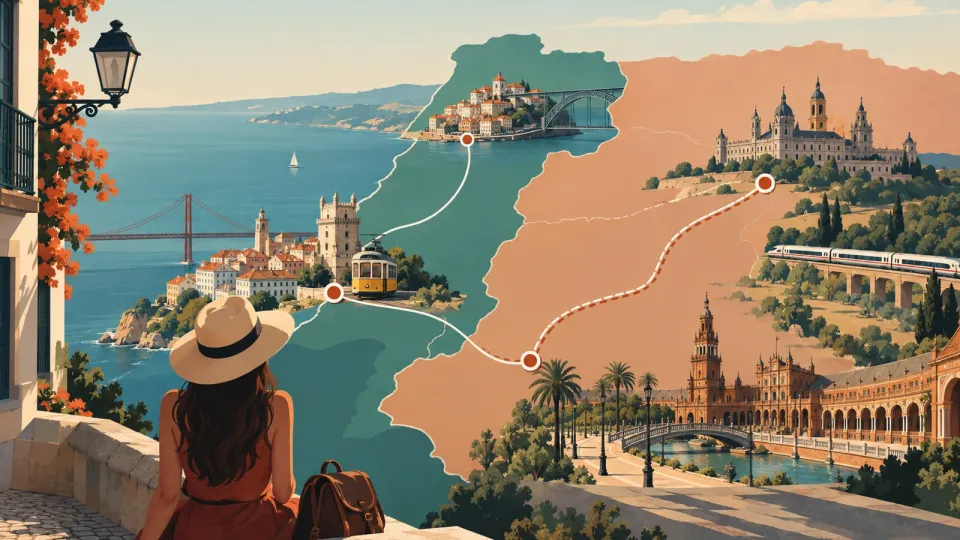
The real decision in a Portugal and Spain itinerary is not cities, it is travel days
If your Portugal and Spain itinerary feels rushed, it is usually not because you picked “the wrong attractions.” It is because you picked the wrong route logic.
On a 14-day mainland, two-country trip, the most time-expensive part is the handoff between Portugal and Spain, then the handoff between major regions inside Portugal. Islands and extras make it worse because you add extra booking friction.
So the question to answer first is this: do you want your Portugal portion to be a clean north arc (Lisbon to Porto), or a southern arc (Lisbon to Seville, then onward)? That one choice changes how many “half days” you lose to transport, station changes, and reconnection risk.
A second misconception is common. People assume you can “fit in one more city” because the map looks small. Portugal stretches your time budget in a different way, even when distances look manageable. Buses are often slower than trains, and city centers can add walking time.
Here is the practical takeaway. If you want time to enjoy Portugal and Spain, plan your itinerary around two bases plus one clean connection day.
You will still see plenty, but your days have a shape: mornings for sights, middles for transit, evenings for one neighborhood loop. That is what keeps the trip enjoyable instead of exhausting.
From there, you choose between two realistic base-to-base structures:
- Lisbon to Porto to Madrid (northern arc inside Portugal, then Spain)
- Lisbon to Seville to Madrid (southern arc inside Portugal’s “Spain approach”, then Spain)
Both can work. The best one depends on how you want your travel days to feel.
Route option A: Lisbon to Porto to Madrid, why it protects your sightseeing time
Route option A keeps Portugal compact in the way most independent travelers need. You base in Lisbon, then move to Porto for the north arc, then continue to Madrid.
Why this helps your Portugal and Spain itinerary: the Lisbon-to-Porto move is a major corridor with frequent rail services, so you can choose an itinerary day that matches your energy. CP describes its Alfa Pendular as a premium service for work and leisure travel between Lisbon and Porto. (www1.cp.pt)
You can also sanity-check timing using CP sources and their timetable tools. CP provides pages for train timetable checking and PDF timetables. (www2.cp.pt)
What “leaves time to enjoy it” looks like in real planning terms:
- You schedule Lisbon days with one beachy or nature day, then you keep Lisbon sighting loops focused.
- You treat the Lisbon-to-Porto day as a single handoff, not a day filled with extra errands.
- In Porto, you pick a compact sightseeing rhythm: one historic core walk, one riverside viewpoint angle, one food stop you can repeat.
A key trade-off: by going to Porto, you commit to a north-heavy Portugal experience. That means you do not get Seville in the middle.
Also, keep expectations honest about the Portugal-to-Spain link. Direct Lisbon-to-Madrid trains are not the default assumption for most schedules. One public overview notes that you should expect a longer journey and multiple segments rather than a single nonstop. (everyrail.com)
How to reduce stress anyway, without inventing “perfect connections”:
- Choose your Madrid arrival day based on your Portugal departure day energy (not your wish list).
- Book the first train segment early, then verify the Spain segment in the same booking flow where possible.
- Build one “buffer” day inside Portugal before the cross-border move.
If you like your trip to feel like two clear chapters, Lisbon then Porto, option A is usually the calmer way to protect sightseeing time.
Route option B: Lisbon to Seville to Madrid, why it can feel easier in Spain
Route option B is best for travelers who want a more southern Portugal and a smoother sense of arrival when you hit Spain.
Your logic here is simple: you keep Lisbon as your first base, then you move to Seville (still within your itinerary story), then you continue to Madrid.
Why this can work for a Portugal and Spain itinerary that leaves time to enjoy it:
- You avoid making Porto the anchor city, so you can spend more time in Portugal’s capital area before the Spain jump.
- You get a Spain rhythm that often feels easier to “keep going” once you are in Andalusia.
For connection options between Lisbon and Seville, check existing coach services. ALSA lists routes between Seville and Lisbon and provides a page where you can check availability for that corridor. (alsa.com)
Important trade-off: the Lisbon-to-Seville segment is more likely to feel like a full travel day than a rail-style “choose your departure, arrive, walk” move.
That does not mean “bad.” It means you must plan around it:
- On your Lisbon side, avoid stacking a late museum the night before the transfer.
- Once you arrive in Seville, pick one neighborhood for your first evening, then stop.
- Keep your Seville sightseeing to a focused sequence, not a laundry list.
Another honest point. Travel days have a hidden cost: station transfers, arrival walk time, and the mental tax of “where do we go next.” A rail corridor inside Portugal (like Lisbon to Porto) can reduce that tax if the connection is clean. A coach corridor can still be fine, but it usually needs more buffer.
So how do you decide between option A and B without guessing?
Use your day preference:
- If you prefer travel days that feel like part of the itinerary (predictable, not frantic), lean toward Lisbon to Porto.
- If you prefer spending your sightseeing time in Spain more heavily, lean toward Lisbon to Seville.
Both can protect your enjoyment, but only if you treat the transport segments as real itinerary days, not “free time” you can fill with extra cities.
A practical comparison table for Portugal and Spain itinerary choices
Use this table to compare the two structures as a travel experience, not as a list of “cool places.”
| Decision lever | Lisbon to Porto to Madrid | Lisbon to Seville to Madrid |
|---|---|---|
| Portugal shape | North arc inside Portugal, two-city Portugal | Southern arc feeling, Lisbon then a Spain-facing move |
| Best for your sightseeing time | Usually better when you want rail-style transitions | Can work well when you want more Spain time and accept heavier transfer days |
| How you protect the “enjoy it” feeling | One clean handoff day Lisbon to Porto, then Porto as a base | Lisbon transfer day to Seville, then Seville as a focused base |
| Transport planning complexity | High-value corridor, rail timetables and services | Coach corridor options exist, but you plan the full travel day tightly |
| Cross-border expectation | Plan for the Portugal-to-Spain journey to be multi-step in many schedules (everyrail.com) | Plan for the Lisbon-to-Seville segment as a full itinerary day, then Spain segments after |
| Where you are most at risk of “rushed” | If you add extra day trips around the handoff days | If you try to do too much in Lisbon or Seville on transfer-adjacent days |
| Best traveler personality | You like a calm rhythm and two strong bases | You want Spain to start earlier in the story |
How to use this table in 5 minutes:
- Pick your priority: Portugal scenery north or Spain time plus Andalusia feel.
- Identify the day you want to be least tiring. That day should be inside the itinerary on the rail-style corridor if possible.
- Decide where you can accept a longer travel day. If it will stress you, put it earlier in Portugal, then enjoy the later bases.
Then, match it to a base count. On a tight 14-day mainland plan, fewer bases usually means more time on foot in each place.
The 14-day mainland example that leaves time to enjoy it (and how to adapt it)
Here is a realistic 14-day mainland structure that keeps travel days as travel days.
It uses two Portugal bases and one Spain base, with one focused handoff day between each chapter.
Example itinerary skeleton (Lisbon to Porto to Madrid)
-
Days 1 to 4: Lisbon base
-
Day 1: easy neighborhood loop, river walk, early dinner
-
Day 2: historic core walking rhythm (one big loop)
-
Day 3: one day trip, early start, no second major attraction list
-
Day 4: coastal belt or protected-area day that still gives you an evening walk
-
Day 5: Buffer and reset
-
Pick a slower day, shopping, markets, or a long late lunch
-
This is your “trip health” day before the main move
-
Days 6 to 7: Lisbon to Porto handoff + Porto settling
-
Day 6 is your move day, pack lightly, keep the evening short
-
Day 7 is one compact Porto day: core walk, one viewpoint, one food stop
-
Days 8 to 9: Porto enjoying days
-
Day 8: riverside and bridges, slow pacing
-
Day 9: choose one add-on (coast walk or nearby culture) and keep it contained
-
Days 10 to 13: Madrid base
-
Day 10: arrive and walk one district only
-
Day 11 to 12: two focused sight days, one evening activity plan
-
Day 13: choose one day trip or a long museum day, but do not double up
-
Day 14: wrap-up day
-
Laundry, souvenirs, one final viewpoint loop, then departure planning
Why this works
The plan avoids the most common mistake: “one day per town.” Instead, it builds days around areas, and it gives you buffer time around transport days.
Adaptation checklist
If you are choosing the Lisbon to Seville to Madrid structure, swap these pieces:
- Replace Porto days with Seville base days.
- Keep the same rule: one neighborhood loop per day, one major attraction sequence per day.
- Treat Lisbon-to-Seville as your full travel day, then stop sightseeing hard the evening you arrive (you will still have time later).
If you want, you can also use our realistic Portugal-in-10-days route as a model for how to base in Lisbon and then shift your pace when you move north. (Portugal in 10 Days: Realistic Mainland Route)
How to book connections without making your trip stressful
A good Portugal and Spain itinerary choice can be ruined by weak connection planning. So focus on how you check connections, not only on which cities you pick.
Step 1: Use the official timetable tools for the Portugal rail corridor
For rail, start with CP, because it is the operator for Portugal services. CP has timetable resources where you can check times and plan station-based logistics. (www2.cp.pt)
If you are using the Lisbon to Porto logic, the Alfa Pendular service is a useful planning anchor, CP presents it as a premium option for Lisbon to Porto. (www1.cp.pt)
Step 2: Accept that Portugal-to-Spain can be multi-segment
A common mistake is assuming one simple rail booking will solve everything. Public overviews indicate that Lisbon to Madrid journeys often involve multiple segments and longer duration than people expect. (everyrail.com)
You can still make it work, but you must choose the right tolerance level:
- If you hate tight connections, aim for arrivals that give you an evening cushion.
- If you are okay with complexity, you can trade buffer time for earlier sightseeing.
Step 3: For Lisbon to Seville, check coach operators and treat it as a full day
If you choose the southern arc option, use existing coach service listings to verify what runs on your dates. ALSA provides a Seville-to-Lisbon route page where you can check service availability. (alsa.com)
Even if you do not buy through ALSA, this is a useful sanity-check step: it tells you the corridor exists as a practical travel option and helps you plan what a “transfer day” will feel like.
Step 4: Build a “connection day rule”
Use this rule to stop itinerary drift:
- The day before a move ends early.
- The move day has no major reservations (unless they are flexible).
- The day after the move has one neighborhood mission, not five.
Step 5: Decide the number of bases, then stop adding cities
If you add a third base in Portugal, you usually destroy the “enjoy it” feeling. You will still see the highlights, but your daily experience becomes a checklist.
Your route decision is really a pace decision. Book the connection in a way that supports that pace.
Decision checklist, pick Lisbon-Porto-Madrid or Lisbon-Seville-Madrid in 10 questions
Answer these quickly. Each “yes” points you toward one structure.
Choose your Portugal rhythm
- Do you want Portugal to feel like one north arc more than a southern arc?
- Yes favors Lisbon to Porto.
- No favors Lisbon to Seville.
- Would you rather have a rail-style, corridor-based transfer inside Portugal than a heavier transfer day?
- Yes favors Lisbon to Porto. CP provides rail planning resources for the Lisbon-Porto axis. (www1.cp.pt)
- Do you prefer a calm “arrival and walk” evening after your main transfer?
- Yes favors Lisbon to Porto.
Choose your Spain feel
- Do you want Spain to start earlier with Andalusia?
- Yes favors Lisbon to Seville.
- Do you prefer one strong Spain base and then controlled day trips?
- Yes fits both, but it works best when your Portugal days are not overstuffed.
Be honest about connection tolerance
- Are you the type of traveler who panics when a connection is tight?
- Yes favors simpler rail-style handoffs where possible, so Lisbon to Porto.
- Are you okay with multi-step journeys to cross borders?
- Yes gives you flexibility for Lisbon to Porto to Madrid because public overviews expect multiple segments for Lisbon to Madrid. (everyrail.com)
- Do you prefer to plan your transfer day as a full schedule block, not a “maybe it works” moment?
- Yes favors treating Lisbon-to-Seville as a full day using coach route pages you verify for your dates. (alsa.com)
Protect your enjoyment
- Will you actually follow a “one neighborhood mission per day” rule?
- Yes favors whichever route keeps your days simpler.
- Do you want one buffer day inside Portugal to recover before the big move?
- Yes favors route A pacing, because it naturally fits a Lisbon reset before moving north.
Practical scoring
- If you answered yes mostly to rail-calm, north-arc, and buffer time, choose Lisbon to Porto to Madrid.
- If you answered yes mostly to Spain starting earlier with Andalusia, and you are comfortable with transfer days feeling heavier, choose Lisbon to Seville to Madrid.
No matter what you pick, the “enjoy it” strategy is the same: stop adding bases, build buffer around moves, and keep each day focused.
FAQs about Portugal and Spain itinerary planning (14 days, mainland only)
1) Is there really a “best” Portugal and Spain itinerary route?
There is a best route for your pacing. If you want fewer stressful transitions, a Lisbon-to-Porto structure often fits that goal because you can plan around Portugal’s rail corridor resources. (www1.cp.pt)
2) Can I do Lisbon, Porto, Seville, and Madrid in 14 days?
You can, but it is usually not a “leaves time to enjoy it” trip. Four bases inside two countries often turns your days into transit and reservation juggling. On a tight plan, two Portugal bases plus one Spain base tends to feel more human.
3) What is the biggest mistake people make with a Portugal and Spain itinerary?
They plan “one day per town.” That looks good on paper but creates rushed evenings. Instead, build your days around neighborhoods or one major attraction sequence, then stop.
4) How do I check transport options without trusting rumors?
Use the operator sources for the segments you rely on. For rail in Portugal, start with CP timetable resources. (www2.cp.pt) For Lisbon-to-Seville by coach, use the ALSA route page to verify services and then match it to your dates. (alsa.com)
5) Is Lisbon to Madrid always a single train?
In many planning situations, you should expect multi-step journeys rather than assuming a single nonstop. Public overviews indicate that Lisbon to Madrid trips often involve multiple segments and longer duration than people expect. (everyrail.com)
6) If I only have time for one choice, what should I prioritize?
Prioritize the structure that gives you the most “easy evenings” after transport. If you need one rule: plan fewer bases, then protect your move days with buffers.
If your dates are already fixed, paste the travel days you want to move between cities, and you can align the itinerary structure to what actually runs on those days.
Your next step: lock the route logic, then build your 14-day days around it
You do not need a perfect itinerary. You need a realistic one that protects your attention.
Here is the best way to finalize your Portugal and Spain itinerary: choose a route that leaves time to enjoy it.
- Pick your route logic now:
- Lisbon to Porto to Madrid if you want rail-style pacing and calmer transitions (CP rail resources support planning for the corridor). (www1.cp.pt)
- Lisbon to Seville to Madrid if you want Andalusia earlier and accept heavier transfer days, verify coach options using route pages like ALSA. (alsa.com)
-
Choose your buffer rule: one day inside Portugal where you do not schedule a major move.
-
Build your day shape:
- One morning focus
- One midday anchor
- One evening neighborhood loop
- Check connections like a planner, not like a gambler.
- For Portugal rail segments, use CP timetable tools. (www2.cp.pt)
- For Lisbon-to-Seville by coach, verify your dates on an operator page. (alsa.com)
- Stop adding bases.
If you want one “do it today” action, do this: write down the two move days you care about most, then test them against your chosen operator pages (CP for rail within Portugal, and ALSA for coach if you choose the Seville route). Once those dates look feasible, the rest of the itinerary becomes much easier to enjoy.
When you are ready, use our realistic mainland route for Portugal in 10 days as a pace model, then extend it with the Spain handoff. (Portugal in 10 Days: Realistic Mainland Route)
Related guides

48 hours in Porto: a Lisbon resident’s working itinerary
48 hours in Porto itinerary that skips tourist theatre. Plan Ribeira, wine cellars, Foz, Matosinhos, and one best day trip. Use this today.

Madeira itinerary for 4 days the right way
madeira itinerary for 4 days, split by north vs south climates. Do Funchal, Porto Moniz, the right levada, and Pico do Areeiro sunrise.

Pico Island: vineyards, coast and a three-day itinerary
Pico Island: vineyards, coast and a three-day itinerary for Madalena, São Roque and Lajes, with UNESCO scenery, optional climbs and whale watching planning.

Sao Miguel Azores itinerary, 5 days the right way
sao miguel azores itinerary for 5 days: Sete Cidades, Furnas cozido, east side, and whale watching. Save time, drive smarter, book right.