
Best length for Instagram Reels: choose what the idea needs
How long should a Reel be? As short as the payoff allows. Scenery reels did best at 8 to 12 seconds in our travel data. Plan, then cut.
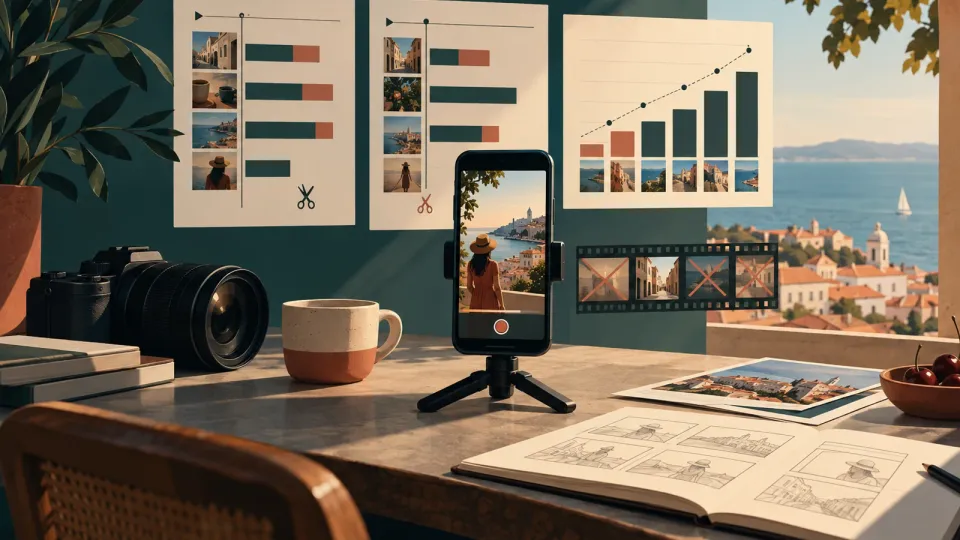
As short as the payoff allows
The best length for Instagram Reels is as short as the payoff allows. For pure scenery, 8 to 12 seconds did best in our travel data. (andginja.com) A story told to camera can run longer if every second earns its place.
The payoff is what your opening promised: the view, the result or the answer. Keep time for reading, seeing a difference or following an action. Cut time that merely repeats what the viewer already knows.
Before you set a length, ask two questions. What must the viewer see? How long does it take to see it clearly? That answer is your length. Anything after it is leftover footage.
A reveal and a tutorial have different jobs. The first may need one visible change. The second may need a result, a method and a close-up of the difficult step. This is a question of useful duration, not the platform's upload limit. As of 2026, Instagram lets you record reels up to 20 minutes, but says reels over 3 minutes won't be recommended to new audiences. (help.instagram.com)
Plan the changes before the seconds
Think in moments that add something, often called beats. Beside each moment, write: “Before this, the viewer knows or expects ____. After this, ____ has changed.”
A change can be emotional as well as factual. A held look can complete a story. Another angle of the same view may add nothing to a tutorial. Judge it by the job it does.
Here are two illustrative plans. Their durations are starting points for editing, not tested winners.
A nine-second reveal: use 0–3 seconds to establish the situation, 3–7 to show the change and 7–9 to let the result register. If the change is already clear at the start, the setup may be unnecessary.
A 24-second spoken tutorial:
| Time | Image | Purpose |
|---|---|---|
| 0–4 s | Two photos of the same view | Show the difference |
| 4–10 s | Camera moves behind a foreground opening | Show the choice |
| 10–18 s | Close-up of the frame edges and result | Make the detail easy to locate |
| 18–24 s | The matched photos again | Connect the method to the result |
The tutorial can run longer than a scenery reel because each step teaches something. If a step teaches nothing, cut it.
Watch the plan at phone size. If the label takes longer to read, simplify it or hold the shot. Do not keep the timetable at the cost of understanding.
Use the shot-deletion test
Duplicate the sequence. Remove one shot and close the gap. Watch both versions.
Did you lose a step, a useful contrast or the completion of an action? Restore the shot. If nothing useful disappeared, keep the shorter version.
In André's editing, scenery is where this test cuts deepest. Viewers came for the view. Once they have seen it from its best angle, a second angle of the same place often adds little. Keep the shot that shows it best, and repeat the test until each remaining shot does a job.
Then inspect the ending. A tutorial may need a final comparison. A story may need the consequence of a choice. Once the promised result has landed, another similar shot can weaken the ending. A deliberate pause is different from leftover footage.
What the travel numbers show
Piles of reels from many niches make the shortest videos look best. But a pile mixes big accounts with small ones. It can hide what works for one creator.
The fairer test compares each creator with their own typical reel. In a set of 82 travel creators, scenery reels past 30 seconds got about half their creator's usual views.
That is a pattern, not a cause. (andginja.com) It does not prove that cutting your own reel will add views.
The Reels Study explains how these comparisons were made and their limits. André's paid guide, “The Anatomy of a Viral Reel”, takes one of his hits apart second by second in its chapter “Promise, payoff and pacing”.
Compare two understandable cuts
Make one cut with the shortest clear sequence. Make another that gives a difficult step more time. Keep both honest to the same promise.
Ask a viewer what changed and how they would repeat the method. A shorter cut that hides the key action has failed the lesson, even if it feels faster.
For published work, compare similar posts at the same age. Record topic, format and any major differences in distribution. Posting two versions is not a randomised experiment: timing, audience and other conditions can change.
Before exporting, check that someone can read the text, locate the important detail and receive the promised result. Let those checks decide the final duration.
The opening guide helps define what the edit must deliver. If a finished post disappoints, the review checklist separates observations from guesses.
Source and limits
The length comparison uses scenery reels from 82 travel creators. Each reel was compared with its own creator's typical reel, not with other accounts.
The numbers describe association. The editing plans teach a method. Neither establishes a guaranteed duration for reach, retention or sales.
Related guides
How to make better Instagram Reels: a practical guide
Plan, film and edit clearer Instagram Reels. A practical workflow with worked examples, a visual checklist and lessons from our Reels study.

Instagram Reels hooks: write an opening you can deliver
Write clearer Reels hooks with matched opening-and-payoff examples. See why short-hook medians from mixed accounts mislead, and what changes inside each creator's reels.
Why your Reels get few views: a practical review checklist
Review a Reel with few views without guessing at the cause. Check the promise, edit and metrics, then choose one useful change to test.

Algarve in October: Plan Your Trip Step by Step
Algarve in October can work well if you plan around cooler nights and rain chances. Use a town base, flexible beach time, and packing checklist.