
Why your Reels get few views: a practical review checklist
Review a Reel with few views without guessing at the cause. Check the promise, edit and metrics, then choose one useful change to test.
Low views tell you the result, not the cause
If your Reel gets few views, the count alone cannot tell you why. The idea, opening, execution, audience and distribution may all matter. Start with what you can observe before blaming a sound, format or account restriction.
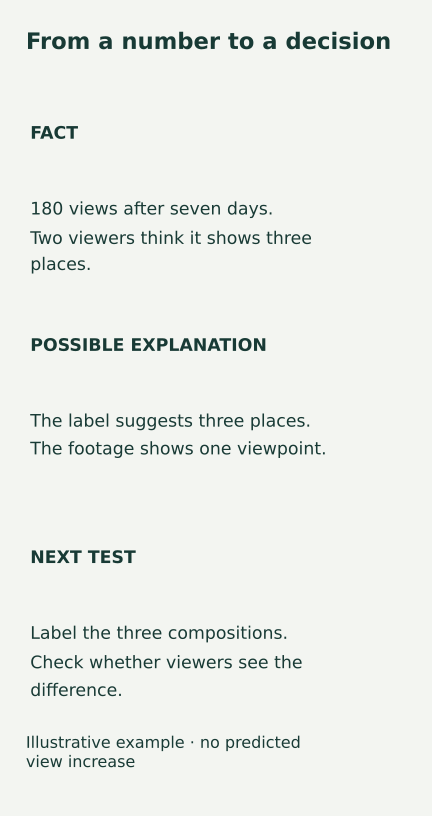
Keep three notes apart: fact, possible explanation and next decision. “The label disappears against the sky” is a fact you can inspect. “People dislike tutorials” is a much broader claim.
First check whether the video fulfils its opening promise. Then check whether someone can see, hear and follow the important parts. Review available analytics and account information after that. This order helps you choose an edit; it does not prove why distribution was low.
Match the observation to a useful check
| What you observe | What to inspect | A reasonable next step |
|---|---|---|
| People cannot explain the premise | First image and opening words | Clarify what the video will show |
| They confuse the examples | Labels, framing and comparison | Make the difference visible |
| Departures cluster early, where viewing detail exists | Slow setup or a confusing start | Show useful evidence earlier |
| Views are low and viewing detail is unavailable | Comparison quality and account information | Keep the observation; make another comparable attempt |
If your insights include a viewing graph, it can show when departures occur. It cannot explain every person's reason. Low views alone do not establish an account restriction. (help.instagram.com)
Check one visible problem at a time. A clear edit with little comparable history may justify another affordable example. An unreadable label already gives you something specific to repair.
Worked repair: three places or three compositions?
This scenario is fictional. A Reel has 180 views after seven days. Two intended viewers think it shows three places. In fact, all the footage comes from one viewpoint.
Before: the opening says “Three places for better photos.” The shots change quickly, with no shared reference.
After: the opening says “One viewpoint. Three compositions.” The comparison keeps the setting visible and labels the choices: wide view, foreground frame and person for scale.
The repair targets a misunderstanding. It does not guarantee more views. Show the revised edit without an explanation and ask what changed between the images. That checks whether the lesson became clearer.
High views do not settle clarity either. A cable-holder demo can attract attention while implying that the holder charges a phone. If it only keeps the cable within reach, narrow the promise and show that function.
Use three passes on the exported video
- Silent pass: can you follow the important changes? If speech carries the lesson, check the subtitles.
- Sound pass: can you hear the words on a phone speaker at a modest volume? Check music levels and sudden audio cuts.
- Fresh-viewer pass: show it once without an introduction. Ask what it offered, what they learned and where they lost track.
Check the busiest frame at phone size. Does the text remain readable when the background changes? Do hands or interface elements cover the step? Does a crop remove the useful detail?
Fix the clearest obstacle, then repeat the relevant pass. Keep the useful context. “Shorter” is not a repair if it removes the explanation.
Keep a small, honest measurement log
Record the publication date, observation date, purpose, format, available post metrics, production time and next change. Use the metric names and definitions shown in your account. (help.instagram.com)
Keep counts from the same post and measurement window together. Do not divide one post's saves by the reach of the whole account. If a definition or field is unavailable, keep the counts separate. Write “unavailable”, not zero.
For example, when we pulled André's insights through the Instagram API in September 2026, it returned almost no shares for his reels posted before 2025. That gap cannot rank which older reels were shared more. It does not prove that nobody shared them.
You might check each new post after seven days. That is a tracking convention, not an Instagram rule. Later views belong in a later snapshot. Compare similar purposes and formats, and note paid promotion or collaborations.
Choose the next decision
Repeat when the structure is useful and you have another suitable example. Revise when you can name an execution problem. Pivot when you want to test a different benefit or approach for the same audience. Pause when the cost is too high for the useful signs you have.
A complete note for the fictional example is: “Two viewers mistook one viewpoint for three places. The wording may explain the confusion; fast cuts may also contribute. I will clarify the opening and check whether the comparison is understood.”
That note separates what happened from what you suspect. Keep weak and ordinary results in the log too. A collection of winners alone cannot show which attempts failed.
The paid guide “The Anatomy of a Viral Reel” turns this kind of review into a one-page flop flowchart. Start at the top and stop at the first exit. It is one of the free sample pages.
The complete workflow helps plan the next attempt. The opening guide gives concrete ways to repair a vague promise.
Source and limits
This checklist draws on our editorial review, the data in our Reels Study (andginja.com) and André's own account. The scenarios are teaching examples, not real performance tests.
The process helps you make a defensible next decision. It cannot identify the cause of low reach from a view count, or promise the result of your next edit.
Related guides

Best length for Instagram Reels: choose what the idea needs
How long should a Reel be? As short as the payoff allows. Scenery reels did best at 8 to 12 seconds in our travel data. Plan, then cut.

How to make better Instagram Reels: a practical guide
Plan, film and edit clearer Instagram Reels. A practical workflow with worked examples, a visual checklist and lessons from our Reels study.

Instagram Reels hooks: write an opening you can deliver
Write clearer Reels hooks with matched opening-and-payoff examples. See why short-hook medians from mixed accounts mislead, and what changes inside each creator's reels.

Algarve in October: Plan Your Trip Step by Step
Algarve in October can work well if you plan around cooler nights and rain chances. Use a town base, flexible beach time, and packing checklist.