
Instagram Reels hooks: write an opening you can deliver
Write clearer Reels hooks with matched opening-and-payoff examples. See why short-hook medians from mixed accounts mislead, and what changes inside each creator's reels.
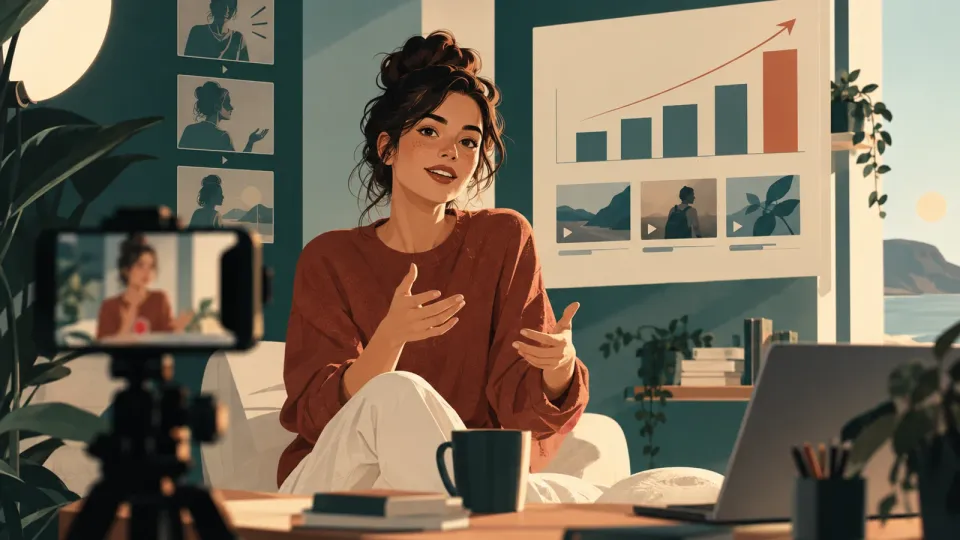
A hook needs somewhere to go
A good Instagram Reels hook makes the subject clear and gives the viewer a reason to continue. It can be an image, a spoken line, text or an action already underway. Write it alongside the payoff: the answer, result or experience the rest of the video will deliver.
“Wait until the end” creates a request. A visible difference creates something to inspect. For a photography lesson, showing two versions of the same view can offer value before a word is spoken.
Start with the material you have. A dramatic claim does not help if the next shots cannot support it. (creators.instagram.com)
Ask four questions about the first moment
Notice: what can someone recognise? Show a clear subject or action.
Care: why might this person care? Connect it to a problem, desire or familiar situation.
Continue: what remains worth seeing? Offer a method, consequence, comparison or unfolding moment.
Receive: what value is already present? Give the viewer enough to judge whether the promise interests them.
These are review questions, not four required lines of text. A quiet scene may answer them through movement and sound. A tutorial may need a label. Keep the opening suited to the video.
Match the words, first image and payoff
The following are constructed alternatives for one lesson about photographing a city. They are not measured winners.
| Opening | First image | What must follow |
|---|---|---|
| “Three ways to photograph Lisbon” | Three visibly different results | Show the choice behind each result |
| “Same viewpoint. What changed?” | Two matched compositions | Reveal the foreground or camera-position change |
| “All your travel photos look like this?” | Repeated wide views | Show a useful alternative and how to make it |
“You have been photographing cities wrong” makes a much broader claim. If the edit shows only another valid style, the accusation adds little. Name the actual difference instead.
The same rule helps a product demo. Show the cable falling, then introduce the holder that keeps it on the desk. Do not imply that it charges the phone.
Let each channel help. The image establishes the object; speech can explain the choice; a label can name the result. Captions should still make essential speech accessible when sound is off. (help.instagram.com)
Use enough words, then test their readability
Compare these two lines: “We only had one evening in Lisbon and I planned six places, but after the first stop we decided to stay here.” Or: “I planned six stops. We stayed at the first.”
The shorter line keeps the choice. The longer line adds context. Read both over the moving footage. Keep the context that matters, and give it enough time to be read.
Try three openings that change the reason to watch. A practical comparison, a familiar frustration and a surprising observation are different ideas. “Beautiful”, “incredible” and “unbelievable” are mostly different adjectives.
Show someone the opening without explaining it. Ask what they expect next. If that expectation differs from your ending, revise the promise or the sequence.
Why the shortest hook is not always the answer
A mixed pile of reels can mislead. If you pool reels from many accounts, one hook style can look far better simply because bigger accounts happened to use it more often. The tall bar then measures the accounts, not the hooks.
Compare each creator with their own reels instead. Within one account the audience and the camera stay roughly the same, so a gap between two hook styles can shrink or even reverse.
Context matters too. A longer line can work in a talking, face-led video and still overload a landscape shot, where one short line is usually enough.
Neither comparison proves that hook length causes views. (andginja.com) The useful lesson is to question a universal rule drawn from one tall bar. Write the promise clearly, test it over the footage and compare your own similar work.
André's paid guide, “The Anatomy of a Viral Reel”, takes ten of his own openings apart, hits and flops alike, in its chapter “The first 3 seconds”.
The complete editing workflow puts the opening in context. The duration guide covers reading time and useful pauses.
Source and limits
None of this is an experiment or a representative survey of all Reels. The opening examples are editorial exercises. Their performance has not been measured.
Related guides
Best length for Instagram Reels: choose what the idea needs
How long should a Reel be? As short as the payoff allows. Scenery reels did best at 8 to 12 seconds in our travel data. Plan, then cut.
How to make better Instagram Reels: a practical guide
Plan, film and edit clearer Instagram Reels. A practical workflow with worked examples, a visual checklist and lessons from our Reels study.
Why your Reels get few views: a practical review checklist
Review a Reel with few views without guessing at the cause. Check the promise, edit and metrics, then choose one useful change to test.

Algarve in October: Plan Your Trip Step by Step
Algarve in October can work well if you plan around cooler nights and rain chances. Use a town base, flexible beach time, and packing checklist.